TL;DR:
- The left hand plays single bass notes and ready-made chords, while the right hand carries the melody.
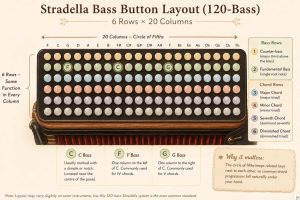
- The Stradella system arranges up to 120 buttons in 6 rows and 20 columns, following the circle of fifths.
- On most Stradella accordions, the C bass button has a small dimple, notch or textured surface, allowing players to find it by touch.
- Two rows play single notes. Four rows each play a ready-made chord from one button.
- Practise the bass rows and chord rows separately at first, then combine them into the classic bass-chord pattern.
The right hand gets all the attention, but the left hand is doing something genuinely clever. Instead of individual piano-style keys, it uses rows of buttons that each do a specific job. Some play a single bass note. Others produce a ready-made chord from one press.
For beginners taking accordion lessons, understanding the bass layout early can make the first stages of practice less confusing.
It is also one of the main reasons the accordion feels genuinely difficult at first, as discussed in Is the Accordion Hard to Learn? A Beginner’s Guide : the left hand works almost entirely by feel rather than sight. Here’s how the system is arranged and how you can start finding your way around it.
What Are Accordion Left Hand Buttons For?
At the simplest level, the left hand does two jobs at once.
- Bass notes provide a low, single-note foundation, similar to a bass guitar or the left hand of a piano player.
- Chord buttons produce a ready-made chord from one press, standing in for a shape that would normally require several fingers on a keyboard.
Together, they let one hand cover both the bass line and the harmony, while the right hand plays the melody on top. It’s a big part of why a solo accordionist can sound like a small band.
What Is the Stradella Bass System?
This layout is called the Stradella bass system, sometimes just “standard bass.” The name comes from Stradella, an Italian town closely associated with accordion manufacturing, where Mariano Dallapè helped develop the system in the late nineteenth century.
How Is the Stradella Bass System Arranged?
On a full-size instrument, it’s arranged as:
- 120 buttons
- 6 rows
- 20 columns
A 120-bass Stradella layout, showing the six rows, circle-of-fifths arrangement, and the positions of the C, F and G bass buttons.
How Do You Read a Stradella Bass Diagram?
Start by finding the fundamental bass row, which contains the main root notes. The counter-bass row sits beside it, while the four chord rows extend in the opposite direction. Each column is organised around one fundamental bass note, with the related chord buttons grouped alongside it.
On the diagram, C can be used as the central reference point. In the fundamental bass row, F sits next to C on one side and G sits next to it on the other.
| Row | What It Plays |
| Counter-bass | A single note, usually a major third above the fundamental bass |
| Fundamental bass | A single root note |
| Major chord | A ready-made major chord |
| Minor chord | A ready-made minor chord |
| Seventh chord | A ready-made dominant seventh voicing |
| Diminished chord | A ready-made diminished voicing |
Why Do the Columns Follow the Circle of Fifths?
The columns follow the circle of fifths, so moving to a neighbouring column takes the hand to a closely related key rather than an unrelated one.
This is deliberate. It places common chord movements close together, allowing players to use similar hand patterns when moving between keys.
Smaller accordions do not always include all six rows. Some junior or travel-sized instruments have fewer bass buttons or omit certain chord rows. The practical effect of choosing a smaller instrument is explained further in Can I Teach Myself Accordion?
A Simple C, F and G Example
In the key of C major, three of the most common chords are C, F and G. On a Stradella layout, those three columns sit next to one another. This means the left hand only needs to make small movements when playing a basic I–IV–V progression.
The same physical pattern can then be moved to another part of the bass board when playing in a different key.
Smaller accordions don’t always have all six rows. A junior or travel-sized instrument often only offers the two bass rows plus major and minor chords, without dedicated seventh or diminished buttons. We go through what that trade-off actually means for a beginner’s first instrument in Can I Teach Myself Accordion.
How Do I Find the C Bass Button Without Looking?
On most Stradella accordions, the C bass button has a small dimple, notch, or textured surface that you can feel with a fingertip. This tactile marker is common across many brands because players need to locate the button without looking down.
A few things make this easier:
- Let your fingers rest lightly across the button panel instead of searching with one fingertip at a time. This gives your hand a wider reference area and makes the marked C button easier to find.
- Learn the C bass position relative to your body, not just the button itself. On a standard 120-bass layout, it sits close to the centre of the bass panel, so your hand should already be landing nearby before you feel for the exact marker.
- Practise finding it cold. Start a session by looking away and locating C before playing anything else. This drill builds the habit far faster than only finding it correctly once you’re already mid-song.
Quick Reference: Once you can find C, the neighbouring fundamental bass buttons are F on one side and G on the other. This gives you a simple starting point for common I–IV–V progressions.
A Common Beginner Mistake
One student spent her first few weeks convinced her accordion was “broken,” because every time she reached for what she was sure was the C bass, she landed on a chord button instead. She had been counting rows from the wrong edge of the panel. Once she found the dimpled C button properly by feel and rebuilt her sense of direction outward from there, the “broken” accordion started working just fine.
This is a common problem. Counting from the top or bottom is unreliable because the hand and instrument move during playing. A better approach is to treat the marked C bass button as a home position and locate nearby notes by their relationship to it.
What Is the Difference Between Accordion Bass and Chord Buttons?
The distinction is simple once you know it. Two rows play single notes. Four rows produce ready-made chord voicings.
What Does Each Row Play?
- The fundamental bass and counter-bass rows each sound just one note per press.
- The major, minor, seventh, and diminished rows each produce a ready-made chord, usually built from three different pitches.
How Do Accordion Bass Buttons Create the “Oom-Pah” Sound?
In practice, this is what creates the accordion’s signature “oom-pah” sound:
- a single bass note on the strong beat
- followed by a chord on the off-beat
- back and forth.
That alternating pattern can create the effect of a compact rhythm section, often using just two fingers.
Are the Bass Buttons the Same on Piano and Button Accordions?
For most beginners, the Stradella bass system works in the same way whether the accordion has piano keys or chromatic buttons on the right-hand side as we mentioned in Piano Accordion vs Button Accordion: Which Should You Learn. The appearance of the treble side changes, but the basic left-hand row functions remain the same.
Do I Need to Memorise All 120 Accordion Bass Buttons?
No. Beginners do not need to memorise every button individually. Because the same six-row pattern repeats across the instrument, the more useful skill is learning the relationship between neighbouring columns.
Most players begin with a small group of common bass notes and chords, such as C, F and G, before gradually expanding into other keys.
How Should I Practise Accordion Bass Buttons?
- Start with the two bass rows alone. Play through a few columns using only the fundamental and counter-bass notes, no chords yet.
- Add one chord type at a time. Begin with major chords, since they come up most often, before bringing in minor, seventh, and diminished.
- Combine bass and chord in the oom-pah pattern. Alternate a single bass note with its matching chord, slowly, until switching rows feels automatic rather than something you have to think about.
- Move between columns, not just within one. Real basslines shift between neighbouring keys, so once a single column feels solid, drill small jumps, like C to G.
- Only then add the right hand. Combining a barely-automatic left hand with a melody too early is one of the most common reasons two-hand coordination falls apart for self-taught players.
The left hand looks intimidating mostly because you cannot see it working. Once the six rows and their layout begin to make sense, most of the mystery disappears, and what remains is largely repetition. For students taking accordion lessons in Sydney, feedback on left-hand position and fingering can be useful because this side of the instrument is difficult to watch while playing.
 September 30, 2026
Where Could I Find an Affordable Clarinet Teacher in Sydney?
TL;DR A limited monthly budget can still leave you with options for clarinet lessons in Sydney. Start with the price… September 26, 2026
Where to Actually Look Before You Buy an Instrument
The obvious first search usually isn't the right one. The instinct is almost always the same. A lesson gets booked,… September 23, 2026
What Should I Learn First on Piano? A Beginner’s Step-by-Step Guide
TL;DR Start by learning the keyboard pattern, a small group of notes, finger numbers and a steady beat. Practise a… September 23, 2026
How Much Does Logic Pro Cost for Beginners?
TL;DR Logic Pro is Apple's music production software for Mac. In Australia, Logic Pro for Mac costs $299.99 as a…