TL;DR:
- You can learn some accordion basics online, but self-teaching has real limits for accordion specifically, more so than for guitar or piano.
- A smaller accordion may be more comfortable for a beginner, but the right bass size depends on the player’s age, physical comfort and musical goals.
- Begin by practising the right hand and left hand separately, then combine them gradually in a simple piece.
- Most self-taught mistakes come from having no one to catch small technique errors early, not from lack of ability.
- First-year costs vary widely depending on whether you buy new or secondhand, the instrument’s condition and whether it needs servicing.
Yes, up to a point. You can genuinely teach yourself the basics of accordion, and plenty of people do exactly that with free videos and a bit of patience. Where self-teaching struggles is catching small technique problems early, the kind that feel harmless in month one but shape how comfortably you play years later. Here is what actually matters if you are deciding whether to go it alone, or bring in a few accordion lessons early to get the fundamentals right from the start.
Can I Learn Accordion Online as a Beginner?
To some extent, yes.
Beginners can find video demonstrations, digital method materials and numbered tablature online, although the quality and teaching sequence vary considerably.
Most free online accordion learning comes down to YouTube tutorials and numbered tablature for the bass buttons, rather than an app that listens to what you play and corrects you the way tools built for guitar or piano can.
That gap matters more for accordion than it would for most instruments. The two things that make accordion genuinely difficult, coordinating two hands that work in completely different ways, and controlling the bellows by feel, are both things a video can show you but cannot correct. A teacher watching in person, or even over a webcam, can catch a shoulder tensing before you notice it yourself, or hear a bellows change happening a beat too early. A pre-recorded video has no idea either of those things is happening.
None of that makes online resources useless. They can help you become familiar with the instrument, learn basic tablature and review individual techniques. The main limitation is that you need to judge your own posture, timing and movement while you play.
How Do I Choose the Right Accordion as a Beginner?
The first decision, piano keyboard or button keyboard, is a big enough topic on its own that we’ve covered it in full elsewhere: Piano Accordion vs Button Accordion: Which Should You Learn? walks through the differences in learning curve, repertoire, and feel. For most complete beginners without a strong reason to start on button, piano accordion remains the more common and better-supported starting point in Sydney.
Once that’s settled, the decision that actually matters most for a beginner is size, and more is not automatically better. Accordions are generally grouped into four rough categories, based on how many treble keys and bass buttons they carry:
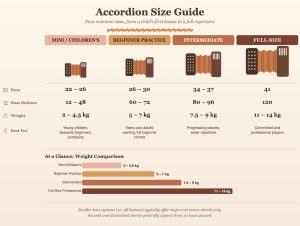
| Type | Keys | Bass Buttons | Weight | Best For |
| Mini / Children’s | 22 to 26 | 12 to 48 | 2 to 4.5kg | Young children, absolute beginners, portability |
| Beginner Practice | 26 to 30 | 60 to 72 | 5 to 7kg | Teens and adults wanting full beginner chords |
| Intermediate | 34 to 37 | 80 to 96 | 7.5 to 9kg | Progressing players, wider repertoire |
| Full-Size Professional | 41 | 120 | 11 to 14kg | Committed and professional players |
For a genuine beginner, a mini/children’s or beginner practice model is usually the smarter starting point. A full 120-bass accordion is the standard adult instrument, but it’s also the heaviest option by a wide margin, and carries far more bass buttons than a beginner will use in the first year or two.
One thing worth knowing before you buy: smaller bass systems offer fewer notes and chord options than larger Stradella layouts, but the exact arrangement varies between models. Check the manufacturer’s bass chart rather than assuming that every accordion with the same number of buttons has an identical layout. That’s rarely a problem in the first year, since most beginner repertoire doesn’t call for those chord types yet, but “beginner-friendly” and “full harmonic range” aren’t quite the same thing.
New or secondhand is the other real decision. A secondhand accordion can be a practical starting instrument, but its condition matters more than its advertised age or appearance.Before buying, check whether the bellows hold air and whether every key, bass button and register produces a consistent sound. A leak or a handful of dead reeds isn’t always obvious to a beginner trying an instrument for the first time, and it can make the accordion feel far harder to play than it should.
What Should I Learn First on Accordion?
1. Start With the Right Hand
Right hand alone, before anything else. Begin with short right-hand melodies while keeping the bellows movement smooth. Practise the left hand separately at first, then begin combining the two when each part feels reasonably secure. This feels slow, and it’s meant to. Combining both hands before either part feels secure can make it harder to identify where a timing or coordination problem begins.
2. Isolate Bellows Control
Bellows control, on its own, next. Before combining both hands, spend dedicated time just opening and closing the bellows smoothly while holding a single note. It sounds like an odd thing to isolate, but bellows control is a physical skill separate from note-reading, and treating it as its own task rather than something that happens automatically alongside everything else pays off later.
3. Learn a Small Part of the Bass Layout
The C bass button and its immediate neighbours, not the whole left-hand layout. Trying to memorise the full Stradella system early is a common self-teaching trap. Learn the C bass button by feel, add the handful of buttons around it, and expand outward gradually as pieces call for new chords, rather than mapping the entire board before playing anything.
4. Combine Both Hands Last
Only then, combine both hands, and only on something genuinely simple. Each hand should be reasonably comfortable on its own before you put them together. If one hand repeatedly loses its place, return to separate practice for a few minutes before trying the passage again at a slower tempo.
Beginner Learning Order
- Right-hand single notes and simple melodies
- Smooth bellows movement
- The C bass button and nearby buttons
- Separate left-hand practice
- Both hands together on a simple piece
What Mistakes Do Self-Taught Accordion Players Make?
- Not knowing the difference between normal difficulty and an actual mistake. Every beginner struggles with hand independence and bellows control at first, and that struggle is completely normal. Self-taught players often can’t tell whether their struggle is the ordinary kind or the kind caused by a genuine technique problem, like gripping the bellows strap too tightly or twisting the wrist to reach a button.If repeated for long enough, an inefficient movement can become familiar and may take additional practice to change.
- Learning from videos in whatever order looks fun, rather than a structured sequence. It’s tempting to jump straight to a favourite song found in an online tutorial. Without someone steering the order, self-taught players often end up learning flashy or favourite pieces before the fundamentals underneath them are solid, producing a player who can perform two or three specific songs but struggles with anything new.
- Developing an idiosyncratic left-hand fingering that doesn’t generalise. Because the bass buttons are learned by feel rather than sight, it’s easy to land on a fingering that happens to work for one song but falls apart on the next, since it was never built on the underlying pattern of the layout underneath it.
A Real Student Example
One student who came to us after eight months of self-teaching had built an entire left-hand system around a wrist angle that let her reach the buttons without moving her forearm, because it worked well enough for the three songs she’d learned from YouTube. It took nearly two months of lessons to unwind that habit and rebuild a left-hand position that would actually generalise to new music, almost as long as she’d spent teaching herself in the first place.
- Ignoring posture because nothing hurts yet. Discomfort from poor posture or a strap sitting wrong tends to show up gradually, not immediately, which makes it easy to dismiss early warning signs. Mild tiredness while adjusting to the instrument’s weight is normal. Ongoing tension or pain is not, and is worth addressing early rather than assuming it will pass on its own.
How Much Does It Cost to Learn Accordion?
Self-teaching may reduce lesson costs, but it does not remove the cost of the instrument, accessories or future maintenance. The instrument, its upkeep, and the accessories around it are the costs that catch people out, whether you’re teaching yourself or taking lessons.
- The accordion itself. A new student accordion in Australia can range from around $700 to $4,000, depending on the brand, bass button count, reed configuration and overall quality, with professional models costing considerably more. Secondhand accordions can sometimes be found for a few hundred dollars, while serviced or refurbished instruments may range from around $900 to $4,000 or more. Always have a secondhand instrument checked by someone who knows accordions before buying.
- Servicing. This is the cost most new accordion players don’t see coming. Reeds drift out of tune over time, valves wear, and bellows can develop small leaks, especially on a secondhand instrument. According to an Australian accordion repair specialist, Reedworks, a typical repair or tuning job runs somewhere between $150 and $800 depending on what needs attention. A well maintained accordion may not need this for years. A neglected secondhand one often needs it immediately.
- Straps and case.Most accordions are sold with a case and a basic set of straps included, so this isn’t always an extra cost, but replacement shoulder straps typically cost around $88 to $185 per pair in Australia if the included ones aren’t comfortable. A padded accordion bag may cost around $165.
- Sheet music and tabs. Free numbered tablature covers a lot of beginner repertoire, so this can cost nothing at all, though method books and printed sheet music for specific pieces usually add a small amount if you want them.
Typical First-Year Costs
- New beginner accordion: around $700 to $4,000
- Secondhand accordion: from a few hundred dollars privately, or around $900 to $4,000 or more for serviced and refurbished instruments
- Repairs or tuning: around $150 to $800
- Replacement padded straps: around $88 to $185 per pair
- Padded accordion bag: around $165
- Sheet music and tabs: free to a small additional cost
First-Year Budget
The largest expense is usually the instrument itself. A secondhand accordion that immediately needs tuning or bellows work may cost more overall than a better-maintained instrument with a higher purchase price.
Self-teaching accordion is genuinely possible, and many beginners successfully learn the fundamentals on their own. The main limitation is not access to information, but the difficulty of noticing small technical issues while you are concentrating on the music itself. A tense shoulder, an awkward wrist angle or a fingering choice that only works for one song can easily go unnoticed until it becomes automatic. Some learners also use occasional sessions with an accordion teacher in Sydney to check posture, bellows control or fingering, while completing most of their practice independently.
 September 30, 2026
Where Could I Find an Affordable Clarinet Teacher in Sydney?
TL;DR A limited monthly budget can still leave you with options for clarinet lessons in Sydney. Start with the price… September 26, 2026
Where to Actually Look Before You Buy an Instrument
The obvious first search usually isn't the right one. The instinct is almost always the same. A lesson gets booked,… September 23, 2026
What Should I Learn First on Piano? A Beginner’s Step-by-Step Guide
TL;DR Start by learning the keyboard pattern, a small group of notes, finger numbers and a steady beat. Practise a… September 23, 2026
How Much Does Logic Pro Cost for Beginners?
TL;DR Logic Pro is Apple's music production software for Mac. In Australia, Logic Pro for Mac costs $299.99 as a…