The main difference between a piano accordion and a button accordion is the right-hand keyboard. A piano accordion uses a familiar piano-style keyboard, while a button accordion uses rows of small round buttons. Piano accordion is the easier starting point for most beginners and especially those with any piano background, while button accordion (in either chromatic or diatonic form) suits players drawn to specific folk and traditional music styles or who want a more compact, lightweight instrument. The smartest move is to ask an accordion teacher during your first accordion lessons so they can give you a recommendation on your unique situation.
What’s the actual difference between a piano accordion and a button accordion?
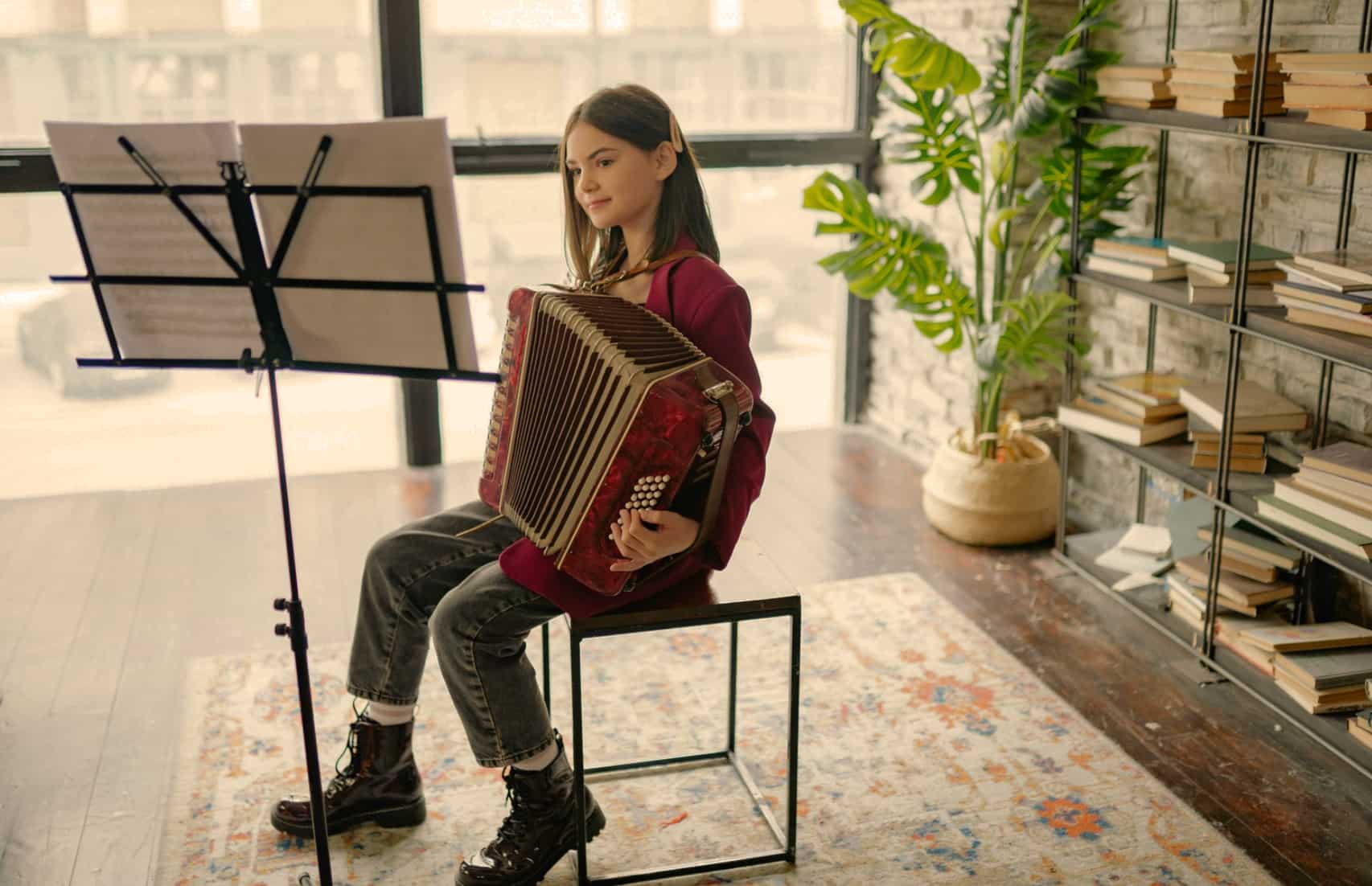
A piano accordion has a vertical piano keyboard with white and black keys on the right hand side, while a button accordion has rows of small round buttons arranged in a diagonal grid. Both use bellows pumped by the left arm to push air through reeds, and both have bass buttons on the left for chords and bass notes. The difference is almost entirely in how the melody side is laid out.
The mechanical layout drives most of the practical differences between the two. A piano accordion keyboard takes up significant vertical space because each key is wide and tall, which means the instrument is physically larger for a given range of notes. A button accordion fits the same range (or more) into a much smaller footprint because buttons are tightly packed in a diagonal pattern. This is why button accordions are typically lighter and easier to carry, while piano accordions tend to be bulkier even at comparable bass sizes.
A useful way to think about it: the piano accordion is a piano keyboard turned vertical and strapped to bellows, while the button accordion is its own thing entirely with a logic that doesn’t borrow from any other common instrument.
Which is easier to learn for a complete beginner?
A piano accordion is generally easier to learn for a complete beginner, especially anyone who has played piano or keyboard before. The right-hand keyboard layout is immediately visually familiar, and most beginner method books, online lessons, and Sydney accordion teachers default to piano accordion as the standard teaching instrument.
The visual logic of a piano keyboard helps beginners understand notes, scales, and chords because the pattern is the same as what they’ve seen on every keyboard instrument. Black keys group in twos and threes, the octave repeats predictably, and finding any note is a matter of counting from a reference point. Button accordion has its own logic, but it isn’t intuitive at first glance, and beginners typically spend several weeks just learning where notes live on the keyboard before they can play simple melodies.
That said, a complete beginner without piano background can learn button accordion reasonably well. The disadvantage is that the global pool of beginner resources is much smaller, and finding a Sydney teacher who specialises in button accordion is harder than finding one who teaches piano accordion.
How do I know which one is right for me?
Start with three questions: what music do you actually want to play, do you already play piano, and do you have the physical capacity to handle a larger instrument? Your honest answers point toward the right choice more reliably than any general advice about “which is better.”
Some clear scenarios:
- You already play piano and want to play general accordion music: Piano accordion is the obvious choice
- You want to play Irish trad sessions in Sydney: Diatonic button accordion (B/C or C#/D)
- You’re drawn to classical or advanced solo accordion repertoire: Chromatic button accordion if you’re willing to invest the years, piano accordion if you want a quicker start
- You’re an adult beginner without specific genre goals: Compact piano accordion in 48 or 72 bass, easiest entry path
- You love French musette or general European folk: Either piano accordion or chromatic button works well
- Portability or weight is a major concern: Button accordion, smaller piano accordion, or melodeon
Are there different types of button accordion?
Yes, button accordions split into two main families: chromatic and diatonic. Chromatic button accordions produce the same note whether you push or pull the bellows, while diatonic button accordions produce different notes depending on bellows direction.
The practical difference matters more than it sounds. A chromatic button accordion (sometimes called a CBA or bayan) lets you play in all 12 musical keys using consistent fingering patterns, because the note layout is symmetrical and the bellows direction doesn’t change pitch. A diatonic button accordion (often called a melodeon in folk circles) is designed to play easily in two or three specific keys and produces a different note on the push than the pull, which gives it a punchy, rhythmic feel ideal for dance music.
The genres associated with each type:
- Chromatic button accordion: Classical, jazz, musette, Russian and Eastern European traditional, virtuosic solo performance
- Diatonic button accordion (melodeon): Irish trad, Scottish folk, English Morris dancing, French folk, Tex-Mex, Cajun, Alpine music
If you don’t recognise any of these genres as music you want to play, the chromatic button accordion is the more versatile starting point of the two. If you specifically want to play Irish reels or Scottish folk, diatonic button accordion is the authentic choice.
Which sounds better for the music I want to play?
The right accordion depends entirely on the genre you want to play, and the wrong instrument can hold you back even with excellent technique. Piano accordion is the most genre-flexible option and suits classical, jazz, klezmer, Balkan, French musette, popular music, and most modern accordion-led ensembles. Button accordions (particularly diatonic) are the traditional choice for Irish, Scottish, and various folk traditions where the push-pull bellows action shapes the characteristic rhythm.
A few practical examples of genre-to-instrument matching:
- Classical solo or chamber music: Piano accordion or chromatic button accordion (CBA is preferred at advanced level for the larger range and easier fingering)
- Jazz, klezmer, gypsy: Piano accordion is standard
- Irish traditional sessions: B/C or C#/D diatonic button accordion (also called the Irish button)
- Scottish dance music: Either piano accordion or two-row D/G melodeon depending on the style
- French musette: Piano accordion or chromatic button accordion, both work beautifully
- Tex-Mex, Conjunto, Cajun: Diatonic button accordion in specific tunings
If you’re drawn to general accordion playing without a specific tradition in mind, piano accordion gives you the broadest path forward. If you’re hooked on a particular style, the button accordion used in that tradition is worth the steeper learning curve.
What about size and weight?
Button accordions are typically lighter and more compact than piano accordions at the same musical capability, which matters more than people expect during long practice sessions or gigs. A full-size 120-bass piano accordion can weigh 11 to 14kg, while a comparable-range chromatic button accordion runs closer to 8 to 10kg because the keyboard layout is much more compact.
This weight difference becomes a real factor for adult learners, older players, and anyone carrying the instrument to Sydney venues regularly. The full-size piano accordion sits on your chest and rests on your thighs when seated, and that weight pulls on your shoulders for the full duration of a practice session. A lighter button accordion (or a smaller-bass piano accordion) reduces fatigue, allows for longer practice sessions, and is genuinely more practical for performers who travel to gigs in suburbs across Sydney without dedicated car parking.
For beginners specifically, a 48-bass or 72-bass piano accordion is much lighter than the full 120-bass version and is plenty of instrument for the first few years of learning. A two-row D/G melodeon weighs even less and is the standard starting point for folk-focused beginners. Don’t assume you need a full-size accordion at the start, because oversized instruments often discourage practice in the early months when commitment is still building.
Does it matter if I already play piano?
Yes, an existing piano background gives you a meaningful head start on piano accordion that you don’t get on button accordion. The right-hand keyboard works the same way as a piano, so any pianist can pick up a piano accordion and play simple melodies within their first hour. The technique differs in important ways (you’re playing vertically with no thumb-under technique, and the bellows control becomes the main expressive tool), but the note-finding work is already done.
For pianists, this head start makes the first six months of accordion learning noticeably easier. The bass side is genuinely new (the Stradella bass system is unique to accordions), but learning the bass alone is far less work than learning both sides from scratch. Most Sydney accordion teachers will accept pianists into intermediate lesson tracks rather than starting from absolute beginner, which saves time and lesson fees.
A pianist who chooses button accordion gives up this advantage entirely. The button layout has no relationship to a piano keyboard, so you’re essentially starting from zero. This isn’t a reason to avoid button accordion if it’s the right instrument for your musical goals, but it is a reason to be honest about the time investment if your background is keyboard-based.
What’s the bass side like and does it differ between the two?
The left-hand bass side is similar across both piano and button accordions for most beginners, because both use the Stradella bass system as standard. Stradella bass has 6 rows of buttons producing single bass notes and pre-set chords (major, minor, dominant seventh, diminished), letting you play accompaniment patterns without needing to construct chords note by note.
Stradella bass takes practice to master regardless of which right-hand keyboard you choose. The fingerings, the chord button positions, and the rhythmic coordination with the bellows are all separate skills from the melody work. Most beginners spend their first six to twelve months developing basic bass technique alongside whatever they’re doing on the right hand.
Advanced players sometimes upgrade to instruments with free bass (single bass notes across a chromatic range, allowing melodic bass lines) or convertor bass (which switches between Stradella and free bass). These are specialist features found on higher-end instruments and aren’t relevant for the first few years of learning. For a beginner, a standard Stradella bass setup on either piano or button accordion is plenty of instrument to work with.
Which type is more popular in Australia?
Piano accordion is significantly more common in Australia than button accordion, both in terms of available teachers and the second-hand instrument market. Sydney’s folk and traditional music scenes have a smaller but dedicated button accordion community, particularly among players involved in Irish trad sessions and Morris dancing groups, while piano accordion appears across a wider range of genres including classical ensembles, jazz, klezmer groups, and community music programs.
The practical implications for a Sydney beginner:
- More piano accordion teachers available across the Inner West, Eastern Suburbs, North Shore, and broader Sydney metro
- Larger selection of second-hand piano accordions on local marketplaces and music shops
- Easier to find replacement parts and qualified repair technicians for piano accordions
- Button accordion teachers tend to specialise in either Irish (B/C, C#/D) or Continental (chromatic) styles, so the right teacher depends on which tradition you’re learning
- Sydney’s folk music scene has periodic button accordion workshops through community arts organisations
This doesn’t mean button accordion is impractical in Sydney, but it does mean the path of least resistance favours piano accordion unless you have a specific musical tradition pulling you toward buttons.
 September 30, 2026
Where Could I Find an Affordable Clarinet Teacher in Sydney?
TL;DR A limited monthly budget can still leave you with options for clarinet lessons in Sydney. Start with the price… September 26, 2026
Where to Actually Look Before You Buy an Instrument
The obvious first search usually isn't the right one. The instinct is almost always the same. A lesson gets booked,… September 23, 2026
What Should I Learn First on Piano? A Beginner’s Step-by-Step Guide
TL;DR Start by learning the keyboard pattern, a small group of notes, finger numbers and a steady beat. Practise a… September 23, 2026
How Much Does Logic Pro Cost for Beginners?
TL;DR Logic Pro is Apple's music production software for Mac. In Australia, Logic Pro for Mac costs $299.99 as a…