TL;DR
- A good beginner cello outfit in Australia costs roughly $900 to $1,700, including the cello, bow and case.
- The Stentor Student I and Kreisler #130 are the two most commonly recommended entry-level outfits here.
- Avoid the $150 to $400 cellos on eBay and Amazon. They are usually not set up and are hard to play.
- Renting costs around $30 to $60 a month and is the smarter option for growing children.
- Professional setup matters more than the brand name on the label.
Buying a first cello is harder than it should be. The market runs from $150 online bargains to instruments costing more than a car, and almost nothing explains which end you should actually be shopping at.
The short version: a properly set up beginner cello outfit in Australia sits between $900 and $1,700, and what you are paying for is not a fancy label but a professional setup that makes the instrument playable. Here is what to buy, what to spend, and what to avoid, along with where cello lessons fit in once you have an instrument in your hands.
What is the best beginner cello to buy in 2026?
For most beginners in Australia, the Stentor Student I outfit is the safest first cello. It sits around $949 to $1,050 depending on size and retailer, comes as a complete outfit with bow and padded case, and is carved from solid tonewoods rather than laminate, which is unusual at that price.
Here is how the main beginner options compare.
| Model | Price | Best for | Set up before sale? |
| Stentor Student I | $949 to $1,050 | First cello, school programs | Depends on retailer |
| Kreisler #130 | $1,500 to $1,650 | Committed beginners | Yes, by a luthier |
| Enrico | Varies by model | Classrooms, consistency | Usually, via specialists |
| Yamaha Silent Cello | Premium | Apartment practice | Electric, not a first cello |
The Kreisler costs more, but it is professionally set up before it ships, which is the single biggest factor in how a beginner cello actually plays. The Yamaha is worth knowing about if noise is a problem where you live, and you can check the Silent Series specifications on Yamaha’s site.
Prices here are approximate Australian street prices and vary by size and retailer. Manufacturers set specifications rather than prices, so it is worth checking a couple of Australian string specialists before committing.
How much should you spend on a beginner cello?
Budget $900 to $1,700 for a new outfit that a teacher will not ask you to replace within a year. That range buys you a solid-wood instrument, a usable bow, a case, and crucially a professional setup.
Here is what the different price bands actually get you.
| Price | What you get | Worth it? |
| Under $400 | Laminate body, no setup, poor strings | No. Often unplayable |
| $900 to $1,200 | Solid tonewoods, complete outfit | Yes. The beginner sweet spot |
| $1,400 to $1,700 | Luthier setup, better strings and fittings | Yes, if you are committed |
| $3,000+ | Hand-carved, aged timbers | Not yet. Wait until intermediate |
Should you buy or rent a cello as a beginner?
Rent if the player is a child who is still growing, or if you are not yet sure the cello will stick. Buy if you are a full-grown adult who has already committed.
| Renting | Buying | |
| Upfront cost | First month plus a bond | $900 to $1,700 |
| Ongoing cost | $30 to $60 a month | None after purchase |
| Changing sizes | Swap as the child grows | Buy again each size |
| If they quit | Return it and stop paying | Resell at a loss |
| Best suited to | Growing children, unsure beginners | Adults, committed students |
Rental in Australia usually comes with a minimum term of three to six months and sometimes a bond. The real advantage is swapping sizes as a child grows, which matters enormously with cellos because a student may move through three or four sizes before reaching full size.
Adults have it simpler. If you are over about 155 cm you will be on a full-size cello permanently, so there is no sizing risk and buying makes sense sooner.
What size cello do you need?
Cello sizing is based on height and arm length rather than age, running from 1/16 up to full size, with most adults and teenagers over roughly 155 cm on a 4/4.
Getting this wrong causes real problems: a cello that is too large forces the left hand into strained positions and makes clean intonation almost impossible. We have covered the measurements in detail in our guide to what size cello your child needs, which is worth reading before you buy anything.
What comes in a cello outfit?
An outfit is the cello plus the accessories you need to play it, and buying one is almost always cheaper than assembling the parts separately. A standard beginner outfit includes:
- The cello, with strings already fitted.
- A bow, usually wood with natural horsehair at this level.
- A padded case or gig bag, often with backpack straps.
- Rosin, though this is sometimes sold separately.
Two things are usually not included and are worth budgeting for: an endpin stop or strap to keep the cello from sliding on floorboards, and a chair of the right height. Neither is expensive, but beginners are often surprised by both.
Is a cheap cello from eBay or Amazon worth it?
No, and this is the most expensive mistake beginners make. Those $150 to $400 instruments look like cellos, but they arrive without a professional setup, which means the bridge, sound post and string heights are wrong.
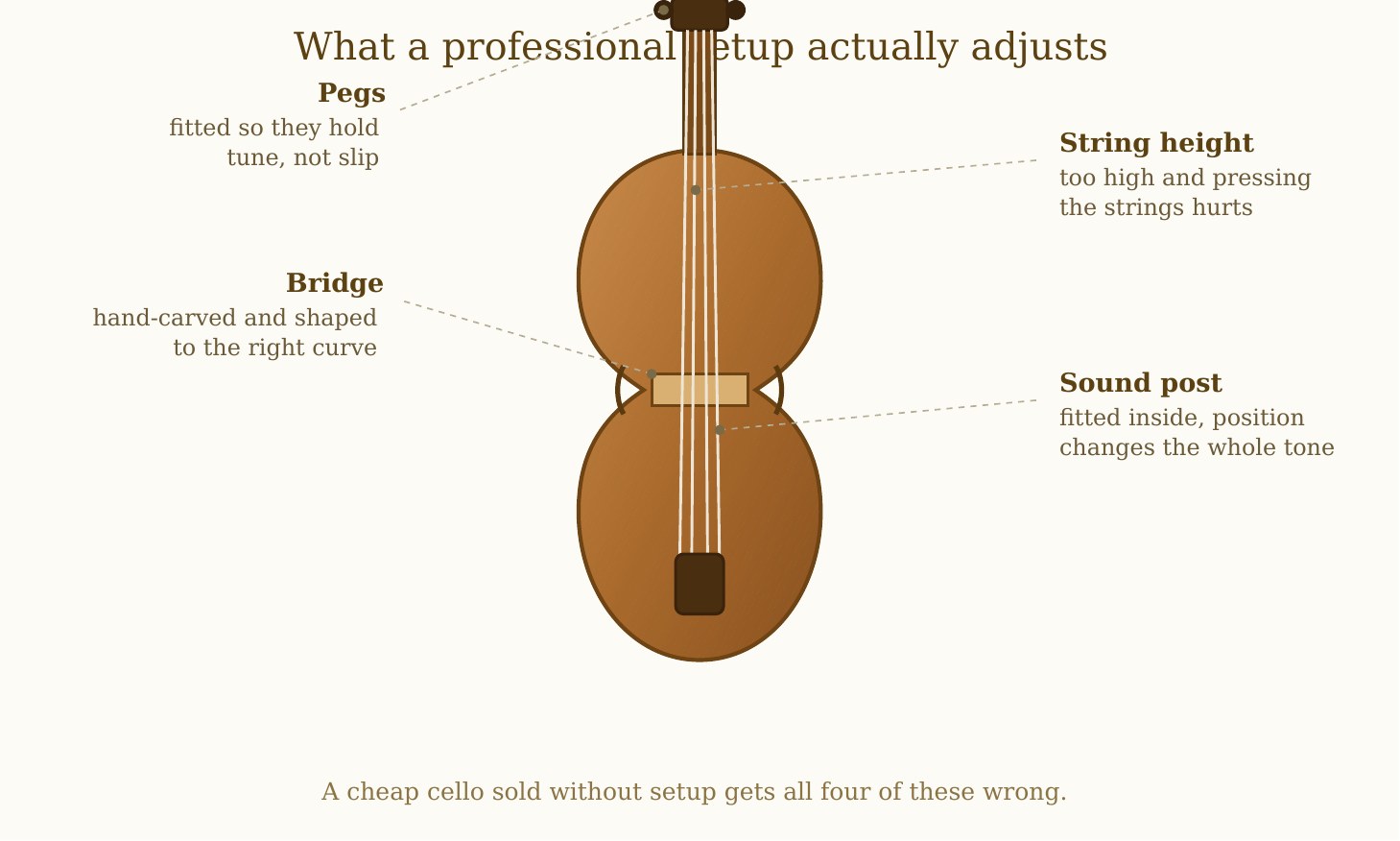
The four things a professional setup gets right, and a cheap unset cello gets wrong.
The consequence is not just poor tone. The strings sit too high, so pressing them down hurts, notes do not speak cleanly, and the student concludes they have no talent when the real problem is the instrument. Australian string specialists see this constantly, and it is a common reason beginners quit within a few months.
If your budget genuinely will not stretch to $900, renting a properly set up instrument is a far better use of $40 a month than owning something unplayable.
Where should you buy a cello in Sydney?
Buy from a string specialist rather than a general music shop or an online marketplace. Specialists employ luthiers who carve and fit the bridge and sound post on every instrument before it leaves the store, and that setup is most of what separates a good beginner cello from a bad one.
The practical advantages of buying in person:
- You can be measured for the correct size on the spot.
- The instrument is set up and checked before you take it home.
- Many shops offer trade-in schemes as a child moves up sizes.
- Adjustments and repairs are handled by the people who sold it to you.
If you are buying online, stick to Australian string specialists who state that instruments are professionally set up before shipping. The extra hundred dollars over a marketplace listing buys the one thing that actually matters.
What should you do after buying a cello?
Get the instrument checked and get a teacher, in that order. Even a well set up cello shifts in transit, and strings stretch and go out of tune constantly in the first few weeks.
The cello is unforgiving in a specific way: there are no frets, so nothing tells you when a note is slightly wrong, and bad left-hand habits set quickly. Working with a cello teacher from the beginning is the difference between building accurate intonation and spending a year unlearning something. If you are ready to start, you can compare and connect with experienced cello teachers and find one who suits your goals and level.
 September 30, 2026
Where Could I Find an Affordable Clarinet Teacher in Sydney?
TL;DR A limited monthly budget can still leave you with options for clarinet lessons in Sydney. Start with the price… September 26, 2026
Where to Actually Look Before You Buy an Instrument
The obvious first search usually isn't the right one. The instinct is almost always the same. A lesson gets booked,… September 23, 2026
What Should I Learn First on Piano? A Beginner’s Step-by-Step Guide
TL;DR Start by learning the keyboard pattern, a small group of notes, finger numbers and a steady beat. Practise a… September 23, 2026
How Much Does Logic Pro Cost for Beginners?
TL;DR Logic Pro is Apple's music production software for Mac. In Australia, Logic Pro for Mac costs $299.99 as a…