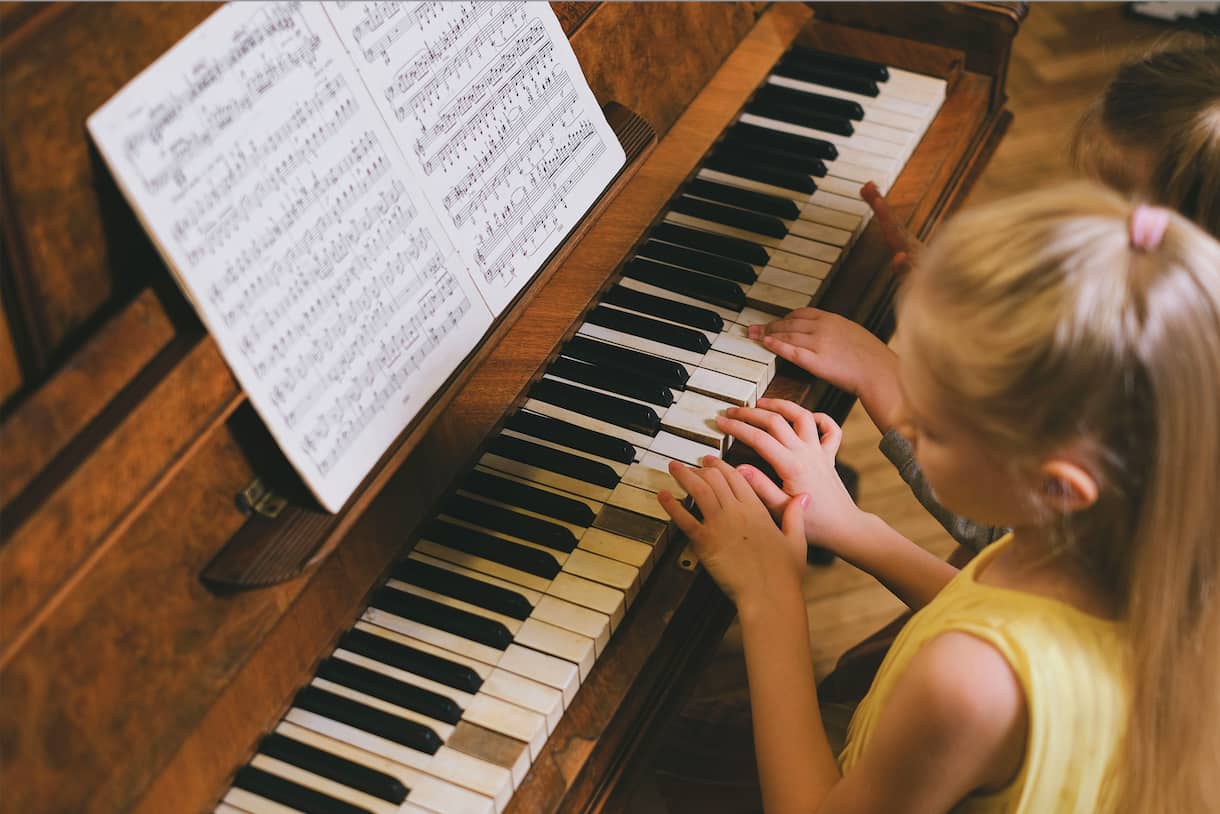
The best age to start piano lessons is between 5 and 7 years old for most children. At this stage, kids have enough finger coordination and attention span to follow structured lessons, and their brains are still in a period of rapid development. This makes it much easier for them to learn music, just like learning a language.
That said, there’s no single right answer. A mature, focused 4-year-old can thrive with the right teacher, and plenty of adults who start in their 30s go on to play beautifully. What matters far more than age is readiness and finding a teacher who knows how to work with where your child actually is.
This guide walks through what to expect at each age, the signs that a child is ready, and how to think about it if you’re an adult considering lessons yourself.
When Is My Child Ready for Piano Lessons?
Age is a guide, not a rule. Here are the actual signs to look for, regardless of how old your child is:
They show genuine interest: They gravitate toward the piano, ask to play, or respond strongly to music they hear. Interest isn’t necessary, but it helps enormously.
They can follow multi-step instructions: “Put your right hand here, press this key, and count to four”. If they can follow that kind of sequence, they’re probably ready.
They can sit and focus for 15-20 minutes: A first piano lesson doesn’t need to be 45 minutes, but some baseline ability to stay on task is necessary.
They know their left from their right: This sounds simple, but matters a lot in early piano lessons.
They have some number sense: Counting beats, understanding “hold for 2”, basic number concepts underpin a lot of early music learning.
If your child ticks most of these boxes, they’re probably ready, regardless of whether they’re 5 or 8.
Is 5-7 the Best Age to Start Piano?
Between ages 5 and 7, most children have developed enough in a few key areas to make piano lessons genuinely productive:
Fine motor skills: Piano requires independent finger movement. Each finger is doing something slightly different at the same time. By age 5 or 6, most children have the dexterity to start working on this, whereas younger children often still lack the coordination for it.
Attention span: A 30-minute lesson requires a child to follow instructions, remember what they just learned, and stay focused enough to practise at home. Most 5-7-year-olds can manage this in short bursts, especially with an engaging teacher.
Reading and number recognition: Piano involves reading notation, understanding basic counting, and following sequences. These connect naturally with what children learn in kindergarten and early primary school.
Brain plasticity: Research consistently shows that the brain is most receptive to musical training before age 9. Children who begin in this window tend to develop stronger pitch recognition, rhythm, and musical intuition than those who start later, even if the later starters practise equally hard.
A 1996 UK study found that enthusiasm for learning an instrument peaks at ages 5 to 6 and roughly halves by age 7 for children not yet learning. Starting during this window captures both the developmental advantage and the natural curiosity.
Can 3 and 4 Year Olds Learn Piano?
Some children are ready before age 5, and some piano teachers do take students as young as 4, but it depends heavily on the individual child and the teacher’s approach.
At 3-4, most children benefit more from musical play than formal lessons: singing games, clapping rhythms, exploring sounds on a keyboard without any pressure to “get it right”. Programs like Kindermusik or similar early childhood music classes are excellent at this age. They build musical awareness and a love of music without the structure that young children often aren’t ready for.
If your 4-year-old is showing strong signs of readiness, like asking to play, able to sit and focus for stretches, and showing a clear interest in the piano specifically, it’s worth having a conversation with a teacher. A good early childhood music teacher will be honest about whether your child is ready for structured lessons or would be better served by something more play-based first.
The piano is also particularly well-suited for early starters among instruments. Unlike violin or cello, which require quite precise physical positioning from the start, piano produces a sound immediately when a key is pressed, which is satisfying and encouraging for little hands.
Is 7-10 Too Late to Start Learning Piano?
If your child is 7, 8, or 9 and hasn’t started yet, don’t worry, this is still an excellent window. In some ways, slightly older beginners have real advantages:
- They can concentrate for longer during lessons
- They understand instructions more easily
- They can take more ownership of their own practice
- Progress in the early stages can feel faster and more rewarding
Many children who start at 8 or 9 catch up quickly with peers who started at 5 or 6, especially if they have a good teacher and are motivated. The brain is still highly plastic in this range, and the foundational skills of music like reading notation, developing timing, and building technique are well within reach.
Can Teenagers Learn Piano?
Teenagers who want to learn piano can absolutely do so, and many do. The learning curve is real, the early window of effortless acquisition has passed, but teenagers bring something younger beginners don’t: genuine intrinsic motivation, the ability to understand theory more deeply, and the emotional connection to music that adolescence tends to foster.
If a teenager wants to learn piano, the best thing to do is find them a teacher who works well with that age group, someone who’ll let them work on music they actually care about, not just classical exercises. Progress driven by enthusiasm is progress that sticks.
Am I Too Old to Learn Piano?
There’s a persistent myth that it’s too late to learn piano as an adult. It isn’t. Adults learning piano won’t develop the same kind of effortless, native-level musicality as someone who started at age 5, but that’s a very high bar, and it’s not the point for most adult learners. Adults who start piano can:
- Learn to play songs they love
- Read music fluently
- Develop solid technique with consistent practice
- Find real enjoyment and stress relief in the process
The main differences for adults are that progress tends to require more deliberate practice, and unlearning any bad early habits takes longer. Starting with a qualified teacher who knows how to work with adult learners makes a significant difference.
Does the Age You Start Piano Matter?
Honestly, yes, but less than most people think, and not in the way they expect.
Children who start young do tend to develop stronger musical intuition and a more natural feel for the instrument over time. The early years of piano build neural pathways that are genuinely harder to build later.
But the vast majority of piano students, children and adults alike, aren’t aiming to be concert pianists. They want to play well, enjoy music, and have a skill for life. For that goal, starting at 6 versus starting at 9 makes very little practical difference, as long as they find a good teacher and stay consistent.
The single biggest predictor of how far a student gets isn’t when they started. It’s whether they found a piano teacher they connected with.
 September 30, 2026
Where Could I Find an Affordable Clarinet Teacher in Sydney?
TL;DR A limited monthly budget can still leave you with options for clarinet lessons in Sydney. Start with the price… September 26, 2026
Where to Actually Look Before You Buy an Instrument
The obvious first search usually isn't the right one. The instinct is almost always the same. A lesson gets booked,… September 23, 2026
What Should I Learn First on Piano? A Beginner’s Step-by-Step Guide
TL;DR Start by learning the keyboard pattern, a small group of notes, finger numbers and a steady beat. Practise a… September 23, 2026
How Much Does Logic Pro Cost for Beginners?
TL;DR Logic Pro is Apple's music production software for Mac. In Australia, Logic Pro for Mac costs $299.99 as a…