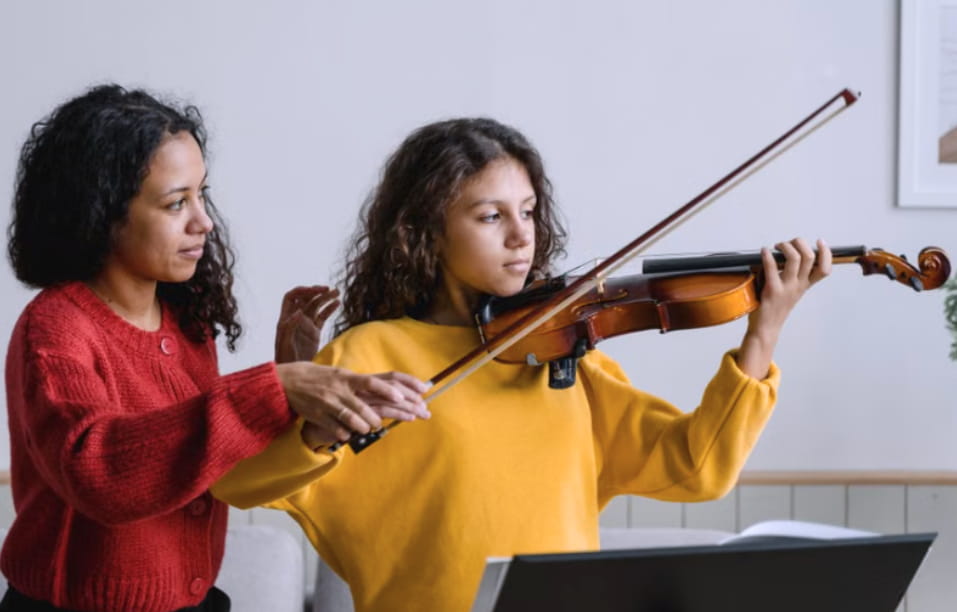
When you’re starting the violin for the first time, it’s completely normal to wonder how much practice actually makes a difference. Some days everything feels smooth, and other days it feels like we don’t even want to pick up our instruments to practice. That’s part of learning violin. It’s a physical skill, and your hands are still figuring out how to work together.
The good news is that beginners don’t need to practice for hours every day to improve. In the beginning, consistency matters more than having one long practice session.
Violin requires several physical skills to work together. Your left-hand fingers need to find the correct notes without frets, while your right arm controls the bow. At the same time, you are thinking about posture, rhythm, tone and reading music. Giving yourself regular opportunities to practice these movements helps them gradually become more natural.
Some days everything feels smooth, and on other days you might not even feel like you want to pick up your violin to practice.
A manageable practice routine can help you improve without making violin feel like a chore. If you are just getting started, violin lessons in Sydney can also give you a clear practice plan and help you correct technical problems before they become habits.
How Long Should a Beginner Practice Violin Every Day?
Most beginners can start with around 15 to 25 minutes a day.
You do not need to force yourself to practice for an hour just because you think longer automatically means better. When you are new to violin, a short session requires a lot of concentration.
You are trying to control the bow, place your fingers accurately, maintain your posture, listen to your intonation and follow the music at the same time. After a while, concentration drops and your technique can become less controlled.
This is why shorter, focused sessions are often more manageable for beginners.
For example, instead of practicing for 60 minutes every Sunday, you could practice for 20 minutes on Monday, Tuesday, Wednesday, Friday and Saturday. That gives you five separate opportunities to work on your technique and remember what you learned. For example, a beginner practice for 20 minutes and spend five minutes on open strings, five minutes on a scale and ten minutes carefully working through a difficult section of a piece. The beginner might practice for an hour but repeatedly play the entire piece from beginning to end without correcting mistakes. It may get more useful practice despite spending less time with the instrument.
The first beginner may get more useful practice despite spending less time with the instrument.
Some beginners may only be comfortable with 10 minutes at first. That is fine too. You can gradually increase your practice time as your concentration and technique develop.
If you reach the end of your practice session and still feel focused, adding another five minutes is reasonable. If you are tired, frustrated or losing concentration, stopping can be more useful than forcing yourself to continue.
Daily practice is ideal, but not essential. Here’s the difference beginners usually notice:
- Daily practice: Your bow feels more predictable, the sound stays more stable, and you are more likely to remember what you worked on the previous day.
- Practicing a few times a week: This can still work, but you may spend more time warming up and finding the correct intonation again.
Think of it like stretching before doing exercise. A little stretching every day keeps everything flexible, while doing it only a few times a week means you’re always loosening up again.
What Is the Best Violin Practice Schedule for a Beginner?
There is no single schedule that works for everyone, but a simple weekly routine could look like this:
| Day | Practice Plan |
| Monday | 20 minutes: technique + current piece |
| Tuesday | 20 minutes: technique + difficult section |
| Wednesday | 20 minutes: scales + current piece |
| Thursday | Rest |
| Friday | 20 minutes: technique + current piece |
| Saturday | 20-25 minutes: full practice session |
| Sunday | Rest |
You do not need to follow this exact timetable. It is simply an example of how you could organize your violin practice throughout the week.
A student with school commitments might practice immediately after getting home. An adult beginner might find it easier to practice after dinner or before work.
The best time to practice is usually the time you can repeat consistently.
Leaving your violin somewhere accessible can also make practice easier. If getting started involves finding the case, moving furniture and setting everything up, it becomes easier to say, “I’ll do it tomorrow.”
Try connecting violin practice to something already in your routine. For example, practice after breakfast, after getting home from school or before your evening shower. Attaching practice to an existing habit makes it easier to remember.
How Do You Structure a Violin Practice Routine for Beginners?
A good beginner practice session should have a clear structure. Instead of picking up your violin and playing random pieces until your time is finished, divide the session into a few small sections.
Here is a simple 20-minute beginner violin practice routine you can follow.
Step 1: Warm Up for 3 Minutes
Start with slow open strings.
Focus on keeping your body relaxed and producing a steady sound. Check your posture, bow hold and violin position before worrying about difficult notes.
The purpose of the warm-up is not to play something impressive. It is simply to prepare your hands and remind yourself what a relaxed playing position feels like.
Step 2: Practice Scales or Finger Patterns for 5 Minutes
Next, work on a simple scale or finger exercise your teacher has given you.
Play slowly enough that you can actually listen to each note. If something sounds out of tune, stop and adjust instead of continuing through the mistake.
You can also practice difficult finger changes separately rather than repeatedly playing an entire scale.
Step 3: Work on Bow Control for 3 Minutes
Spend a few minutes concentrating only on your bow.
You could practice long bows, short bows, string crossings or a simple rhythm pattern.
Try to keep the bow controlled and listen carefully to the sound. If the tone becomes rough or scratchy, slow down and check what your bow arm is doing.
Step 4: Practice Your Piece for 8 Minutes
Now work on your current piece.
Instead of automatically starting at the first bar every time, find the section that gives you the most trouble.
Take two or four bars and play them slowly. If necessary, practice the notes without worrying about the rhythm first, then add the correct rhythm once your fingers are comfortable.
When that section improves, connect it with the bars before and after it.
This is usually more productive than repeatedly playing the whole piece and making the same mistake every time.
Step 5: Finish With a 1-Minute Review
Before putting your violin away, play something simple that you feel comfortable with.
You can also quickly think about what improved during the session and what you want to work on tomorrow.
That gives your next practice session a clear starting point.
How Long Does It Take to Get Good at Violin?
There is no exact number of months or years because every student learns differently.
Your progress depends on several things, including how regularly you practise, the quality of your practice, your previous musical experience, your goals and the feedback you receive.
Instead of asking whether you are “good” yet, look for smaller improvements.
Can you hold the bow more comfortably than you could last month? Are you finding notes more accurately? Can you play a piece that felt impossible a few weeks ago? Does your sound feel more controlled?
Those small changes are much better signs of progress than comparing yourself with another violinist.
A beginner who practices thoughtfully for 20 minutes on most days can build a stronger foundation than someone who practices inconsistently for much longer periods.
What Happens If You Don’t Practice Violin Enough as a Beginner?
If you’re not practicing regularly, you might notice:
- your bow slips or feels harder to control
- your fingers don’t land confidently on the notes
- your intonation changes between practice sessions
- pieces take longer to learn
- posture feels inconsistent
- you lose momentum and motivation
- you forget some of the things you worked on in your previous lesson
This happens because violin depends heavily on coordination. Unlike instruments with frets or fixed keys, violin players need to learn where notes are located on the fingerboard. Your fingers gradually become familiar with those positions through repetition and listening.
Bowing also requires repeated practice. Small changes in bow speed, pressure and position can affect the sound you produce. That is why practicing a little more regularly is generally better than waiting until you have enough free time for a very long session.
If you miss two or three days, do not try to compensate with a huge practice session. Simply return to your normal routine. Consistency over several months matters much more than having a perfect week. Without regular practice, your hands may take longer to become comfortable with the movements.
How Do You Know If You’re Practicing Violin Too Much?
Beginners can practice too much, especially when they suddenly increase their practice time.
Pay attention to how your body and concentration feel while playing.
Possible signs that you need a break include:
- your left hand becoming tight or cramped
- your bow arm becoming unusually tired
- your shoulders constantly rising or becoming tense
- your posture getting worse as the session continues
- your sound becoming less controlled
- repeating mistakes without understanding why
- becoming increasingly frustrated or distracted
These signs do not necessarily mean you should practice less overall. Sometimes you simply need to divide your practice into smaller sessions.
For example, if 30 continuous minutes feels uncomfortable, you could practice for 15 minutes, take a break, and complete another 15 minutes later.
You should not try to play through actual pain. Stop if something hurts rather than assuming discomfort is a normal part of learning violin. If pain continues, speak with your teacher and consider getting appropriate medical advice.
If you want a routine that suits your goals and learning style, beginner violin teachers in Sydney can help you build technique safely and confidently from the start.
 September 7, 2026
What Will I Do In My First Harp Lesson?
TL;DR: Your first harp lesson is usually about getting comfortable at the instrument, producing a clear sound and leaving with… September 2, 2026
How Often Should You Practice Violin as a Beginner?
When you’re starting the violin for the first time, it’s completely normal to wonder how much practice actually makes a… August 27, 2026
How Often Should You Practice Tuba as a Beginner?
If you have just started learning tuba, you might wonder how often you need to practice. Do you need to… August 23, 2026
Top Flute to Buy in 2026
Buying a flute is one of the most important decisions you will make when starting or advancing your musical journey.…