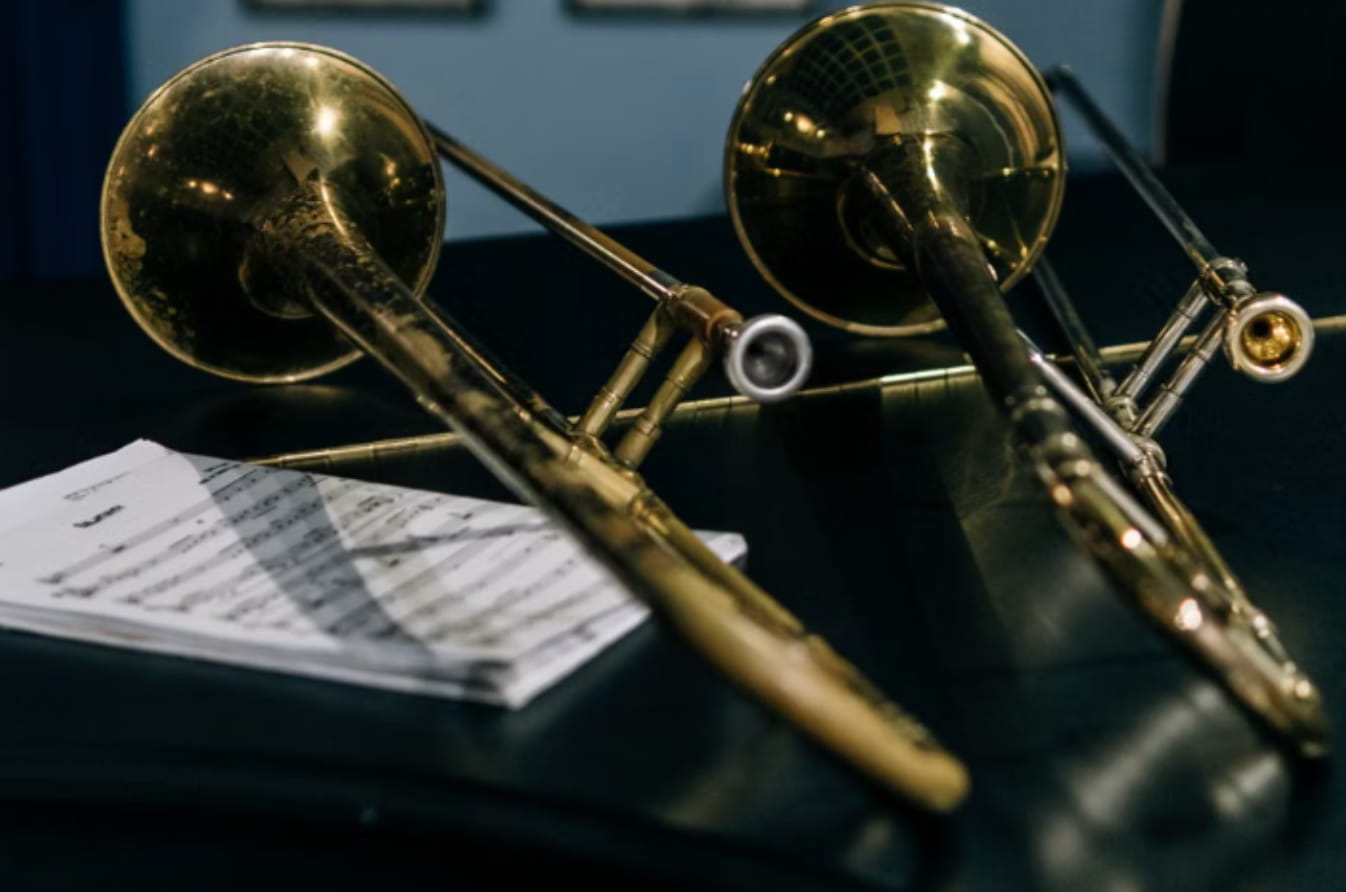
Buying your first trombone can be a little confusing. Unlike clothes, trombones are not simply labelled small, medium or large. Instead, you will see terms such as small bore, large bore, tenor trombone, bass trombone and F attachment.
For most beginners, a “student Bb tenor trombone” is a good place to start. You do not need the biggest or most expensive instrument. What matters more is whether the trombone feels comfortable, the slide is easy to control and the instrument suits the type of music you are learning.
For example, Yamaha describes its standard trombones as being designed to make it easier for beginning students to play, and its YSL-154 student model uses a 0.500-inch bore.
If you have never played before, trombone lessons in Sydney can also help you become familiar with the instrument before deciding what to buy.
What Size Trombone Is Best for a Beginner?
When someone talks about the “size” of a trombone, they may actually be talking about its “bore size.”
The bore is the internal diameter of the tubing in the slide. It may sound like a small technical detail, but it affects how the instrument responds and how much air it needs.
For beginners, student tenor trombones commonly use a bore around 0.500 inches. For example, both the Jupiter JTB730A student model and Jupiter’s ergonomic JTB710A use a 0.500-inch bore and an 8-inch bell.
Here’s a simple way to understand your options:
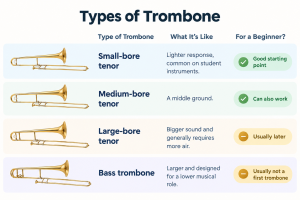
This does not mean every beginner must buy a 0.500-inch trombone. Your teacher, ensemble and playing goals can affect what is appropriate.
The main thing is not to assume that “bigger means better.”
A large professional trombone may look impressive, but a straightforward student instrument can actually make much more sense when you are learning how to control your breathing, embouchure and slide.
What Size Trombone Should a Child or Adult Use?
Age can help narrow down your options, but physical fit matters more than the number on someone’s birthday.
For a child, one of the biggest issues is arm reach. Trombone players need to move the slide through different positions, and some younger students may struggle to comfortably reach the farther positions.
The instrument should also feel manageable to hold. Try This Quick Trombone Fit Test before buying, let the beginner actually hold the trombone.
1. Hold the trombone normally.
Does it feel manageable, or does the player immediately struggle with its weight?
2. Bring the mouthpiece to the lips.
The player should not need to push their head forward or twist their neck.
3. Move the slide slowly.
Can they move it while keeping a comfortable posture?
4. Test their reach.
Can they reach the positions they need without leaning their entire body forward?
5. Hold the playing position for a little while.
A trombone that feels fine for ten seconds may become uncomfortable after several minutes.
For an adult beginner, reaching the slide is usually less of an issue. However, this doesn’t mean an adult needs to start with a large-bore instrument.
Think about where you want to play instead.
If you are joining a community band, learning for enjoyment or simply trying trombone for the first time, a standard student tenor can be enough.
Someone who eventually wants to play orchestral music may move towards a larger-bore instrument later. A jazz player may prefer a smaller-bore trombone.
There is plenty of time to make those decisions as your playing develops.
Simple Rule
Your first trombone should feel comfortable enough that you can focus on learning music rather than fighting the instrument.
Does a Beginner Need an F Attachment?
You may notice that some tenor trombones have extra tubing wrapped around the back of the instrument and a trigger near the player’s left hand.
This is called an “F attachment.”
Using the trigger changes the length of the instrument’s tubing, giving the player access to additional notes and alternative slide positions.
It can be useful, but it is not something every beginner needs.
| Straight Tenor | Tenor With F Attachment |
| Simpler | More complex |
| Usually lighter | Usually heavier |
| Common student option | Common as players develop |
| Often less expensive | Usually more expensive |
| Good for learning the basics | Offers additional flexibility |
For a complete beginner, a simple straight tenor trombone can be perfectly suitable.
An F attachment may make sense if your teacher recommends one or you know you will need it for the music you plan to play. Otherwise, you should not feel pressured to buy an instrument with more features just because it looks more advanced.
The same applies to expensive professional models.
More features do not automatically make learning easier.
How Much Does a Beginner Trombone Cost in Australia?
This is probably one of the first things you will want to know before shopping.
Based on Australian retailer prices checked, many established student trombones currently sit at around $1,000 to $1,500, although cheaper and more expensive choices are available.
Here are some real examples:
| Beginner/Student Trombone | Current Advertised Price |
| Jupiter JTB730A Student | $1,095 |
| Yamaha YSL-154 – Musos Corner | $1,229 |
| Yamaha YSL-154 – In Tune Music | $1,345 |
| Jupiter JTB710A Ergonomic Student | $1,389 |
| Yamaha YSL-354E | $1,449 |
| Yamaha YSL-254CF | $1,495 |
These are advertised prices, not permanent prices. Sales, stock and retailer pricing can change.
For example, In Tune Music’s student trombone range currently lists the Jupiter JTB730A at $1,095, the Yamaha YSL-154 at $1,345 and the Yamaha YSL-254CF at $1,495.
Musos Corner’s Yamaha YSL-154 is currently advertised at $1,229, reduced from $1,294.10.
And Guitar World Australia’s Yamaha YSL-354E is currently $1,449, reduced from $1,699.
So, if you ask how much should you budget? You don’t need an exact number, but this is a reasonable starting guide based on those current listings:
Under $1,000:
You may find budget brands, sales or used trombones. Check the quality carefully.
$1,000–$1,500:
This is where several current established-brand student instruments sit.
$1,500–$2,500:
You’ll start seeing more intermediate choices and different features.
$2,500+:
More advanced and professional instruments become increasingly common. A complete beginner usually does not need to start here.
The price tag shouldn’t be your only consideration.
For example, the “$1,095 Jupiter JTB730A” has a 0.500-inch bore, 8-inch bell and moulded case, making it a genuine student model rather than simply a cheap trombone.
Meanwhile, Yamaha’s YSL-154 is specifically marketed as a beginner-friendly standard model.
So rather than thinking:
The $2,000 trombone must be twice as good as the $1,000 one.
Ask:
Which one is actually suitable for me?
That is a much more useful question.
That is a much more useful question.
 September 30, 2026
Where Could I Find an Affordable Clarinet Teacher in Sydney?
TL;DR A limited monthly budget can still leave you with options for clarinet lessons in Sydney. Start with the price… September 26, 2026
Where to Actually Look Before You Buy an Instrument
The obvious first search usually isn't the right one. The instinct is almost always the same. A lesson gets booked,… September 23, 2026
What Should I Learn First on Piano? A Beginner’s Step-by-Step Guide
TL;DR Start by learning the keyboard pattern, a small group of notes, finger numbers and a steady beat. Practise a… September 23, 2026
How Much Does Logic Pro Cost for Beginners?
TL;DR Logic Pro is Apple's music production software for Mac. In Australia, Logic Pro for Mac costs $299.99 as a…