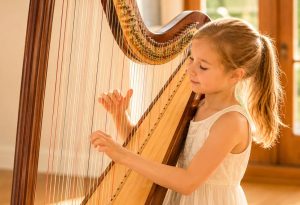
TL;DR: Your first harp lesson is usually about getting comfortable at the instrument, producing a clear sound and leaving with a small practice task you can repeat correctly. You do not need to arrive knowing how to read music, and you may not need to own a harp yet. Ask the teacher what instrument will be available before the lesson. Wear comfortable clothes, keep your fingernails reasonably short and bring any music or questions you already have.
A first harp lesson is quieter and more practical than many beginners expect. You are unlikely to spend the whole session playing a piece from beginning to end. A good portion of the lesson may go into adjusting the seat, learning where the instrument rests and finding a hand position that lets the strings ring without forcing the fingers.
If you are comparing beginner harp lessons in Sydney, it helps to know what the first session should give you. The aim is not to cover everything. It is to establish a few movements clearly enough that you can recognise them again at home.
Do I Need My Own Harp Before My First Lesson?
Not always. Some teachers teach from a studio instrument, while others expect the student to bring or have access to a harp. Online lessons normally require an instrument at home. Confirm the arrangement before you book rather than assuming a harp will be supplied.
The American Harp Society’s guide for new harpists recommends thinking about the music you want to play, the time you can commit and your longer-term goals when looking for a teacher. Those questions are useful even if you have not chosen an instrument. A teacher can explain whether the harp you are considering suits your size, current level and repertoire.
What should I bring to my first harp lesson?
- A notebook or a notes app for practice instructions
- Any music you have already tried, even if you cannot play it yet
- Your tuning key and tuner if you are bringing your own harp
- A short list of questions about the instrument or your goals
Keep your fingernails reasonably short because harpists normally play with the pads of the fingers rather than the nails. Comfortable clothing also helps. Bulky jewellery, watches or loose sleeves can knock against the instrument and distract you from the movement.
What Will My Harp Teacher Check First?
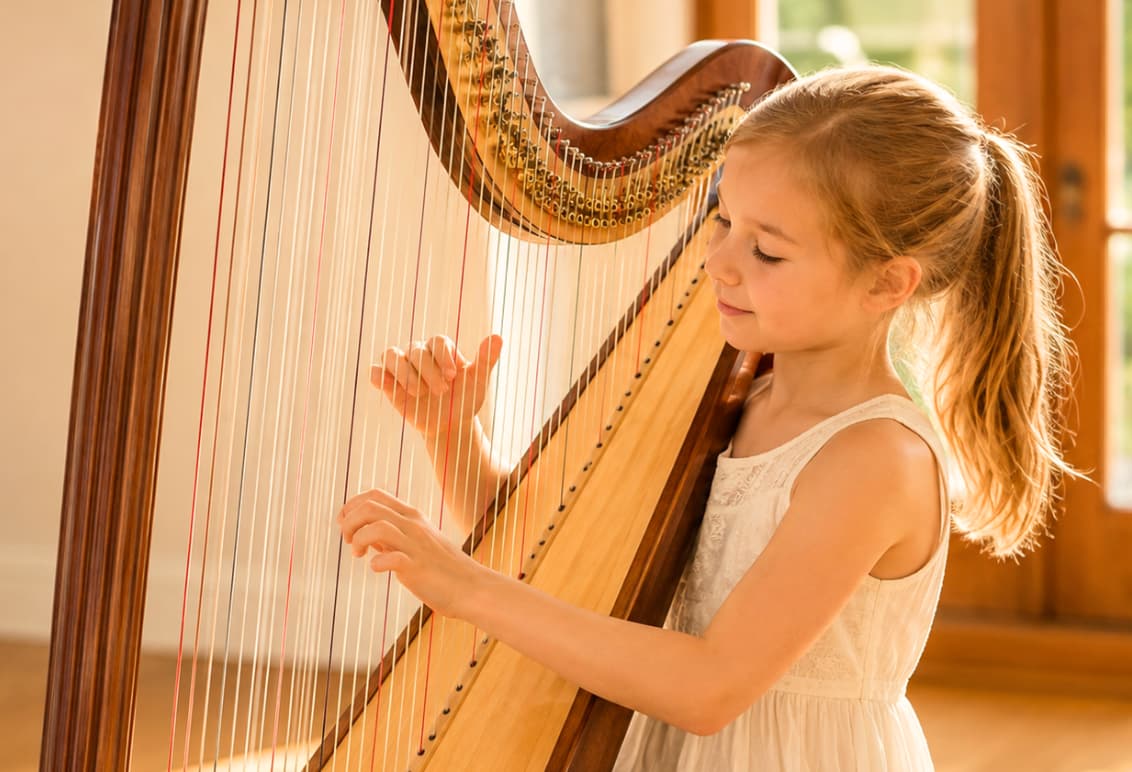
Most first lessons begin with setup. The teacher may adjust the height of the seat, the distance between you and the harp, and the point where the instrument rests against your shoulder. A small change here can make the strings easier to reach and stop the arms from working harder than they need to.
There is no single measurement that suits every student. Harps vary in height, string spacing and balance, and two people using the same instrument may need different seats. The useful test is whether you can sit steadily, reach the working range without lifting your shoulders and move both arms without feeling pinned against the soundboard.
Why does hand position matter in the first lesson?
Harp technique involves more than pulling a string towards you. The fingers are placed before they play, the thumb has its own position, and each finger closes into the hand after release. A teacher will usually demonstrate a simple version of that sequence and watch what happens to your wrist and thumb.
This is where live feedback is useful. You can hear whether a note buzzes, but it is harder to notice that your wrist has collapsed or that you are squeezing before every note. Research on musical learning also treats attention and movement instructions as part of performance, rather than separating physical action from the sound it produces. A 2024 systematic review of attentional focus in musical learning found that researchers use a range of internal, external and musical focus instructions. For a new harpist, that is a useful reminder: the teacher may ask you to listen for an even tone instead of giving you five body instructions at once.
Which Notes and Fingers Will I Learn First?
Your teacher will probably begin with a small group of strings rather than the full range of the harp. On many modern harps, coloured strings act as landmarks: C strings are red, while F strings are commonly blue or black. From those reference points, you can work out the neighbouring notes without counting from the bottom of the instrument every time.
Standard harp fingering numbers the thumb as 1, followed by the index finger as 2, middle finger as 3 and ring finger as 4. The little finger is not normally used in standard lever or pedal harp technique. Your first exercise might use one finger, then two, so that you can hear and feel each release before adding more notes.
Will I use both hands straight away?
Possibly, but not necessarily at the same time. A teacher may let each hand try the same short pattern before combining them. Beginners often find one hand easier to organise than the other. That is normal. Separating the hands gives the less familiar movement a chance to settle before rhythm and coordination are added.
Consider a typical adult beginner who can already read piano music. They may recognise the notes immediately, then discover that looking down at the strings interrupts the rhythm. The first lesson might therefore spend less time on note names and more time on finding a red C string, placing two fingers and returning the eyes to the page. Previous musical knowledge helps, but the physical map is new.
Will I Play a Song in My First Harp Lesson?
Many beginners can play a short melody or pattern during the first lesson. Whether that counts as a complete song depends on the learner, the instrument and the length of the session. Playing four clean notes with a relaxed hand is better preparation than rushing through sixteen notes while the shoulders tighten.
A teacher may use a familiar tune, a short exercise or a simple improvised question-and-answer pattern. Reading notation is not always required at this point. Some students learn the first pattern by imitation, then connect it to the written notes once the movement feels less unfamiliar.
What does a first harp lesson usually include?
The exact order varies, but this example shows how a 60-minute introductory lesson could be organised. A shorter lesson would cover fewer items rather than squeezing every stage into less time.
| Approximate time | Lesson focus | What the student is working towards |
|---|---|---|
| First 10 minutes | Goals, instrument check and seating | A comfortable, stable setup |
| Next 15 minutes | String landmarks and one-finger sound | Finding notes and producing a clean release |
| Next 15 minutes | Two-finger placing or a short pattern | Keeping the hand organised between notes |
| Next 10 minutes | Simple rhythm, melody or two-hand introduction | Connecting technique with music |
| Final 10 minutes | Review and practice notes | Knowing exactly what to repeat at home |
This is a planning example, not a fixed syllabus. A child may need more time to settle at the instrument. An adult with music-reading experience may move through the note names quickly. Someone using an unfamiliar harp may need most of the first session simply to find a comfortable setup.
What Should I Practise After My First Harp Lesson?
The best first assignment is small enough to remember and specific enough to check. “Practise the harp” is too vague. “Place fingers 2 and 1 on two neighbouring strings, play them slowly four times, then pause and relax the hand” gives you an action and a stopping point.
A useful 10-minute practice plan for the first week
- One minute: adjust the seat and check that both shoulders feel loose.
- Two minutes: find the coloured C and F strings named in the lesson.
- Three minutes: repeat the placing and release exercise slowly, resting between attempts.
- Three minutes: play the short rhythm or melody from the lesson without speeding up.
- One minute: write down one thing that felt easier and one question for the teacher.
Stop before the movement becomes tense or careless. Ten attentive minutes can be more useful than half an hour of repeating an uncertain action. If the teacher gave you different instructions, follow those instead. The person who saw your setup is in a better position to adjust the task.
How do I know if I am practising correctly?
Look for a repeatable setup, a clear sound and a hand that can release without gripping. A short phone recording can help with rhythm and tone. A mirror may show whether one shoulder rises, but do not try to diagnose every detail alone. Write down anything that feels confusing and bring it to the next lesson.
Sharp pain, persistent numbness or pain that continues away from the instrument is not a normal practice goal. Stop and seek advice from an appropriate health professional if symptoms persist. A music teacher can adjust technique, but cannot diagnose an injury.
How Do I Know If My First Harp Lesson Went Well?
A successful first lesson does not need to sound like a performance. You should leave knowing how to sit at the instrument, how to find at least one reliable reference string and what to practise next. The instructions should be clear enough that you can describe them in your own words.
It is also reasonable to notice whether the teaching style suits you. Did the explanation make sense? Could you ask questions without feeling rushed? Did the teacher adapt when an instruction did not work? Those details matter because early lessons involve close observation and small corrections.
Questions worth asking before you leave
- Which exercise should I practise first?
- How many careful repetitions should I do?
- What should I stop and check if the sound starts buzzing?
- Do I need music, a tuner or another accessory before the next lesson?
- May I record the teacher demonstrating the exercise for personal practice?
Your next lesson can then begin with something concrete: what worked, what did not, and what changed during the week. If you want to compare lesson formats or see what is normally covered beyond the first session, the overview of harp teachers across Sydney explains the available approaches without changing the basic goal of lesson one: a comfortable setup, a clear first sound and a practice task you understand.
 September 7, 2026
What Will I Do In My First Harp Lesson?
TL;DR: Your first harp lesson is usually about getting comfortable at the instrument, producing a clear sound and leaving with… September 2, 2026
How Often Should You Practice Violin as a Beginner?
When you’re starting the violin for the first time, it’s completely normal to wonder how much practice actually makes a… August 27, 2026
How Often Should You Practice Tuba as a Beginner?
If you have just started learning tuba, you might wonder how often you need to practice. Do you need to… August 23, 2026
Top Flute to Buy in 2026
Buying a flute is one of the most important decisions you will make when starting or advancing your musical journey.…