When you watch a live band perform on stage or attend a classical concert at a hall, it is incredibly easy to get confused by musical terminology. You might be researching different types of rhythm instruments because you want to explore a new creative outlet, or perhaps you are simply curious about how a musical ensemble structures its rhythm section. The terms drums and percussion are constantly used interchangeably in casual conversation by the general public, yet they actually represent two completely different levels of musical classification.
To understand the core difference between these musical concepts, you have to look closely at the physics of how these instruments produce their unique sound. In the grand family of musical instruments, one term acts as a massive umbrella category that encompasses hundreds of distinct sound makers from around the globe, while the other refers to a highly specific type of instrument nestled underneath that exact same umbrella.
What’s the difference between drums and percussion?
The easiest way to understand the difference between these two musical terms is through a simple classification rule that teachers often use. All drums are percussion instruments, but not all percussion instruments can be classified as drums. Percussion is the name of the entire instrument family, which is actually the largest, oldest, and most diverse category in the whole music world. By historical and academic definition, a percussion instrument is anything that makes a musical sound when a player hits it, shakes it, scrapes it, or rubs it.
Drums are a specific sub category within that massive architectural family. For a musical instrument to be called a true drum, it must possess a hollow body shell covered by a tightly stretched membrane, which is commonly known in the music industry as a drum head or drum skin. When a musician strikes that membrane with a wooden stick, a soft mallet, or their bare hands, the air vibrates inside the hollow shell to create a resonant, booming sound.
While drums rely purely on this vibrating skin to produce sound, academic taxonomy records a much wider variety of methods for the rest of the family. According to the comprehensive instrument research library by the Vienna Symphonic Library, the wider percussion family includes instruments made of solid wood, metal, glass, or stone that vibrate entirely on their own structure when struck. This means that while a standard orchestral snare is a drum, a pair of wooden maracas, a hollow wood block, or a metal triangle are percussion instruments, but they are definitely not drums.
Is a drum kit considered a percussion?
Yes, a standard drum kit is entirely made up of percussion instruments, even though modern musicians and contemporary bands usually talk about it as its own separate entity. When you look at a classic setup used in rock, jazz, blues, and pop music, you are actually looking at a collection of different individual percussion instruments grouped together into a single station so that one lone musician can play them all at once using their hands and feet.
The clever thing about a modern drum kit is that it beautifully combines two distinct types of percussion physics into one single performance layout. The bass drum, the floor tom, the rack toms, and the snare drum all belong to the membrane category because they use stretched skins over wooden or metal shells to produce deep, punchy, and resonant tones.
The cymbals, including the hi hats, the ride cymbal, and the crash cymbals, belong to a completely different branch of the percussion family called idiophones. These are instruments where the entire solid body of the metallic object vibrates from the centre to the edge to make a sharp or washing sound. Because a drum kit requires you to coordinate both types of musical instruments simultaneously, it represents a highly specialized and deeply integrated form of percussion playing.
What instruments are in the percussion family?
Because the academic definition of percussion is so incredibly broad, the family contains an astonishing variety of instruments gathered from almost every cultural tradition across the globe. Musicologists generally separate the wider percussion family into two main groups based on whether the instrument can play a specific, recognizable musical tune or not.
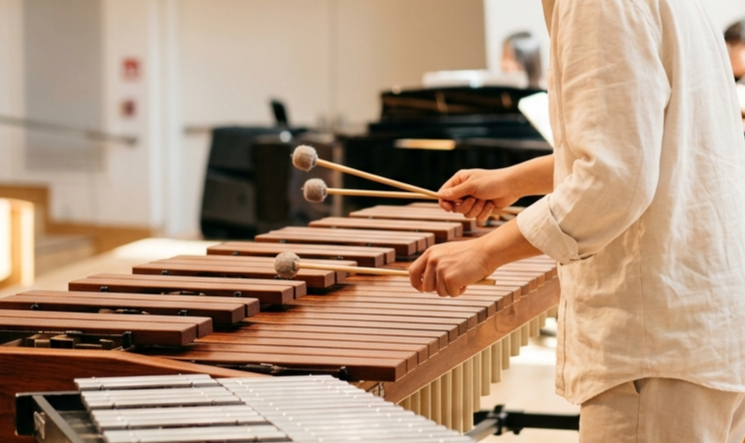
The first group consists of tuned percussion instruments. These have what musicians call a definite pitch, meaning they can play actual scales, melodies, harmonies, and chords just like a traditional piano or a guitar can. The most famous examples of tuned percussion include the wooden xylophone, the deep sounding marimba, the metallic glockenspiel, the tubular bells, and the orchestral timpani. Timpani are fascinating because they are actual drums with stretched skins, but they can be tuned precisely to specific bass notes using a mechanical foot pedal system.
The second group consists of untuned percussion instruments. These produce unique sounds with an indefinite pitch, meaning they are used purely for driving a rhythm, marking accent points, and providing atmospheric texture rather than carrying a melody. This group includes a massive array of items such as:
- The steel triangle, orchestral cymbals, and heavy gongs
- Tambourines, hand shakers, and traditional Latin maracas
- Spanish castanets, hollow woodblocks, and metal cowbells
- Notched guiros and metallic cabasas
Are drummers percussionists?
The answer is yes. Every single drummer is technically a percussionist because every single component they strike belongs to the percussion family. However, in the professional music industry and academic circles, these two terms usually describe two completely different career paths, technical skill sets, and musical mentalities.
A dedicated modern drummer usually spends their entire life focusing on a single, highly complex station known as the drum kit. Their primary training revolves around achieving total four limb independence. They must train their hands and feet to execute entirely different rhythmic patterns at the exact same time to lock in a band’s groove and maintain the steady timing of a song. They are the driving emotional powerhouse of contemporary bands.
On the other hand, a general percussionist in a classical orchestra or a world music ensemble acts as a versatile musician who plays many instruments. Instead of deep diving into a single drum kit, they must master the physical mechanics of dozens of different instruments. It is completely normal to see a classical percussionist play an intricate snare drum solo in the first half of a piece, move over to clash massive cymbals for a single dramatic movement, and then immediately play a complex melody on a tuned marimba within the exact same concert.
Ultimately, while a drummer is always a percussionist by definition, they possess a highly specialized, groove driven skill set. They focus on micro timing and endurance behind one station, whereas a general percussionist focuses on spatial versatility, hand technique variations, and a massive palette of acoustic textures.
Should I learn drums or percussion first?
If you are trying to decide where to begin your rhythmic education, it is usually best to look at your personal musical goals, the types of music you enjoy listening to the most, and your lifestyle. Both paths offer incredible benefits for your musicality, physical health, and rhythmic awareness, but they demand a slightly different focus in the beginning stages of your journey.
Starting with the drum kit is fantastic if your ultimate dream is to play in a contemporary band, perform heavy rock or pop music, or master complex full body physical coordination. Learning the kit gives you a complete, practical understanding of how to drive a musical group and maintain the steady, reliable heartbeat of a song from behind a central performance station.
On the flip side, starting with auxiliary percussion instruments like the hand drums, congas, West African djembe, or even tuned mallet instruments like the xylophone can be a much gentler introduction to the world of rhythm. These instruments often place less demand on complex four limb independence in the early stages, allowing you to focus your mind purely on hand technique, active listening skills, and basic timing. They are also highly portable, easy to transport, and can easily fit into any busy lifestyle or home layout.
There is absolutely no wrong choice when it comes to exploring the world of rhythm. The most important step you can take is simply to begin your education. Picking up a rhythmic instrument is one of the most rewarding decisions you can make in your life. Do not spend any more time wondering about the technical differences from afar. Find a rhythm class, choose the percussion instrument that interests you most, and start your musical journey today.
 September 30, 2026
Where Could I Find an Affordable Clarinet Teacher in Sydney?
TL;DR A limited monthly budget can still leave you with options for clarinet lessons in Sydney. Start with the price… September 26, 2026
Where to Actually Look Before You Buy an Instrument
The obvious first search usually isn't the right one. The instinct is almost always the same. A lesson gets booked,… September 23, 2026
What Should I Learn First on Piano? A Beginner’s Step-by-Step Guide
TL;DR Start by learning the keyboard pattern, a small group of notes, finger numbers and a steady beat. Practise a… September 23, 2026
How Much Does Logic Pro Cost for Beginners?
TL;DR Logic Pro is Apple's music production software for Mac. In Australia, Logic Pro for Mac costs $299.99 as a…