TL;DR: Yes, you can teach yourself the basics of harp, including tuning, simple music theory, and easy one-hand melodies. However, hand position, thumb technique, and wrist tension are difficult to correct once they become habits. Most beginners benefit from a few harp lessons for beginners before practising independently. In Sydney, a mid-range lever harp usually costs around $3,000 to $6,000, and ongoing costs such as strings, lever regulation, and humidity control can add up over time.
When people become interested in learning the harp, one of the first questions they often ask is simple: can I teach myself, or do I really need lessons?
It is a fair question. Harp teachers are usually less common than piano or guitar teachers, especially if you are looking for in-person lessons in a specific Sydney suburb. Lessons are not cheap, and online tutorials are now easier to access than ever. For many beginners, self-teaching feels like the most practical place to start.
The honest answer is somewhere in the middle. You can learn some harp basics on your own, but there are parts of harp technique that are much harder to fix later if they are learned incorrectly at the beginning. This guide explains what you can realistically teach yourself, where lessons are most useful, how much starting harp can cost in Sydney, whether hand size matters, and what beginners should know before buying or renting an instrument.
Do I need a harp teacher?
Let’s start with the good news: some parts of harp are genuinely fine to pick up on your own. Music theory, note names, key signatures and rhythm do not usually require someone watching over your shoulder. Neither does learning the string layout (red strings are always C, black or blue strings are always F), tuning your own instrument, or working out a simple melody with one hand from a book or a video. It is the physical side where things get shaky. Harp technique depends on a handful of very specific habits:
- How your fingers land on the string before you pluck it
- How relaxed your wrist stays through that motion.
- How your thumb moves compared to the other fingers.
The tricky part? None of that is easy to judge on yourself, and none of it feels obviously wrong while you are doing it. You usually only find out later, sometimes a year later, sitting in front of an actual teacher for the first time, that you have been placing your fingers at the wrong angle the whole time and now have to unlearn it before you can move forward.
A common beginner pattern looks like this. An adult student taught herself for eight months using YouTube, could play recognisable tunes, and honestly sounded pretty good on a recording. In person, her wrist was collapsing on every pluck. It was not audible yet, but it would have become a real problem within another year or two. It took four lessons to undo, four lessons to fix something that a few minutes of early feedback could have caught before it started.
That is really the argument for starting with a Sydney harp teacher, not because teaching yourself does not work at all, but because a small amount of guidance early on tends to save far more time than it costs.
What Type of Harp Should I Buy?
“The harp” is not one instrument. The type you choose affects what you can learn, who can teach you, and what you’ll spend.
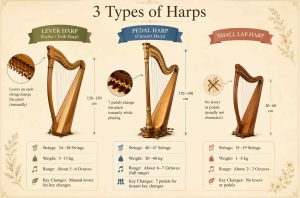
Lever harp (Celtic harp / folk harp) uses small metal levers to raise individual string pitches by a semitone. It typically has 34–38 strings, weighs around 5–15 kg, and is portable enough to carry in a soft case. This is the standard starting point for most beginners, but it is also a complete instrument in its own right, not a steppingstone. Plenty of professional harpists play lever harp exclusively throughout their careers.
To give a more realistic sense of size and portability, Lyon & Healy’s 34-string Drake lever harp weighs 10 kg, while its 34-string Ogden weighs 12.7 kg. Salvi’s 38-string Gaia and Una models weigh around 11–11.6 kg. Lever harp is especially well suited to folk, Celtic, early music, and contemporary repertoire.
To give you a realistic idea of the investment, here is a quick breakdown of what you can expect to budget for a new lever harp:
| Level | Strings | Price (AUD, new) |
| Entry-level | 22–26 | $1,200 – $2,500 |
| Mid-range | 30–34 | $3,000 – $6,000 |
| Professional | 36–38 | $8,000 – $20,000+ |
Pro Tip: If you are not ready to buy, harp hire is available through some Sydney suppliers from about $25 per week, depending on the harp size and model. Renting for your first 6 to 12 months is highly sensible while you figure out if the instrument is a long-term fit.
Pedal harp (concert harp) uses seven pedals, operated by the feet, for real-time key changes across all strings. It has 47 strings, stands 1.8 metres tall, weighs around 38 kg, and requires purpose-built transport. Student-grade pedal harps start at $10,000–$20,000 new; professional instruments reach $80,000 and beyond. Pedal harp is necessary for orchestral performance and complex classical repertoire but is not the right starting point for most beginners.
Small lap harps (15–19 strings, under $600) are marketed at beginners but have too limited a range and string spacing for developing proper technique. They are fine for young children exploring sound but are a false economy for anyone serious about learning.
To summarise, for most Sydney beginners, a mid-range lever harp with a full set of levers is the practical sweet spot.
Can I Play Harp With Short Fingers?
No, and this misconception puts off more prospective students than it should.
The harp has no finger length requirement; what matters most is technique, relaxation, and choosing the right-sized instrument.
Myth: Long fingers are required
- Unlike piano, where a wide hand span helps reach larger intervals, harp technique is based on the angle and placement of fingers rather than their length.
- The plucking motion is a relaxed, drawing-in action that doesn’t demand reach.
- In fact, professional harpists come in all hand sizes.
Fact: Relaxation matters more
- What the harp actually requires is relaxation and flexibility, not length.
- Your fingertips may feel a little tender at first, but there should never be sharp pain.
- Some players develop mild callusing over time; proper technique, gradual practice, and sensible session lengths will keep your hands comfortable.
- A relaxed hand with short fingers will outplay a tense hand with long fingers every time.
A note for young children
- Very young children (under six or seven) may find a full-size lever harp physically awkward, but this is simply an instrument sizing issue resolved by choosing a smaller harp, not a reason to wait.
What Age Can I Start Learning Harp?
There is no strict age limit either way, but a few patterns hold true in practice.
Most Sydney teachers suggest starting children somewhere around seven to nine years old, once hand strength and coordination are developed enough for consistent tone. That said, smaller lap harps make an earlier start possible for a keen five- or six-year-old, so it is worth asking a teacher rather than ruling it out based on age alone.
Adults have no upper limit at all and honestly tend to progress faster in the early months than people expect. Adult students bring longer attention spans, stronger reading ability, and usually a much clearer sense of what they actually want to play, which counts for a lot in the first year.
Is It Better to Rent or Buy a Harp First?
For many beginners, renting is the safer, smarter first step.
Because a high-quality harp is a significant financial investment, it takes a few months of actual physical playing to discover what you truly enjoy. You need time to figure out whether you prefer the portability and folk-friendly range of a lever harp, or whether you are working towards the wider range and chromatic flexibility of a pedal harp. Renting for the first 6 to 12 months buys you the time to build a solid technical foundation without dropping $3,000 to $6,000 on an instrument you might want to swap later.
How Much Does It Cost to Learn Harp?
The instrument price is the most visible cost, but several ongoing expenses catch beginners off guard.
String replacement: Harp strings do break, especially during seasonal humidity changes. The cost varies depending on the string’s material, length and register, so it is better to budget for spare strings rather than treating this as a one-off expense. As a rough guide, replacing a full set of strings on a 34-string lever harp can cost around $100 to $250, but beginners usually will not replace the whole set at once. Individual strings can snap throughout the year, so keeping spare upper-register strings is standard practice.
Lever regulation: The levers on a lever harp need periodic adjustment to keep the pitch accurate. As a rough Sydney budget, a technician visit for regulation can cost around $100 to $300, depending on how many levers need adjustment, the condition of the instrument, and whether travel is included. It is not usually a frequent expense, but many players factor it in every few years.
Tuning equipment: An electronic clip-on tuner usually costs around $15 to $40 and is essential for beginners. New strings stretch significantly, so a harp may need tuning daily at first until the strings settle.
Humidity management: Harps are mainly wooden instruments, so Sydney’s seasonal humidity changes are worth taking seriously. A basic hygrometer usually costs around $20 to $50 and helps you monitor the room. Depending on your home environment, you may also need a humidifier or dehumidifier to reduce the risk of cracking, buzzing, or glue-joint problems over time.
Transport and storage: A lever harp needs a protective transport bag, which can cost around $80 to $200 depending on size and padding. Pedal harps are a bigger transport commitment and usually need a padded cover, often $300+, plus a harp dolly, which can cost around $200 to $400.
Sheet music: Harp-specific music is less widely available than piano or guitar repertoire, and some books may need to be ordered from overseas. A practical beginner budget is around $30 to $80 per year for method books, beginner arrangements, and simple repertoire.
Key Takeaways
- Self-teaching limits: You can self-teach some elements of the harp, but physical fundamentals, including hand position, tension, and posture, are difficult to establish correctly without feedback, and early errors compound.
- Equipment: A mid-range lever harp ($3,000 to $6,000) suits most Sydney beginners, while a pedal harp is for students with specific classical or orchestral goals.
- Finger length: Finger length is not a factor because relaxation and placement matter far more than hand size.
- Versus other strings: The harp sounds good immediately but demands earlier two-hand coordination than the guitar. In addition, while piano experience transfers well, harp technique still starts from scratch.
- Hidden costs: Remember to factor in strings, lever regulation, a tuner, humidity management, transport, and sheet music on top of the instrument price.
If you’d like to start with proper foundations, exploring harp lessons in Sydney is the right starting point for you.
 September 30, 2026
Where Could I Find an Affordable Clarinet Teacher in Sydney?
TL;DR A limited monthly budget can still leave you with options for clarinet lessons in Sydney. Start with the price… September 26, 2026
Where to Actually Look Before You Buy an Instrument
The obvious first search usually isn't the right one. The instinct is almost always the same. A lesson gets booked,… September 23, 2026
What Should I Learn First on Piano? A Beginner’s Step-by-Step Guide
TL;DR Start by learning the keyboard pattern, a small group of notes, finger numbers and a steady beat. Practise a… September 23, 2026
How Much Does Logic Pro Cost for Beginners?
TL;DR Logic Pro is Apple's music production software for Mac. In Australia, Logic Pro for Mac costs $299.99 as a…