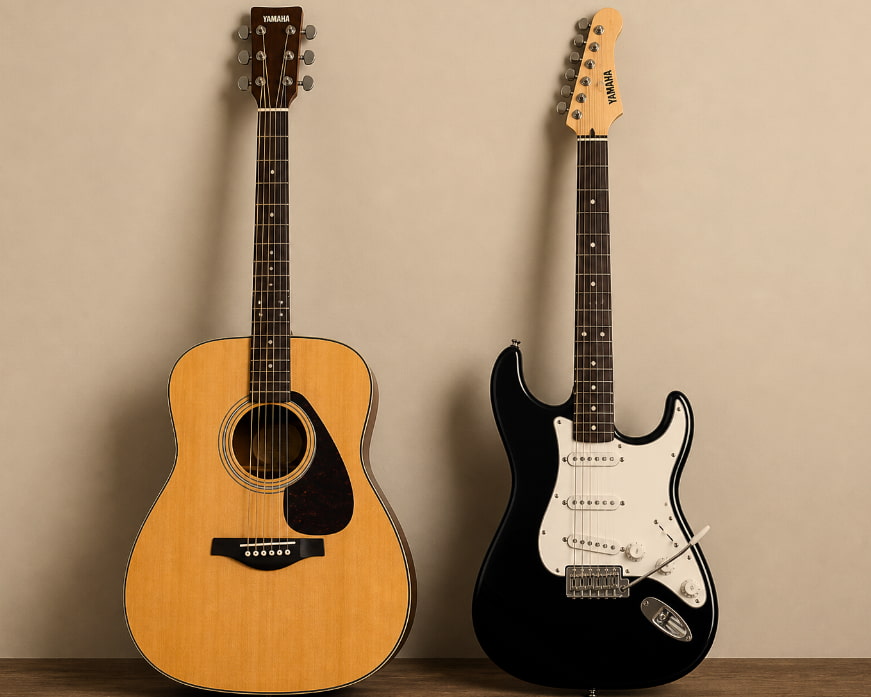
The most important decision isn’t which brand to buy, it’s whether to go acoustic or electric, and that answer depends entirely on the music you actually want to play. For most beginners exploring guitar lessons, a decent instrument in the $300 to $500 range is more than enough to learn properly and develop real technique. The bigger risk isn’t spending too little, it’s buying the wrong type of guitar for your goals or buying something so cheap it makes learning harder than it needs to be.
Should a beginner start on acoustic or electric guitar?
Start on the guitar that suits the music you want to play, not the one someone told you is better.
The common advice is that acoustic is better for beginners because it builds finger strength and doesn’t require extra gear. That’s partially true, but it misses the point. If you want to play rock, blues, or anything that uses distortion and effects, starting on acoustic means months of practice on an instrument that sounds nothing like what you’re trying to learn. That gap between what you’re practising and what you’re inspired by is one of the main reasons beginners quit.
Electric guitars actually have lighter strings and lower action than most acoustics, meaning the strings sit closer to the fretboard and are physically easier to press down. For complete beginners, particularly younger players or anyone with smaller hands, an electric can be a more comfortable starting point technically, not a harder one.
The honest answer is this: acoustic if you want to play folk, country, singer-songwriter, or fingerpicking styles. Electric if you want rock, blues, jazz, or contemporary pop with effects. Either if you’re genuinely unsure, but lean toward whichever one makes you actually want to pick it up. If you’re torn between the two, check out whether you should you get an acoustic vs electric guitar as a beginner.
What does a beginner electric guitar actually need?
An electric guitar for a beginner needs to be comfortable to hold, stay in tune reliably, and come with or be paired with a small practice amplifier. Everything else is secondary.
The three things that actually vary at the beginner price point and affect your experience are the neck profile, the pickup configuration, and tuning stability. Neck profile refers to the shape and thickness of the back of the neck. Thinner, flatter necks are generally easier for beginners and players with smaller hands. Pickup configuration determines what sounds the guitar can produce. A single-coil pickup produces a brighter, cleaner sound associated with funk, blues, and classic rock. A humbucker (double-coil) produces a warmer, thicker sound better suited to heavier rock and metal. Most beginner-friendly guitars have a versatile combination of both.
Tuning stability is the one that causes the most frustration early on. A guitar that doesn’t hold its tuning makes practice actively discouraging because you’re constantly stopping to retune. Budget guitars with low quality tuning pegs are the main culprit. This is another area where buying from a reputable brand at a slightly higher price point genuinely pays off.
One specific thing to avoid as a complete beginner: guitars with a Floyd Rose or similar floating tremolo bridge system. These look appealing and are associated with certain guitar styles, but they make changing strings and maintaining tuning significantly more complex than a standard bridge. It’s an unnecessary complication at the beginner stage and worth actively avoiding until you have more experience.
For electric beginners, a small practice amp in the 10 to 20 watt range is all you need at home. It doesn’t need to be loud, it needs to sound decent at bedroom volume and have a headphone output for quiet practice. Buying the guitar and amp as a bundle is often good value if the bundle is from a reputable brand, but budget bundles from unknown brands often include a poor quality amp that makes the guitar sound worse than it actually is.
What type of acoustic guitar suits a beginner?
For most beginners, a dreadnought or concert body acoustic with steel strings in the $300 to $500 range from a reputable brand is the right starting point.
Dreadnought bodies are the large, classic acoustic shape. They project well, have a full sound, and are what most people picture when they think of an acoustic guitar. Concert or orchestra body shapes are slightly smaller and easier to hold for players with smaller frames or shorter arms. Classical guitars with nylon strings are softer on the fingers but have a wider neck that makes chord shapes harder for smaller hands, and a sound specific to classical and flamenco. Unless that’s your goal, a standard steel-string acoustic is the more versatile starting point.
The three things that vary at the beginner price point and actually affect your experience are nut width, top construction, and bracing. Most steel-string acoustics have a nut width around 43 to 44mm which suits most adult beginners. A solid spruce top, where the face of the guitar is a single piece of wood rather than laminate layers, produces a noticeably richer tone and improves over time as the wood opens up. Most reputable entry-level acoustics in the $300 to $400 range include a solid top with laminate back and sides, which is the right balance at the beginner stage. Bracing refers to the internal wooden struts supporting the top. X-bracing is the standard on quality steel-string acoustics and handles both strumming and fingerpicking well. Very cheap guitars often cut corners here, which limits how much the guitar can resonate and project regardless of how well you play it.
What’s the problem with cheap beginner guitars?
A badly made guitar is the most common reason beginners give up, and it’s almost never identified as the cause.
Very cheap guitars, generally anything under $150 to $200, tend to have two problems that don’t show up in the spec list. The first is high action, meaning the strings sit too far above the fretboard. This makes pressing down on notes significantly harder than it should be and causes finger pain that has nothing to do with the normal adjustment period. The second is poor intonation, meaning the guitar goes increasingly out of tune as you play higher up the neck. Practising on a guitar that sounds wrong even when you’re playing correctly is genuinely damaging to ear training.
Neither of these problems is about the brand name or the look of the guitar. A $150 guitar from an unknown brand might look identical to a $400 guitar from a reputable one. The difference is in the manufacturing tolerances, the quality of the hardware, and whether the instrument has been properly set up before sale. This is why a professional setup, where a guitar technician adjusts the action and intonation, can transform even a budget guitar into something genuinely playable. If you’re buying second-hand or at the lower end of the price range, budgeting $50 to $80 for a setup is often the best investment you can make.
How much should a beginner spend on their first guitar?
The right budget depends on your situation, but here’s what each price range actually gets you.
Under $200 is genuinely risky territory for an acoustic guitar. At this price point, the likelihood of high action, poor intonation, and hardware that doesn’t hold tuning is real. It’s not impossible to find a playable instrument here, but the odds are against you without trying it in person first or having it set up professionally.
$300 to $500 is the sweet spot for most beginners. This range covers well-built instruments from reputable brands with good playability straight out of the box. For acoustics, this often gets you a solid top which improves sound quality and resonance over time. For electrics, this gets you reliable hardware, better pickups, and instruments that will comfortably carry you through several years of lessons.
$500 to $800 gets you a noticeably better instrument that will last longer before you feel like upgrading. Worth considering if you’re a committed adult beginner or if you already play another instrument and know you’ll stick with it.
Above $800 at the beginner stage, you’re into diminishing returns for learning purposes. That money is better spent on lessons.
What guitar should a beginner actually buy?
If you want a straight answer rather than a checklist, here are the recommendations by situation.
Best acoustic for most adult beginners:Yamaha FG800. Solid spruce top, reliable tuning, well set up from the factory, and consistently outsounds guitars at twice the price. Around $300 to $350 Australian.
Best acoustic for kids or smaller players: A 3/4 size acoustic from Yamaha or a similar reputable brand in the $150 to $250 range. Don’t buy full size for a child under ten, it creates uncomfortable posture habits.
Best electric starter setup: A Yamaha Pacifica paired with a small 10 to 15 watt practice amp with a headphone output. The Pacifica consistently punches above its price for build quality and versatility. Budget around $400 to $500 for guitar and amp together.
Best budget acoustic if money is tight: Fender CD-60S. Solid top at an entry-level price, plays well straight out of the box, and holds its value if you decide to upgrade later. Around $250 to $300.
Best option if you’re serious from day one: Spend $500 to $600 on a mid-range acoustic or electric from Yamaha, Fender, or Taylor’s entry-level range. You won’t need to upgrade for years and the better playability makes a real difference to how quickly you improve.
These aren’t the only good options but they’re all safe, well-regarded choices that won’t let you down.
Which brands are worth buying as a beginner?
At the beginner to intermediate price point, a handful of brands consistently produce instruments that are reliable, well-made, and hold their value reasonably well.
For acoustics, Yamaha has the strongest reputation at the entry level for consistent build quality and sound across the price range. Their instruments tend to be well set up from the factory and sound noticeably better than similarly priced alternatives. Taylor and Fender both produce solid entry-level acoustics at the higher end of the beginner budget, with Fender’s dreadnought range being a particularly well-regarded starting point for adults.
For electrics, the entry-level sub-brands of the major guitar manufacturers are the most recommended starting points for good reason. They produce instruments with genuine playability at accessible prices, use recognisable body shapes that are comfortable and well-balanced, and have a strong second-hand market if you decide to upgrade later. Yamaha’s Pacifica series is also consistently praised for build quality and versatility at the beginner price point, and suits players who want something reliable without brand-name pricing.
Ibanez is worth mentioning for anyone drawn to faster, thinner necks and heavier music styles. Their entry-level instruments suit players who know from the start that they want to play metal or progressive styles.
As with pianos, the brand matters less than buying from within the reliable tier rather than going unknown to save $50. The quality gap between a reputable brand’s entry-level instrument and a no-name guitar at the same price is significant and felt immediately when you play them side by side.
Does the guitar’s action really affect how hard learning feels?
Yes, more than almost any other factor, and it’s the thing most beginner guides never mention.
Action refers to the height of the strings above the fretboard. High action means you need more finger pressure to produce a clean note, which causes more finger soreness, more buzzing on chords, and significantly more physical effort for the same result. A beginner on a high-action guitar will develop calluses slower, find chord transitions harder, and generally feel like they’re fighting the instrument rather than playing it.
Low action solves most of these problems. It doesn’t eliminate the adjustment period, every beginner goes through a few weeks of finger soreness as the fingertips toughen up, but it makes that period shorter and less discouraging. String gauge also plays into this. Lighter strings, around 9s or 10s for electric and light gauge for acoustic, are significantly easier on fingers during that adjustment period than heavier gauges. Some budget guitars come strung with heavier strings from the factory, which makes early playing more painful than it needs to be. It’s worth asking when you buy or having them changed at a setup.
How do you test a guitar in a store if you can’t play yet?
You don’t need to be able to play to tell whether a guitar is worth buying, and walking into a store as a complete beginner is less intimidating than most people expect.
The first thing to do is hold it. Does it feel comfortable against your body or does it feel awkward and unwieldy? A guitar that feels wrong to hold will feel wrong to play. Sit down with it in your lap, rest your strumming arm over the body, and reach your other hand up to the neck. You should be able to reach the headstock without straining. If you’re buying for a child, the same test applies, they should be able to hold it comfortably without the body swamping them.
Next, run your thumb along the edges of the fretboard on the side of the neck. Sharp or rough fret ends that catch your skin are a sign of lower build quality and will cause discomfort during playing. A well-made guitar should feel smooth all the way along.
Press down on a string anywhere on the neck with one finger and pluck it. You’re not trying to play a note, you’re feeling how much pressure it takes to push the string down cleanly. If it feels like you’re pressing through concrete, the action is too high. If it feels manageable with light pressure, that’s a good sign.
Ask a store staff member to play the guitar for you, or ask them to tune it and strum a few open chords. You’re listening for buzzing, rattling, or notes that sound choked or dead. A healthy guitar produces a clear, resonant sound on every string without obvious buzzing. If something sounds off even when someone experienced plays it, that’s the guitar, not the player.
If the store allows it, and most reputable music stores in Sydney will, take a pair of headphones for electric guitars and plug them in. Playing through headphones gives you a much clearer sense of how the guitar actually sounds without the room acoustics and ambient store noise interfering.
Finally, trust your gut. If a guitar makes you want to keep holding it and picking at the strings, that matters. If it feels awkward, heavy, or uninspiring in the store, it’ll feel the same way at home.
What accessories does a beginner actually need?
A few things are genuinely essential and the rest can wait.
A tuner is non-negotiable. Practising on an out-of-tune guitar actively damages your ear training and makes everything sound worse than it is. Tuner apps work but a dedicated clip-on tuner is faster and more reliable in a lesson setting.
A guitar strap matters more than people expect. Playing without a strap while seated creates tension in the fretting arm and encourages poor posture habits that are harder to correct later. A basic strap costs very little and makes a real difference to how comfortable practice feels from day one.
A capo is useful early on for acoustic players because it allows you to play songs in different keys using the same chord shapes you already know. It expands what you can play without requiring new technique.
Extra strings and picks are worth having on hand. Strings break at inconvenient times, and different pick thicknesses produce noticeably different sounds and feel. Thin picks are more forgiving for strumming. Heavier picks give more control for single note playing. Trying a few different thicknesses early on helps you develop preferences rather than just defaulting to whatever came in the box.
For electric players, a simple cable and a small practice amp complete the setup. A guitar with no amp is technically playable but misses the point entirely of why you chose electric.
Should you get your guitar set up before starting lessons?
Yes, and it’s one of the highest return decisions you can make as a beginner.
Even a decent guitar can feel terrible if it hasn’t been adjusted properly. A basic setup includes adjusting the string height, neck relief, and intonation, and costs $50 to $80 at most Sydney guitar shops. Many students who struggle in their first few months aren’t lacking ability or practice time. They’re playing on a guitar that hasn’t been set up and is working against them without them realising it.
If you’re buying new from a reputable music store, ask whether the guitar has been set up before purchase. If you’re buying second-hand or online, factor a setup into your budget from the start. The difference between a guitar before and after a proper setup can be significant enough to change how you feel about practising entirely.
What actually determines whether a beginner guitar purchase works out?
Whether consistent lessons and practice follow it.
A guitar sitting in a corner after three weeks of self-teaching is the most common outcome of a beginner guitar purchase, and it almost never has anything to do with the guitar itself. Self-directed learning on guitar has a specific wall that most beginners hit around the one to two month mark, usually when the initial songs they learned stop feeling new and the path forward becomes unclear. A teacher navigates you through that wall rather than leaving you to figure out alone whether the problem is your technique, your practice approach, or the instrument.
Think of it this way: a smooth, responsive guitar removes the friction between you and the music. But good guitar teachers in Sydney removes the friction between you and the progress. You need both working together to actually get somewhere.
 September 30, 2026
Where Could I Find an Affordable Clarinet Teacher in Sydney?
TL;DR A limited monthly budget can still leave you with options for clarinet lessons in Sydney. Start with the price… September 26, 2026
Where to Actually Look Before You Buy an Instrument
The obvious first search usually isn't the right one. The instinct is almost always the same. A lesson gets booked,… September 23, 2026
What Should I Learn First on Piano? A Beginner’s Step-by-Step Guide
TL;DR Start by learning the keyboard pattern, a small group of notes, finger numbers and a steady beat. Practise a… September 23, 2026
How Much Does Logic Pro Cost for Beginners?
TL;DR Logic Pro is Apple's music production software for Mac. In Australia, Logic Pro for Mac costs $299.99 as a…