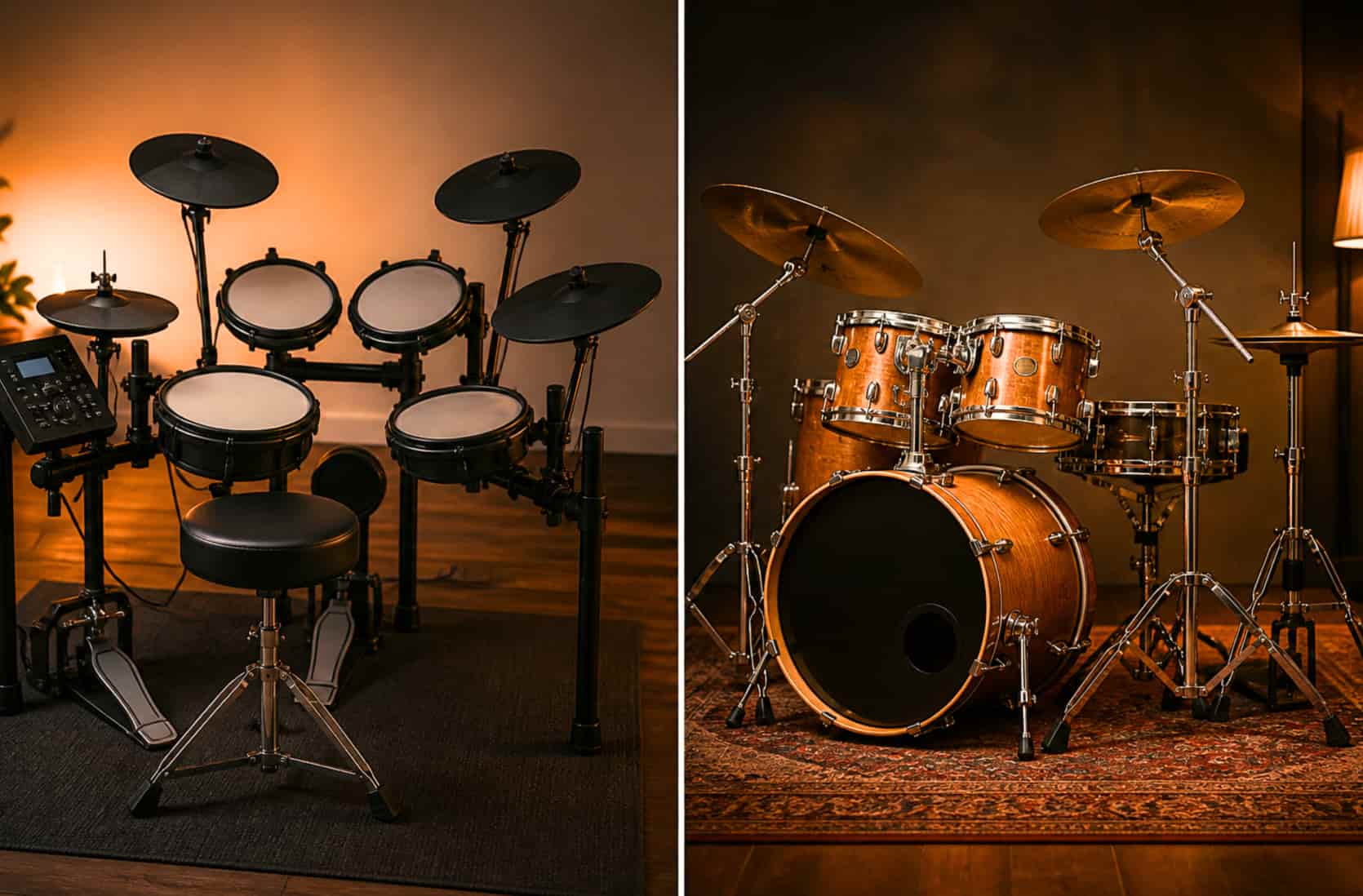
For most beginners in Sydney, where you live makes this decision more than anything else. If you’re in an apartment, electronic is most likely your realistic option. The main problem with acoustic drums in shared buildings isn’t airborne sound through walls, it’s low-frequency vibration from the kick pedal travelling through the floor and into the building structure, and that’s almost impossible to solve without switching to electronic. If you have a house with some space around you, acoustic becomes genuinely viable. If you’re considering drum lessons, understanding why that distinction matters and what each kit does to your development is what this blog is actually about.
Do I need to own a drum kit before starting drum lessons?
No, and for many beginners it makes more sense to start lessons before buying anything.
A good teacher will help you figure out which type of kit suits your situation, your goals, and your budget before you spend money on something that might not be right. Starting lessons first also means your first few sessions happen on a proper acoustic kit, which gives you a real feel for the instrument before you commit to a home setup. Many students who buy a kit before their first lesson end up with something that doesn’t suit them, either the wrong type, the wrong size, or a quality level that creates unnecessary frustration.
If you’re keen to practise between lessons from the very start, a basic practice pad costs very little and is genuinely useful for developing hand technique without needing a full kit. A full kit at home becomes more valuable once you’ve had a few lessons and know what you’re working on between sessions.
Does it matter which kit you start on, or is a drum kit just a drum kit?
It matters, and the difference goes deeper than just volume.
An acoustic drum has a physical drumhead stretched over a shell, and when you strike it the head rebounds based on tension and impact. That rebound is what drumming technique is built around. Ghost notes, dynamic control, the subtle difference between a centred hit and a rim shot, all of these depend on reading and responding to physical feedback that the kit gives you honestly. When you play poorly on an acoustic kit, it tells you. The sound changes, the feel changes, and your ear starts learning to distinguish what good playing feels like versus what adequate playing feels like.
An electronic kit with mesh heads gets reasonably close to that feel, noticeably closer than older rubber pad kits, but it’s not identical. The sound module processes your hits and produces a consistent sample regardless of minor technique variations. That consistency is useful early on, but it gradually becomes a ceiling. The kit stops reflecting your technique back to you because it sounds similar whether you played something well or just adequately.
A good way to think about it: electronic kits are treadmills. Safe, consistent, you know what you’re going to get, and you can use them to genuinely get into shape. Acoustic kits are running on real ground, and your true technique is exposed. You can still make real progress on the treadmill. Some things just only become clear when you’re outside.
Can I use an acoustic kit with mutes and a platform and be okay in an apartment?
Probably not, and it’s worth being honest about this rather than giving false hope.
The combination of drum mutes, low-volume cymbals, and a floor isolation platform does meaningfully reduce both noise and vibration on an acoustic kit. Mutes bring the airborne sound down by around 70 percent. A floor isolation platform physically decouples the kit from the floor and significantly reduces the kick pedal vibration that travels into the building structure. Low-volume cymbals cut cymbal noise by around 80 percent. Used together, this is a legitimate setup for a house where you need to keep things reasonable.
In an apartment the problem is that even after all of those reductions, an acoustic kit is still significantly louder than an electronic kit with mesh heads. The muted acoustic kit still produces around 70 to 80 decibels of airborne sound from the pads and remaining cymbal noise. An electronic kit with mesh heads sits at 60 to 75 decibels from pad tap alone before any muting is applied. Remember decibels are logarithmic so even a small difference in numbers is a big difference in noise. The acoustic kit is just likely too loud for shared building situations even with every noise reduction measure applied.
There’s also the technique problem. To keep the noise down further on a muted acoustic kit, most people naturally hold back their playing. Playing restrained and cautious to avoid complaints isn’t the same as playing correctly. You end up training compensating habits rather than developing real technique, which costs you later.
The honest answer is that mutes and a platform make an acoustic kit workable in a house and borderline in a semi-detached with cooperative neighbours. In a Sydney apartment they reduce the problem but don’t solve it. Electronic is the only option that genuinely works in shared building situations.
One thing acoustic drummers should also know: at 90 to 120 decibels, hearing protection isn’t optional. Every session without proper ear protection carries a real risk of cumulative hearing damage. Dedicated hearing protection with decibel reduction is essential, not the noise-cancelling headphones used for listening to music. On electronic kits the pads themselves are well below the damage threshold, but headphone volume during long practice sessions is worth monitoring.
So is electronic always the right starting point for beginners?
Electronic is the right starting point if noise or space is a constraint, which it is for the majority of Sydney beginners. Acoustic is the better developmental instrument if your living situation genuinely allows it.
The answer here isn’t about which kit is better in an abstract sense. It’s about which kit lets you actually practise. A beginner who can sit down and play every day on an electronic kit will develop faster than someone who can only play acoustic occasionally because the noise creates constant friction. Consistency compounds over weeks and months in a way that occasional access doesn’t.
That said, if you have a house in areas like the Hills District, Western Sydney, or anywhere with a detached home and some space around you, starting acoustic is worth seriously considering. The developmental benefits are real and they start from day one rather than something you work toward later.
What size drum kit does a beginner actually need?
For most beginners, a standard five-piece kit is the right starting point regardless of whether you go acoustic or electronic.
A five-piece kit consists of a kick drum, snare, two rack toms, and a floor tom, plus hi-hats, a crash cymbal, and a ride cymbal. This is the configuration most drum teachers use for lessons and the setup most beginner learning material is structured around. It covers everything you need for the first several years of playing without being overwhelming.
Full-size kits use standard acoustic dimensions, kick drum around 22 inches, snare at 14 inches, toms from 10 to 16 inches. For adults and teenagers this is the right choice. For children under around ten, a junior or smaller kit can make physical sense while their reach and hand size are still developing, but the goal should be moving to a full-size kit as soon as it’s physically practical. Playing on undersized equipment too long creates posture and technique habits that need correcting later.
On the electronic side, this size consideration matters differently. Many budget electronic kits have pads significantly smaller than acoustic dimensions, which creates a transition challenge when you eventually play a real kit. Choosing an electronic kit with pad sizes closer to acoustic dimensions costs more upfront but makes the adjustment to acoustic playing noticeably smoother. Your teacher can advise on specific models once you’ve had a few lessons and know what you’re working toward.
What does an electronic kit actually teach well, and where does it fall short?
For the first several months of learning, an electronic kit is completely adequate for developing coordination, timing, and the fundamental patterns that all drumming is built on. These skills transfer directly to an acoustic kit. The vast majority of beginner development happens in areas where electronic and acoustic kits perform similarly.
Where electronic kits create a specific gap is in dynamics. On an acoustic kit, controlling volume requires genuine technique. Playing a quiet ghost note next to a loud backbeat takes precise control of stick height, grip pressure, and wrist motion. The mesh head on an electronic kit is more forgiving, which means you can develop consistent timing without necessarily developing the dynamic sensitivity that separates expressive drumming from mechanical drumming.
There’s also a volume calibration problem that’s easy to overlook. On an electronic kit you can turn down any drum or cymbal that feels too loud. The risk is that you gradually train yourself to play at a volume that doesn’t exist on a real kit. When you move to acoustic you’ve essentially practised with wrong dynamics, playing too lightly because you were always compensating for adjustable levels. The kit rewards that lighter touch, and then suddenly it doesn’t. A good teacher builds acoustic kit time into lessons specifically to prevent this from becoming a habit.
There’s also a counterintuitive advantage to electronic kits worth mentioning. Because electronic cymbals have defined trigger zones, you either hit the bell correctly or you don’t. The kit won’t let you get away with sloppy stick placement the way an acoustic cymbal does, where the overall volume and wash can mask imprecise technique. Some drummers find that regular electronic practice actually makes them more precise about where they’re striking.
What are the cost differences between electronic and acoustic at the beginner level?
The upfront cost comparison is less straightforward than it looks, and there’s a counterintuitive tradeoff worth understanding.
At the same price point, a beginner acoustic kit will often serve you longer before you feel like you’ve outgrown it. A similarly priced electronic kit tends to show its limitations faster as your skills and ear develop, because the gap between entry-level and mid-level electronic kits is more pronounced than the equivalent gap in acoustic. You might find yourself wanting to upgrade the electronic kit sooner than you would an acoustic one at the same price.
On the other hand, acoustic drums have significant ongoing costs that electronic kits don’t. Drumheads wear and need replacing. Cymbals crack. Hardware needs maintenance. You’ll also need dampening accessories for quieter practice. Electronic kits are essentially a one-time purchase with minimal ongoing expenses.
In Australia, a complete playable acoustic beginner setup including hardware and cymbals runs from around $800 to $1,500. A solid entry-level electronic kit with mesh heads runs from around $600 to $1,200. The electronic kit wins on ongoing cost. The acoustic kit holds its developmental value longer at the same price point.
What’s the adjustment like when moving from electronic to acoustic?
More significant than most beginners expect, particularly in the arms and on the larger drums.
Entry-level electronic kits typically have 8-inch pads for toms and snare. A real acoustic snare is 14 inches, and toms run from 10 to 16 inches. Moving between those sizes after months on small pads requires a genuine adjustment period for stick placement and reach between drums. The floor tom is where most beginners notice the biggest difference. The head is larger and on a real kit it doesn’t bounce nearly as easily as a mesh head does. Playing a floor tom properly on an acoustic kit requires noticeably more arm strength and control than the same motion on an electronic kit, and that gap only becomes apparent when you sit behind the real thing.
This is one of the strongest arguments for buying a mid-level electronic kit with acoustic-sized pads rather than the cheapest option available. Drum teachers consistently report that students who practised on kits with acoustic dimensions transition far more smoothly than those who practised on small beginner pads with beaterless pedals. If the kit you’re practising on at home is physically closer to a real kit, the switch is genuinely less disruptive to your playing.
Which kit is better for a beginner who wants to play in a band?
Acoustic, and the most practical solution for most Sydney beginners is electronic at home combined with acoustic during lessons.
If you want to play with other musicians, in a band, at rehearsals, or in any live context, acoustic is the standard. Being comfortable on an acoustic kit under those conditions requires time on one, which is why lesson time on a full acoustic kit matters even if home practice is entirely electronic. The electronic kit builds consistency and coordination at home. The acoustic kit during lessons builds feel, dynamics, and the expressive range that performing requires. Those two things work well together as a system.
When buying an electronic kit with this transition in mind, a kick tower with an actual beater is worth prioritising over a beaterless pedal. A beaterless pedal feels nothing like a real kick drum. A kick tower significantly closes that gap and means less adjustment when you get on an acoustic kit. Similarly, choosing a kit where the pad sizes are close to acoustic dimensions will make the eventual transition noticeably smoother.
So which kit should a Sydney beginner actually choose?
If you’re in an apartment, a unit, a townhouse, or anywhere with shared floors or walls, an electronic kit is the right call. Mutes won’t solve the acoustic problem in those situations and the frustration of constant noise management will kill your practice habits faster than anything else.
If you have a detached house with some space around you and neighbours who are either far enough away or genuinely cooperative, acoustic is worth starting on if you can manage the cost and setup. A muted acoustic with low-volume cymbals during reasonable hours is viable in that situation and the developmental benefits start immediately.
If you’re genuinely unsure or your situation is somewhere in between, start electronic, get regular lesson time on acoustic, and reassess once you’ve been playing for six months and have a clearer picture of where you want to take it.
The best kit is the one that lets you practise every day without it becoming anyone else’s problem. You can also talk to drum teachers in Sydney and see what they recommend.
 September 30, 2026
Where Could I Find an Affordable Clarinet Teacher in Sydney?
TL;DR A limited monthly budget can still leave you with options for clarinet lessons in Sydney. Start with the price… September 26, 2026
Where to Actually Look Before You Buy an Instrument
The obvious first search usually isn't the right one. The instinct is almost always the same. A lesson gets booked,… September 23, 2026
What Should I Learn First on Piano? A Beginner’s Step-by-Step Guide
TL;DR Start by learning the keyboard pattern, a small group of notes, finger numbers and a steady beat. Practise a… September 23, 2026
How Much Does Logic Pro Cost for Beginners?
TL;DR Logic Pro is Apple's music production software for Mac. In Australia, Logic Pro for Mac costs $299.99 as a…