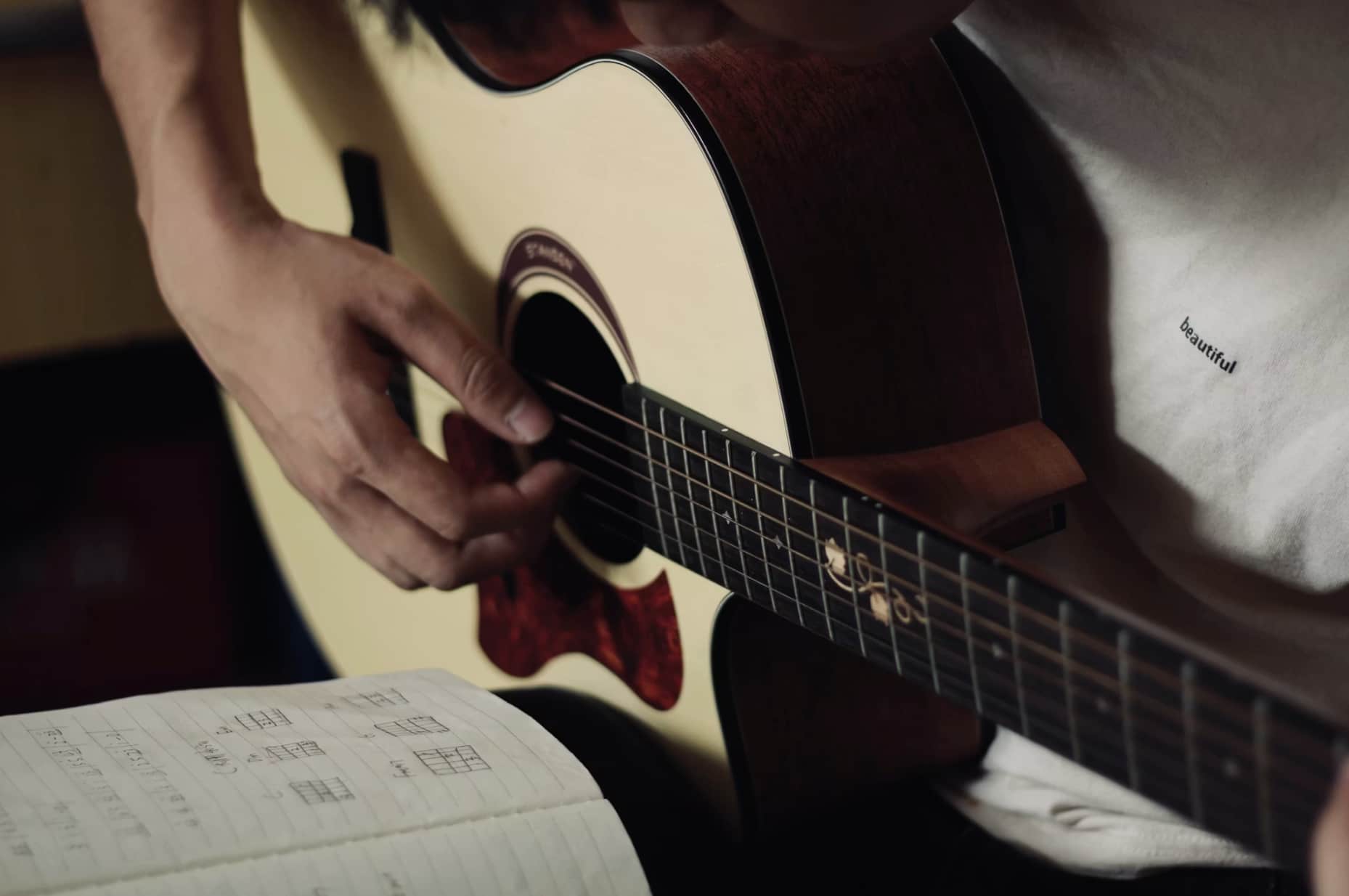
At some point, a surprising number of guitars become room decorations.
They end up leaning silently against bedroom walls beside tangled phone chargers, slowly turning into expensive wooden guilt. Their owners still like the idea of playing guitar. They just don’t touch it anymore.
Most people don’t quit all at once. Instead, the practice sessions slowly thin out. Four nights a week becomes two, then once on Sunday afternoon, then “I’ll start again next week.” Eventually the guitar case stops opening entirely.
For beginners, this tends to happen around the two or three month mark with almost eerie consistency.
Why?
Is guitar secretly harder than people expect? Do most people quit because they lack talent? Or does the instrument simply stop feeling rewarding before most people get good enough to enjoy it?
Usually, it’s the last one.
Most beginners don’t quit because they lack talent. They quit because progress becomes less visible after the first few months, even though they are still improving.
If you’re considering guitar lessons in Sydney, or you’ve already started learning and feel yourself drifting into frustration, the answer is usually less dramatic than people think.
Most beginners are not failing, they’ve just reached the part where learning guitar stops feeling cinematic and starts feeling real.
Is it normal to struggle with guitar after 3 months?
Completely normal. Almost every musician experiences some version of this wall.
The first major wall usually appears when beginner excitement fades but automatic fluency hasn’t arrived yet. Your fingers still hesitate. Rhythm still requires concentration. Playing still feels mentally exhausting.
Then slowly, without you fully noticing, things begin changing.
Chord shapes stop feeling foreign.
Your fingertips toughen up.
Your hands begin moving automatically.
Rhythm settles into your body instead of staying trapped inside conscious thought.
One day, you suddenly realise you can play while thinking about something else at the same time.
That moment feels almost strange. The instrument finally starts feeling less like an object you’re fighting and more like something you can actually communicate through.
Most people who continue long enough eventually reach this stage, the problem is simply that many quit a few weeks too early.
Why do adults quit guitar faster than kids?
Adults are often deeply uncomfortable being visibly bad at something.
Children expect learning to feel awkward. Adults usually expect competence much faster, especially if they’re already successful in other parts of life. Sitting alone trying to switch between G and C smoothly can feel strangely embarrassing when you spend the rest of your week studying at university, working professionally, or managing responsibilities.
Adults often compare their progress more than they realise, which can make learning guitar feel more discouraging than it actually is.
They compare themselves to friends who seem to pick things up faster.
They compare themselves to musicians online who already play at a high level.
And they also compare themselves to the version of themselves they expected to become when they first bought the guitar.
The issue is that these comparisons are usually made against people with completely different levels of experience, which can distort how progress actually feels in the early stages.
Children rarely do this, they just keep going.
Many adults who learn guitar in Sydney also struggle with consistency because life slowly eats practice time alive. Work, study, commuting, relationships, exhaustion, and random daily stress quietly push practice sessions aside.
Then guilt enters the picture. The guitar starts feeling less like a hobby and more like evidence of personal failure sitting in the corner of the room.
Ironically, this pressure often disappears once adults start proper guitar lessons. Having a teacher makes the struggle feel normal instead of personal. Students realise other people are dealing with the same frustrations.
Why does learning guitar suddenly feel harder?
Most beginners experience a noticeable slowdown in progress after the first few months of learning guitar. This is often described as “hitting a wall.”
In the first month, improvement is usually rapid. Beginners are learning entirely new skills such as basic chord shapes, simple chord changes, and the ability to play short sections of songs. Because everything is new, progress is easy to notice on a day-to-day basis.
By around the second to third month, this rate of visible improvement begins to change. Instead of learning completely new techniques, beginners start focusing on improving coordination, timing, and consistency. These skills develop gradually through repetition and are less immediately noticeable.
For example, chord transitions may become slightly smoother, rhythm may become more stable, and finger placement may become more efficient. However, these improvements are often subtle and do not feel as significant as early progress.
Because the changes are less obvious, many learners assume they have stopped improving. In reality, they are still developing core motor skills in the background, but the progress is less visible compared to the initial learning stage.
This shift from rapid early gains to slower skill refinement is the main reason beginners describe this stage as “hitting a wall.”
Why is the acoustic guitar frustrating?
Acoustic guitar is often more physically demanding for beginners compared to electric guitar.
This is mainly because the strings require more pressure to press down cleanly, especially before finger strength has developed. As a result, beginners often experience soreness in their fingertips during the early stages.
Barre chords can also feel challenging because they require consistent pressure across multiple strings using one finger. Without enough hand strength and coordination, this can lead to fatigue and frustration.
On top of this, beginners often develop tension in their posture without realising it, such as gripping the neck too tightly or lifting the shoulders while playing. These habits make the instrument feel more difficult than it actually is.
Many beginners in Sydney start with an acoustic guitar because it feels simpler or more affordable than an electric guitar, but acoustic guitars are physically demanding in ways people don’t expect. The strings often require more pressure, small mistakes become very obvious, and bad posture quickly turns into tension.
Beginners also tend to squeeze the neck way too hard.
This creates tension everywhere: wrists, forearms, shoulders, sometimes even the jaw. A guitar teacher notices this almost immediately. A self-taught player might spend months fighting unnecessary tension without realising it’s slowing everything down.
First barre chords make otherwise emotionally stable adults look genuinely distressed.
That’s normal. Nobody looks graceful learning them.
Do people quit guitar because they lack talent?
Usually, no.
Most people quit because their expectations collide with reality. The internet has badly distorted how people think musical skill works. Beginners compare their week three progress to musicians who have been playing for ten years. Online, we mostly see polished performances instead of the years of awkward repetition hiding underneath them.
The result is that many beginners quietly decide:
“Maybe I’m just not musical.”
But most experienced guitarists were once terrible.
- They missed chords.
- They played out of time.
- They restarted songs constantly.
- They avoided difficult techniques.
- They got frustrated and considered quitting too.
The difference is not that talented people avoid struggle. The difference is that they stay long enough to move through it.
Guitar is less about discovering hidden talent and more about slowly building coordination through repetition. It’s mechanical before it becomes expressive. Most people simply quit before the expressive part arrives.
Why do many beginners lose motivation when learning guitar alone?
Self-teaching guitar is completely possible. There are amazing YouTube teachers and free online resources now. A motivated person can absolutely learn chords, songs, scales, and music theory online. The internet solved the information problem years ago.
What it didn’t solve is the feedback problem. When you practise alone, it’s hard to see your own mistakes clearly. Your brain quietly fills in the gaps because you already know what you meant to play. A chord sounds “close enough.” Your timing feels “mostly fine.” Small issues slowly become habits.
Similar to other instruments, this is one reason beginner lessons in Sydney are still so valuable even with endless free tutorials online.
A good guitar teacher does not just give you information you could Google yourself. They watch you in real time. They notice tension, posture problems, rhythm issues, weak technique, or practice habits that are quietly slowing your progress.
More importantly, they help make progress visible again. That matters more than people realise. A lot of beginners don’t actually need more motivation. They need proof that they’re improving.
Why do beginners improve faster with a guitar teacher?
Many people think guitar teachers simply teach songs. Good teachers do much more than that.
They help organise the chaotic early stages of learning so beginners don’t drown in random YouTube videos and unrealistic expectations. They choose songs that are difficult enough to challenge you but achievable enough that you still want to continue.
They also stop small technical problems from turning into permanent habits.
Common beginner issues include:
- pressing strings too hard
- inconsistent rhythm
- unnecessary tension
- poor wrist position
- weak timing
- awkward chord switching
- avoiding difficult techniques completely
Most self-taught players can’t easily identify these issues in themselves because they’re too busy trying to survive the song.
A guitar teacher sees them immediately.
This is why many students suddenly improve after only a few lessons. Sometimes the problem isn’t lack of effort at all. Sometimes they’ve simply been practising inefficiently for months without knowing it.
More importantly, having structured guidance often helps beginners stay consistent during the stage when many people consider quitting.
Most beginners do not stop learning guitar because they are incapable of improving. They stop because progress becomes harder to notice, motivation becomes less reliable, and frustration starts to outweigh enjoyment.
The good news is that these challenges are a normal part of learning the instrument. Almost every experienced guitarist has gone through periods where practice felt repetitive, progress felt slow, and improvement seemed difficult to measure.
In many cases, success comes down to staying consistent long enough to move beyond that stage.
Guitar rarely rewards people overnight. Instead, it rewards small efforts repeated over time. The beginners who continue are usually not the most talented. They are the ones who keep showing up long enough to see those small improvements turn into real musical ability.
 September 30, 2026
Where Could I Find an Affordable Clarinet Teacher in Sydney?
TL;DR A limited monthly budget can still leave you with options for clarinet lessons in Sydney. Start with the price… September 26, 2026
Where to Actually Look Before You Buy an Instrument
The obvious first search usually isn't the right one. The instinct is almost always the same. A lesson gets booked,… September 23, 2026
What Should I Learn First on Piano? A Beginner’s Step-by-Step Guide
TL;DR Start by learning the keyboard pattern, a small group of notes, finger numbers and a steady beat. Practise a… September 23, 2026
How Much Does Logic Pro Cost for Beginners?
TL;DR Logic Pro is Apple's music production software for Mac. In Australia, Logic Pro for Mac costs $299.99 as a…