TL;DR:
- Most teachers suggest starting bass lessons somewhere between 8 and 10, once a child can focus for 20 to 30 minutes and has the finger strength to press a string down cleanly.
- A short-scale bass (around 30 inches, or even smaller at 28.5 to 28.6 inches) fits most children far better than a standard 34-inch bass.
- It is genuinely never too late to start as an adult. Research on older adults learning instruments shows real, measurable brain benefits, not just reassurance.
- Fingerstyle and pick suit different styles of music. Neither is more “correct,” and most bassists eventually learn both.
- The biggest beginner mistakes are about timing and technique, not talent or starting too late.
There is no single right age to start bass guitar. Committed adults take it up in their 50s and end up playing in a covers band within a year or two. Genuinely ready 8 year olds pick it up and stick with it for life. Age on paper matters less than a handful of practical signals, on both ends of the spectrum.
What Age Can My Child Start Learning Bass?
Many children are ready to begin somewhere between the ages of 8 and 10, although readiness matters more than age alone.
Why Does Bass Usually Start Later?
Bass tends to start a little later than piano or guitar, mostly because of the instrument itself rather than musical difficulty.
- It is heavier (typically 8 to 10 lb, even before a strap is pulling it forward against a small frame).
- The strings are thicker and need more finger strength to press down cleanly
- A standard bass is close to the height of an average 8 year old.
Can Younger Children Learn Bass?
Younger exceptions exist.
Bassist Victor Wooten famously started around age 2 with a musical family around him constantly, but that is genuinely rare, not a realistic bar to measure a typical child against.
Rather than fixating on a birthday, look for three signals:
- Focus. Can your child concentrate on one task, not just bass, for around 20 to 30 minutes without losing interest? Lessons and practice both need that baseline.
- Finger strength. Can they press a string down against the fretboard firmly enough to get a clean note, without it buzzing? This takes more hand strength than most people expect from an instrument this size, and it is worth testing on an actual bass before committing to lessons.
- Sustained interest, not a single afternoon of excitement. Has your child asked about the bass more than once, on different days? Enthusiasm that shows up repeatedly is a far better predictor than enthusiasm after seeing a music video once.
What Size Bass Is Best for My Child?
For most children under about 12, a short-scale bass, roughly 30 inches, fits far better than a standard 34-inch bass, and for smaller or younger children, an even shorter scale down around 28.5 to 28.6 inches is worth trying first.
As a rough height guide, Standard-scale basses are generally more comfortable for taller or larger-framed players, while short-scale models often suit children and smaller-framed beginners. The Squier Mini Precision Bass and the Ibanez Mikro are two widely available models built specifically around these shorter scales, and despite the smaller size, they are genuinely playable instruments rather than toys.
| Scale Length | Approx. Size | Typically Suits |
| Standard (34″) | Full size | Older children, teenagers and adults comfortable with a full-sized instrument |
| Short-scale (~30″) | About 3/4 size | Many children and smaller-framed beginners |
| Mikro/3-4 size (~28.5 to 28.6″) | Smallest common option | Younger or particularly small-framed children |
Pro Tip: Let your child try the bass while sitting and standing before buying it. A bass that looks suitable on paper may still feel too heavy, wide or awkward once they hold it properly.
We cover the small-hands side of this in more depth, including why a shorter scale solves most of the stretch problem entirely, in How Do I Start Playing Bass? 5 Things to Know Before Your First Lesson. The short version for kids specifically: it is almost always better to start smaller than to start big and “grow into” a bass, since a poor fit early on tends to create posture habits that are more work to undo later than simply buying a second, larger bass down the track.
Am I Too Old to Learn Bass Guitar?
No. There is no upper age limit on learning bass. This is not just an encouraging line; it is backed by real research into how adult brains respond to learning an instrument.
Does Age Affect Your Ability to Learn Bass?
- A longitudinal study following adults over four years found that people who took up an instrument later in life, with an average starting age in their 70s,showed measurable improvements in working memory and greater preservation of some subcortical brain structures over the four-year period.
- If a 70-something brain can adapt meaningfully to a new instrument, the evidence gives adults in their 40s and 50s little reason to assume that age alone prevents meaningful musical learning.
What Actually Holds Adult Beginners Back?
What actually slows adult beginners down is rarely age itself. It is inconsistent practice, competing priorities, or a bit of self-consciousness about being a beginner at something in public. None of that is about brain plasticity or finger dexterity going into decline.
A Student Example
One of our current students started playing bass at 52, once her kids had left home and she finally had time for something she had always wanted to learn.
Eighteen months in, she is playing regularly in a covers band with people half her age, and by her own account, being the oldest person in the room stopped bothering her after about the third rehearsal.
Once age and instrument size are settled, most new players have two more practical questions: how to play the strings and which early habits to avoid.
Should I Play Bass With a Pick or My Fingers?
Are Both Techniques Valid?
Either is a valid starting point, and the honest answer is that most bassists end up using both eventually, depending on the sound a song calls for.
What Does Fingerstyle Sound Like?
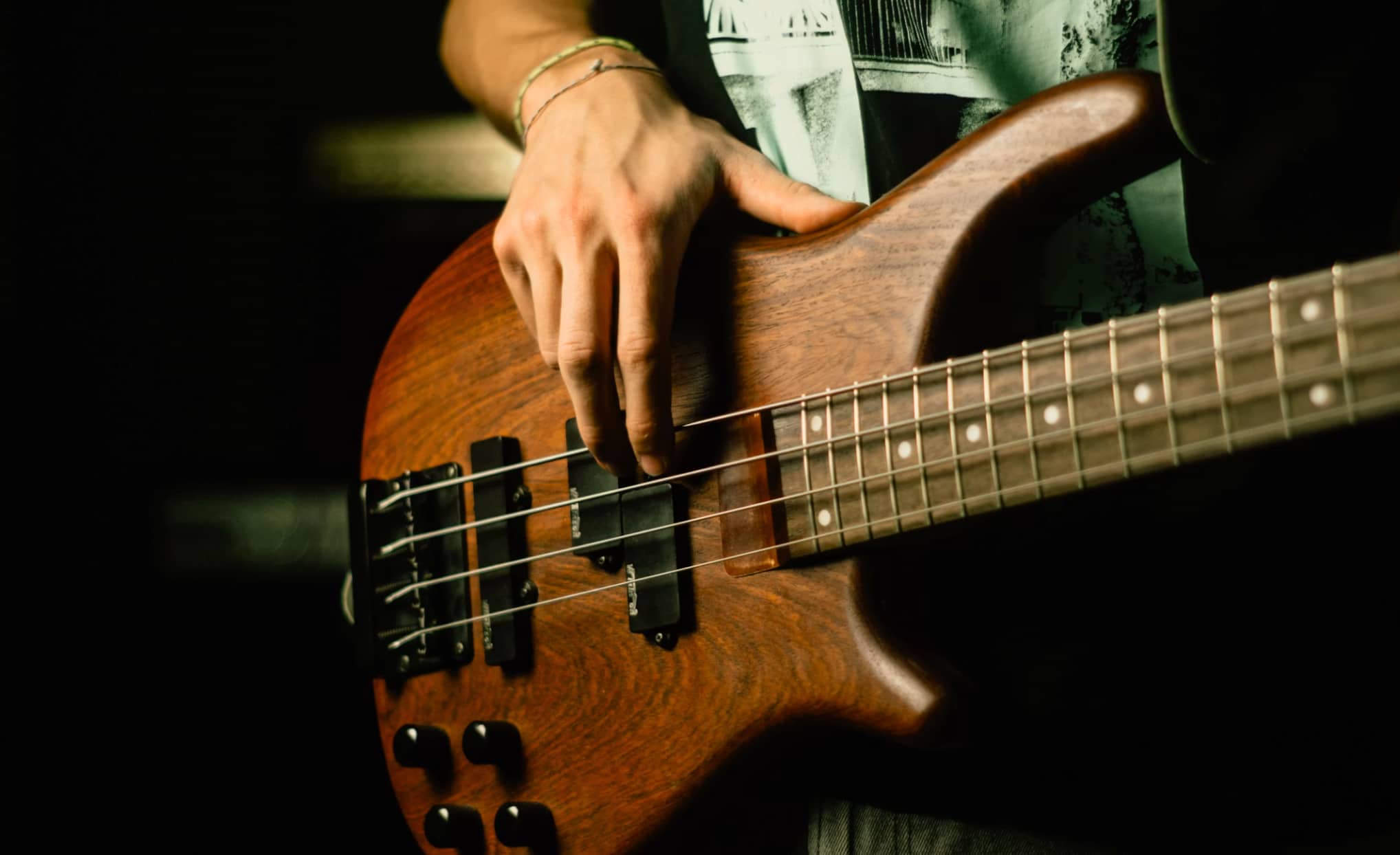
Fingerstyle (plucking with the pads of your first two fingers) tends to produce a warmer, rounder tone, and it is the standard approach in funk, soul, jazz, and most R&B, an approach closely associated with players such as James Jamerson and Marcus Miller
What Does Playing With a Pick Sound Like?
A pick produces a brighter, more percussive attack that cuts through a mix more easily, which is why it dominates in punk, most rock, and a lot of metal.
Which Should a Beginner Learn First?
- For a total beginner with no strong style preference yet, fingerstyle is usually the easier starting point.
- It builds a more direct feel for the string under your fingers and translates a little more naturally into good muting technique early on.
- If you already know you want to play punk or fast rock basslines, though, there is no real downside to starting with a pick from day one.
- Whichever you start with, most teachers will introduce the other within your first year, since being able to switch between them is genuinely useful rather than a nice-to-have.
What Mistakes Do Beginner Bass Players Make?
Once hand size, age, and technique are sorted, the mistakes that actually slow beginners down are almost all about timing and habits, not talent.
Skipping the Metronome
- It feels tedious early on, but timing is the one thing a bassist genuinely cannot fake.
- Students who avoid the metronome in their first few months almost always have to go back and fix timing habits later, which takes longer than building them correctly from the start.
Pro Tip: Start with the metronome slower than you think you need. Playing a simple bassline cleanly at a slower tempo builds better timing than rushing through it with mistakes.
Letting Other Strings Ring
- New players focus so hard on the string they are playing that they forget the others are still vibrating underneath.
- Learning to mute the strings you are not using, with your fretting hand, your plucking hand, or both, is what separates a clean, tight sound from a muddy one, and it is worth as much early attention as hitting the right notes.
Overplaying
- It is tempting to fill every gap with extra notes, especially once you can technically play more than a simple line.
- Good bass is usually about what you leave out.
- Locking in with the drummer and holding a simple part solidly tends to sound far better, and get you hired far more often than a busy one played inconsistently.
Only Practising in One Position
- If you always sit while practising, standing up with a strap on can feel like starting over, and vice versa.
- Getting comfortable in both positions early avoids a frustrating adjustment period later, especially once you start playing with other people.
Other Common Beginner Struggles
This list deliberately leaves out two of the most common early struggles, sore fingertips and wrist strain, along with the question of what amp to practise through. We cover all three in detail in How Do I Start Playing Bass? 5 Things to Know Before Your First Lesson.
Whatever age you or your child are starting at, an in-person assessment can help clarify readiness, including hand size, physical comfort and practice habits. A bass guitar teacher in Sydney can identify which areas are worth focusing on during the first lesson.
 September 30, 2026
Where Could I Find an Affordable Clarinet Teacher in Sydney?
TL;DR A limited monthly budget can still leave you with options for clarinet lessons in Sydney. Start with the price… September 26, 2026
Where to Actually Look Before You Buy an Instrument
The obvious first search usually isn't the right one. The instinct is almost always the same. A lesson gets booked,… September 23, 2026
What Should I Learn First on Piano? A Beginner’s Step-by-Step Guide
TL;DR Start by learning the keyboard pattern, a small group of notes, finger numbers and a steady beat. Practise a… September 23, 2026
How Much Does Logic Pro Cost for Beginners?
TL;DR Logic Pro is Apple's music production software for Mac. In Australia, Logic Pro for Mac costs $299.99 as a…