When people picture a musical instrument, they often imagine the sleek curves of a violin or the metallic shine of a saxophone. Sitting right at the back of the band, anchoring every chord with deep and warm tones, is the tuba. Because of its massive size and booming voice, many prospective musicians wonder if anyone can play the tuba without special physical abilities.
The short answer is a resounding yes. You do not need giant lungs, super-human physical strength, or years of prior music theory experience to pick up this magnificent brass instrument. With a dedicated tuba tutor, learning the tuba is far more approachable than most people expect, whether you want to play for fun at home, join a community band, or pursue music professionally.
What Is the Tuba?
The tuba is the largest and lowest-pitched member of the brass instrument family. First patented in the mid-19th century, it was engineered specifically to provide a rich and powerful bass foundation for military bands, brass ensembles, and symphonic orchestras.
Like all brass instruments, the sound of a tuba does not originate from inside the instrument body itself. It begins with the vibration of your lips. The player vibrates their lips together inside a cup-shaped metal mouthpiece, a fundamental brass technique known as buzzing. This vibration sends sound waves traveling through meters of coiled brass tubing. By pressing mechanical valves, either piston valves or rotary valves, the musician instantly lengthens or shortens the air path inside the horn, changing the pitch to produce different notes across a wide musical range.
Tubas come in several keys and configurations, most commonly BBb (B-flat), CC, Eb (E-flat), and F. The BBb tuba is the standard choice used in community bands, school programs, and traditional brass bands because its warm tone and forgiving pitch center make it exceptionally suitable for absolute beginners. The Eb tuba is also widely used across British-style brass bands, offering a slightly lighter frame and agile response. Meanwhile, CC and F tubas are smaller, higher-pitched orchestral models typically reserved for advanced conservatory students, soloists, and classical orchestral professionals.
From an acoustical standpoint, researchers studying brass wind instruments have explored how tube length and bore profile impact initial sound production. Studies on low-brass acoustics published in journals such as the Journal of New Music Research demonstrate that larger-bore BBb and Eb tubas provide lower acoustic impedance in the lower register. This allows beginners to establish consistent air column oscillations much more easily than on tighter, high-register brass instruments.
Is Tuba hard to learn for beginners?
It is a widespread misconception that the tuba is one of the most difficult brass instruments to master. In reality, many music educators consider it remarkably accessible compared to high-brass instruments like the French horn or trumpet.
Contrary to popular myth, playing the tuba effectively is about efficient airflow and breath management rather than sheer lung volume. You do not need massive lungs to sound good. Instead, you learn how to take deep and relaxed breaths using proper diaphragmatic control. Scientific research into brass and wind musicians highlights the unique relationship between instrument playing and respiratory mechanics. Studies on wind and brass instrumentalists, such as research by Studer et al. (2019) in PLOS ONE and Fuhrmann et al. (2011) in Respiratory Medicine, demonstrate that playing brass instruments relies heavily on specific breath control and continuous respiratory muscle engagement rather than abnormal anatomical lung size.
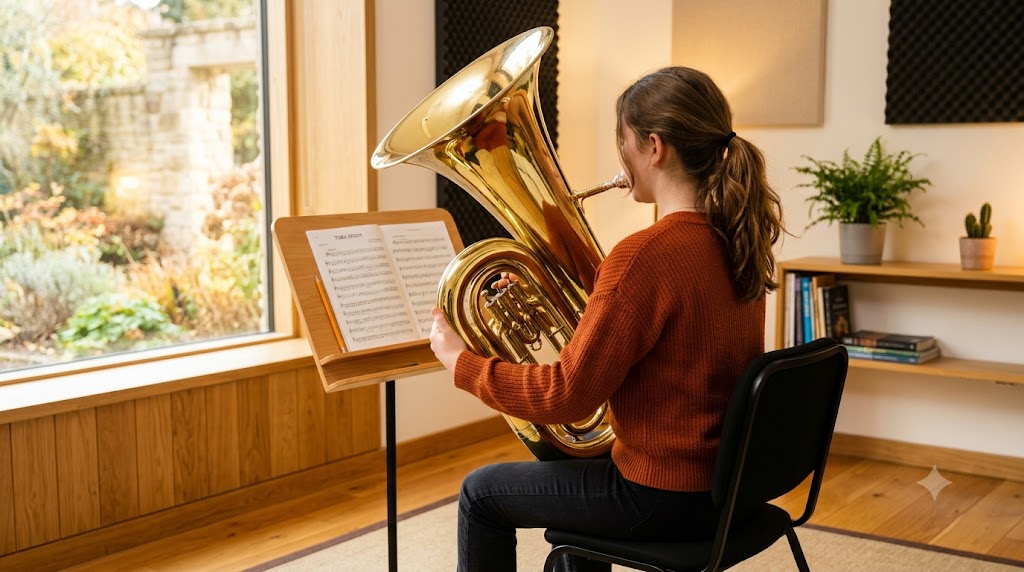
When it comes to physical strength, modern players rarely support the full weight of the horn solely with their arms. While seated, the tuba rests naturally on the player’s lap or on an adjustable floor stand. This allows players of all physical builds to practice comfortably without strain. Furthermore, unlike bowed string instruments which require precise finger placement just to play in tune, a tuba yields a resonant and satisfying tone as soon as you form a steady lip buzz. Most beginner students can produce their first clear notes during their very first practice session and learn basic songs within a couple of weeks.
Is the Tuba Suitable for students?
Parents often wonder if the tuba’s impressive size makes it impossible for children or young teens to learn. Younger students can certainly play the tuba, provided the instrument fits their physical frame. While a full-sized orchestral tuba can be overwhelming for a nine-year-old, the brass industry manufactures 3/4 size tubas (three-quarter size) and mini-brass models.
These compact instruments feature identical fingering systems and tonal qualities as full-sized models, but they are substantially lighter and easier to hold. Additionally, lap pads and specialized tuba performance stands eliminate instrument weight completely, allowing young players to focus entirely on posture and tone production without physical fatigue.
What can I learn in tuba beginning lessons?
In a beginner tuba curriculum, instruction focuses on building solid foundational habits before moving to complex repertoire. Early lessons place heavy emphasis on correct breathing techniques, teaching deep diaphragmatic inhalation alongside controlled air release. Tutors will also guide you through basic instrument assembly, proper valve lubrication, and comfortable holding posture.
Once comfortable holding the instrument, students learn how to form a relaxed lip shape (embouchure) to buzz into the mouthpiece. You will practice producing initial sound on open harmonic notes, learn basic valve fingerings, and work through simple rhythm drills designed to build immediate playing confidence and musical reading skills.
How much do Tuba cost?
Understanding the financial commitment involves looking at both tuition fees and instrument acquisition options. In major metropolitan areas such as Sydney, private tuba lesson rates generally range between $60 and $180 per hour depending on the teacher’s experience, qualifications, and lesson location. Most students pay between $90 and $130 per hour for a fully qualified and experienced low-brass tutor. Tutors with professional orchestral performance experience or advanced conservatory degrees typically charge higher rates, whereas online lessons are often slightly cheaper than in-home visits because travel time is excluded.
Lesson duration depends heavily on the student’s age and goals. A 30-minute lesson is ideal for young beginners who benefit from focused and shorter practice blocks. On the other hand, 45 to 60-minute lessons are recommended for teenagers, adults, and intermediate players who need ample time for technique, tone exercises, breathing drills, and piece preparation.
Instrument acquisition also offers flexible paths depending on your budget. Monthly rentals typically range from $50 to $100 per month, making it the best option for beginners testing their interest without a heavy commitment. Purchasing a reliable used student tuba usually costs between $1,500 and $3,500, while a brand-new entry-level tuba ranges from $3,500 to $6,000. Professional orchestral tubas used by conservatory students and symphony players can cost upwards of $10,000.
Can I play Tuba in apartments?
While an acoustic tuba can generate powerful sound when played unmuted, you do not need a soundproof house or a large basement to practice effectively at home.
Modern brass accessories have solved noise concerns for apartment dwellers. Electronic mutes, often called silent practice mutes, insert directly into the bell of the tuba. They dampen the physical sound down to a whisper while sending clear, uninhibited audio straight into your headphones. Furthermore, a compact 3/4-size student tuba sitting on a stand takes up minimal floor space, occupying no more room in a bedroom than a standard armchair.
Can I play the Tuba in an Orchestra or Pursue It as a career?
The tuba is far more versatile than many people realize. It goes well beyond simple “oom-pah” baseline rhythms, serving as a vital voice in dynamic musical styles across the globe. Because almost every large musical ensemble requires a solid low-frequency foundation, skilled tuba players are constantly in demand.
Symphony orchestras rely on the tuba to deliver the majestic, deep bass that underpins full orchestral works. Concert bands and traditional brass bands depend on it for both harmonic warmth and rhythmic momentum. In jazz and New Orleans brass bands, tubas play agile and syncopated basslines that drive the rhythm of the entire group. Modern film and video game scoring ensembles also rely heavily on low brass to create powerful, cinematic soundscapes.
Professional tuba players build sustainable careers through various avenues, including full-time orchestral playing, military bands, brass quintets, studio recording work, and private music teaching. Because fewer people pick up the tuba compared to guitar or piano, starting your tuba learning journey today means encountering less competition when auditioning for ensemble positions and professional gigs.
 September 30, 2026
Where Could I Find an Affordable Clarinet Teacher in Sydney?
TL;DR A limited monthly budget can still leave you with options for clarinet lessons in Sydney. Start with the price… September 26, 2026
Where to Actually Look Before You Buy an Instrument
The obvious first search usually isn't the right one. The instinct is almost always the same. A lesson gets booked,… September 23, 2026
What Should I Learn First on Piano? A Beginner’s Step-by-Step Guide
TL;DR Start by learning the keyboard pattern, a small group of notes, finger numbers and a steady beat. Practise a… September 23, 2026
How Much Does Logic Pro Cost for Beginners?
TL;DR Logic Pro is Apple's music production software for Mac. In Australia, Logic Pro for Mac costs $299.99 as a…