TL;DR
Start by learning the keyboard pattern, a small group of notes, finger numbers and a steady beat. Practise a simple five-note pattern with each hand before combining them. You do not need to memorise every key or read a full piece of sheet music before you begin playing.
The piano can look complicated when every white key seems identical and both hands are expected to do different things. The simplest starting point is much smaller: learn how the keys are organised, give each finger a number, find five notes and play them in an even rhythm.
If you are preparing for beginner piano lessons, these basics will also help you understand the language a teacher uses in the first few sessions. They are not a test you need to pass beforehand. Think of them as the first pieces of a map.
You can begin making sound straight away while learning notation gradually. Each new fact should connect with something you can see, hear or feel at the keyboard.
How Do I Find the Notes on a Piano?
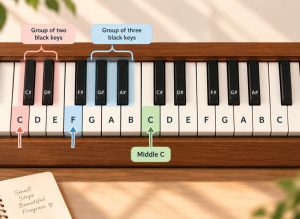
Begin with the black keys. They repeat in groups of two and three across the keyboard, giving you reliable landmarks among the white keys.
Find a group of two black keys. The white key immediately to its left is C. Moving to the right from there gives you C, D and E around that group. Find a group of three black keys and look to its left for F. The next white keys are F, G, A and B. After B, the pattern begins again at C.
This means you do not need to memorise dozens of separate keys. You are learning one seven-letter pattern that repeats at higher and lower pitches.
Where is middle C on a piano?
Middle C is the C near the centre of the keyboard. On a standard piano, look around the middle of the instrument for a group of two black keys, then choose the white key directly to their left. A smaller keyboard may place its central area differently, so use the repeating black-key pattern instead of relying only on the case or music stand.
Try this quick keyboard-map exercise:
- Find every group of two black keys.
- Play the C immediately to the left of each group.
- Return to middle C without counting up from the lowest key.
- Choose another C and name D, E, F and G as you move to the right.
Spend a minute or two on this at the start of practice. Once the pattern feels familiar, move on rather than turning note-finding into a long drill.
What Do Piano Finger Numbers Mean?
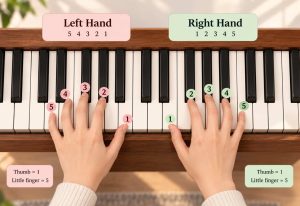
Piano fingering uses the numbers 1 to 5. On both hands, the thumb is 1, the index finger is 2, the middle finger is 3, the ring finger is 4 and the little finger is 5.
The matching numbers can feel odd at first because the hands are mirror images. When both hands rest on the keyboard, the two thumbs point towards each other, but both are still finger 1. The two little fingers are both finger 5.
| Finger | Left hand | Right hand |
|---|---|---|
| Thumb | 1 | 1 |
| Index finger | 2 | 2 |
| Middle finger | 3 | 3 |
| Ring finger | 4 | 4 |
| Little finger | 5 | 5 |
Finger numbers printed above or below notes suggest which finger to use. They are instructions for movement, not alternative note names. A written 3 does not mean the third white key. It means to play that note with your middle finger.
Keep the suggested fingering consistent while learning a short passage. Changing fingers on every attempt makes the movement harder to remember. However, fingering is not one rigid rule for every player. Hand size, the notes around a passage and the direction of the phrase can all affect a sensible choice. For your first exercises, consistency matters more than finding a supposedly perfect fingering.
Which Piano Notes Should a Beginner Learn First?
C, D, E, F and G around middle C make a practical first group. Place the right thumb on C, then let fingers 2, 3, 4 and 5 rest over D, E, F and G. Play each note slowly from C to G and back to C.
This is often called a five-finger position. It is a starting exercise, not a hand position you will use for every piece. As soon as music moves beyond those five notes, the hand may shift or the thumb may pass under another finger.
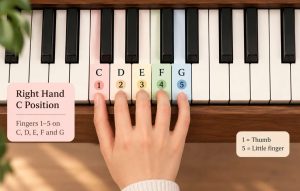
Tips: This five-note position is a practical starting exercise, not a hand position you will use for every piece.
At this stage, work on three things together:
- Location: find each note from the black-key pattern.
- Sound: listen for the steps rising towards G and falling towards C.
- Control: press one key at a time without holding down its neighbours.
Once C to G is comfortable, add A and B so you understand the complete repeating sequence. There is no benefit in trying to name all 88 keys as separate facts. The same seven letter names repeat throughout the instrument.
Do not rush into major scales simply because you can play five adjacent notes. A full scale introduces a change of hand position and a thumb movement that deserves its own careful explanation. First make sure you can find the notes, keep a steady pulse and release unnecessary tension between attempts.
Should Piano Beginners Practise One Hand at a Time?
Yes, when the notes, rhythm or movement are still unfamiliar. Practising one hand at a time reduces the number of decisions you need to make at once. It lets you notice a wrong note or awkward fingering before adding the coordination of the other hand.
That does not mean each hand must be perfect before you put them together. Use a short section, perhaps one or two bars, and follow this sequence:
- Play the right hand slowly enough to keep the rhythm even.
- Play the left hand at the same manageable speed.
- Check the first note and finger in each hand.
- Combine the hands for only that short section.
- If the beat breaks down, slow the section or separate the hands again.
A common mistake is to play a whole piece with the stronger hand many times, then give the other hand one hurried attempt. Give the less certain hand enough attention to understand its own pattern.
For a very simple exercise, such as both hands playing a single note together, you may try both hands straight away. Use separate-hand practice as a problem-solving tool, not a rule that delays every attempt at coordination.
Do I Need to Read Sheet Music Before Playing Piano?
No. You can find notes, copy a short pattern and begin developing control before you can read a complete score. It is still worth building reading skills from the beginning because notation helps you see pitch, rhythm and musical structure without relying on memory alone.
Learn reading in small pieces. Start with the fact that pitch is written on a five-line staff and that a clef gives those lines and spaces their note names. Then learn a few written notes near middle C and connect each one to the matching key. The open textbook Steps to Music Theory explains the staff, clefs and common note values if you want a source-based overview of those symbols.
Rhythm should develop alongside pitch. A crotchet (quarter note), minim (half note) and semibreve (whole note) show relative durations, but the time signature helps determine how beats are organised. Clap and count a rhythm before playing it. This separates the timing problem from the finger problem.
Try it in this order:
- Find two or three notes on the keyboard.
- Clap the written rhythm while counting aloud.
- Name the notes on the page.
- Play the short pattern slowly.
- Listen for an even pulse rather than racing to the end.
If you want to explore the notation in more detail, the existing beginner’s guide to reading sheet music covers that topic separately. For this first stage, two or three correctly connected notes are more useful than memorising every line and space without touching the keyboard.
What Should a Beginner Practise During a 15-Minute Piano Session?
Fifteen minutes is not a compulsory or scientifically perfect length. It is simply long enough to revisit several basics without turning the first routine into a test of endurance. If your teacher has given you a different plan, follow the plan designed for your music and current technique.
Here is a practical starting session:
| Time | Focus | What to do | What to check |
|---|---|---|---|
| 2 minutes | Keyboard map | Find several Cs, then name C to G. | Use the black-key pattern instead of counting from the bottom. |
| 3 minutes | Finger control | Play C to G and back with each hand separately. | Keep the wrist comfortable and release each key cleanly. |
| 3 minutes | Rhythm | Clap and count a short rhythm before playing it. | Keep the pulse even, including through longer notes. |
| 4 minutes | Short passage | Work on one or two bars, first separately and then together if ready. | Stop and isolate a repeated mistake instead of returning to the beginning. |
| 3 minutes | Complete attempt | Play the short exercise or piece once or twice. | Notice one improvement and one detail to revisit next time. |
A planned stopping point can make it easier to return with a clear task the next day. In a study of distributed practice in musicians’ keyboard learning, 29 non-pianist musicians learned a nine-note sequence in sessions separated by different intervals. The results suggested that longer intervals, including an overnight interval, could support aspects of accuracy and speed. The participants were musicians rather than complete beginners, so the study does not prove one ideal schedule for every new pianist. It does support treating learning as something revisited across sessions, not something that must be mastered in one sitting.
How do I know when to move on?
Move on when you can repeat the small task with reasonable control, not only when it works once by chance. For example, you might find middle C three times without counting every key, or play C to G twice with an even beat. If a movement causes pain, stop. A teacher can help adjust piano technique, but persistent pain, numbness or weakness needs advice from an appropriate health professional.
At first, aim for a dependable connection between a written or spoken instruction and an action at the keyboard. Once you can find a few notes, use consistent fingers and keep a simple pulse, short pieces become much easier to understand.
If you would like feedback on hand position, rhythm or what to practise next, the overview of private piano lesson across Sydney explains the available lesson formats. Either way, keep the next step small enough to hear, feel and repeat correctly.
 September 30, 2026
Where Could I Find an Affordable Clarinet Teacher in Sydney?
TL;DR A limited monthly budget can still leave you with options for clarinet lessons in Sydney. Start with the price… September 26, 2026
Where to Actually Look Before You Buy an Instrument
The obvious first search usually isn't the right one. The instinct is almost always the same. A lesson gets booked,… September 23, 2026
What Should I Learn First on Piano? A Beginner’s Step-by-Step Guide
TL;DR Start by learning the keyboard pattern, a small group of notes, finger numbers and a steady beat. Practise a… September 23, 2026
How Much Does Logic Pro Cost for Beginners?
TL;DR Logic Pro is Apple's music production software for Mac. In Australia, Logic Pro for Mac costs $299.99 as a…