TL;DR
- The circle of fifths arranges all 12 musical keys in a circle, each one a fifth apart from the next.
- Going clockwise adds one sharp at a time. Going anticlockwise adds one flat at a time.
- It tells you at a glance how many sharps or flats any key has, which saves memorising 15 key signatures.
- Keys next to each other on the circle sound good together, which is why it predicts chord progressions.
- You can learn to read it in about ten minutes. Using it fluently takes a few weeks.
The circle of fifths is the single most useful diagram in music theory, and also the one most likely to be shown to a beginner without explanation and then never mentioned again.
It looks complicated. It is not. It is a way of arranging the 12 musical keys so that the relationships between them become obvious, and once you can read it you have a shortcut for key signatures, chord progressions, transposing and working out what will sound good next. Here is what it means and how to actually use it, plus where music theory lessons fit in.
What is the circle of fifths?
The circle of fifths is a diagram of all 12 keys in Western music, arranged so that each key is a perfect fifth above the one before it.
Start at C at the top, which has no sharps and no flats. Count up five notes (C, D, E, F, G) and you land on G, which sits one step clockwise. Do it again from G and you get D. Keep going and you eventually work through all 12 keys and arrive back at C.
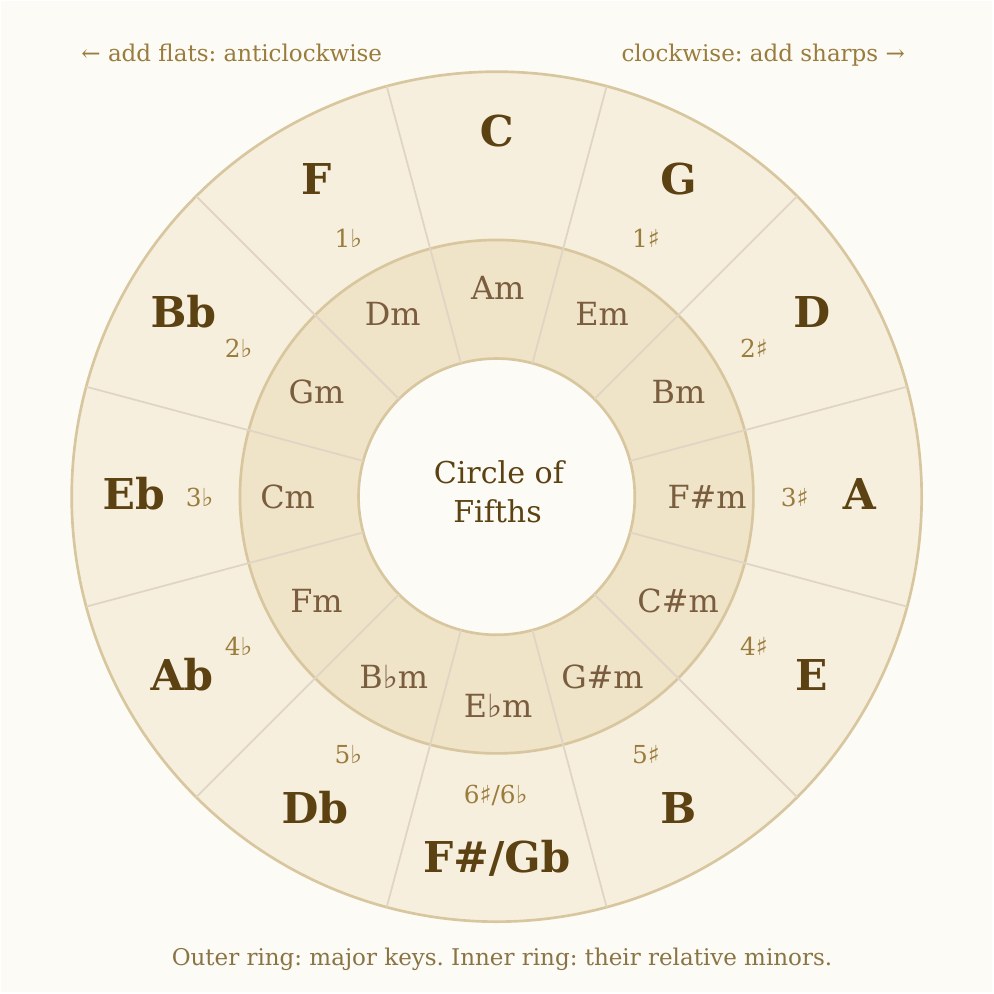
The circle of fifths. Outer ring shows major keys, inner ring shows their relative minors.
The reason this arrangement matters is that neighbouring keys are closely related. C and G sit next to each other and share every note but one. Keys on opposite sides of the circle share very few notes and sound distant from each other. The circle turns an abstract relationship into a picture.
How do you read the circle of fifths?
Three rules cover almost everything:
C is at the top and has no sharps or flats. It is the reference point for everything else.
Clockwise adds sharps. Each step clockwise adds exactly one sharp to the key signature. G has one, D has two, A has three, E has four, B has five, and F sharp has six.
Anticlockwise adds flats. Each step the other way adds one flat. F has one, B flat has two, E flat has three, A flat has four, D flat has five, and G flat has six.
At the bottom of the circle the two directions meet, which is why F sharp and G flat occupy the same position. They are the same pitches written differently, which musicians call enharmonic equivalents.
What is the inner ring on the circle of fifths?
The inner ring shows relative minors, and it is the half most beginners ignore.
Every major key has a minor key that shares its exact key signature. C major and A minor both have no sharps or flats. G major and E minor both have one sharp. They use the same notes and are written the same way on the page, but they centre on a different home note, which is why one sounds bright and the other sounds darker.
To find any relative minor without the diagram, count down three semitones from the major. C down three semitones is A. G down three is E. The inner ring simply saves you the counting.
This is genuinely practical. If you know a piece is in two sharps, the circle tells you instantly that it is either D major or B minor, and a glance at the last chord usually settles which.
What is the circle of fifths used for?
Four things, in rough order of how often you will use them:
- Key signatures. Instead of memorising 15 of them, you read them off the circle.
- Chord progressions. Neighbouring keys sound good together, so the circle predicts which chords will work.
- Transposing. Moving a song to a different key becomes counting steps around a circle.
- Modulation. When a piece changes key, it usually moves to a neighbour on the circle, which is why the change sounds smooth rather than jarring.
How does the circle of fifths help with chord progressions?
This is where it stops being theory homework and starts being useful.
Take any key on the circle, say C at the top. The key immediately clockwise is G, and the key immediately anticlockwise is F. Those three, C, F and G, are the three most important chords in the key of C, and they are literally adjacent on the diagram. Musicians call them the one, four and five chords.
That pattern holds everywhere on the circle. Pick any key, look at its two neighbours, and you have the three chords that sit at the heart of thousands of songs. Add the relative minor from the inner ring and you have four chords that will carry an enormous amount of popular music.
It also explains why certain progressions feel like they are pulling somewhere. Chord movements that travel anticlockwise around the circle create a strong sense of resolution, which is why so many songs and almost all of classical harmony are full of them.
What order do sharps and flats go in?
Sharps always appear in the same order, and so do flats. The circle of fifths generates both.
Sharps go F, C, G, D, A, E, B. A key with three sharps always has exactly F sharp, C sharp and G sharp, never a different combination.
Flats go in the reverse order: B, E, A, D, G, C, F. The first four spell the word “bead”, which is how most people remember it.
There is also a neat shortcut hiding in the diagram. For any sharp key, the last sharp in the key signature is one semitone below the name of the key. For any flat key with more than one flat, the second-to-last flat is the name of the key.
Do you need to memorise the circle of fifths?
Eventually, but not by rote and not straight away.
Most musicians absorb it through use rather than sitting down to memorise it. You look it up while working out a key, you use it to find chords for a song, and after a few dozen encounters you simply know that E major has four sharps without thinking about it.
If you do want to speed that up, learning the clockwise order as a sentence works well. Many students use “Father Charles Goes Down And Ends Battle” for the order of sharps, which read backwards also gives the order of flats.
The important thing is that you do not need to memorise it to benefit from it. Keep it in front of you while you practice and let the repetition do the work.
Is the circle of fifths hard to understand?
Reading it takes about ten minutes. Using it fluently takes a few weeks of bumping into it while you play.
The reason it feels hard is that it is usually taught in the wrong order, as a diagram to memorise before anyone explains what it is for. Approached the other way round, starting with “here are the three chords in your song and here is why they are next to each other”, it becomes obvious very quickly.
If you are getting stuck, the most likely problem is that you are learning it away from an instrument. Play the chords as you trace the circle and the relationships stop being abstract almost immediately. That is also the fastest way a teacher will fix it, since most circle of fifths confusion is one good explanation away from clearing up. You can compare and connect with music theory teachers and find one who suits how you learn.
 September 30, 2026
Where Could I Find an Affordable Clarinet Teacher in Sydney?
TL;DR A limited monthly budget can still leave you with options for clarinet lessons in Sydney. Start with the price… September 26, 2026
Where to Actually Look Before You Buy an Instrument
The obvious first search usually isn't the right one. The instinct is almost always the same. A lesson gets booked,… September 23, 2026
What Should I Learn First on Piano? A Beginner’s Step-by-Step Guide
TL;DR Start by learning the keyboard pattern, a small group of notes, finger numbers and a steady beat. Practise a… September 23, 2026
How Much Does Logic Pro Cost for Beginners?
TL;DR Logic Pro is Apple's music production software for Mac. In Australia, Logic Pro for Mac costs $299.99 as a…