Learning a new instrument can feel like a big step, but few instruments welcome newcomers quite like the ukulele. Warm, portable, and surprisingly versatile, this four-string instrument has grown into one of the most popular choices for beginners of all ages. Whether you want to play light hearted songs at family gatherings or simply add a creative outlet to your weekly routine, picking up the ukulele is one of the most accessible ways to start making music. If you are exploring options for ukulele lessons to guide your progress, knowing what to expect early on makes the whole process smooth and enjoyable. This guide walks through all the basics, from choosing your first instrument to understanding lesson costs and practice routines.
Is the ukulele easy to learn?
One of the main reasons people love the ukulele is its friendly learning curve. Compared to a standard steel-string acoustic guitar, the ukulele is much kinder on beginner hands. It uses soft nylon strings under relatively low tension, meaning you will not experience the heavy finger soreness that often discourages new guitar players during their first few weeks. The neck is slender, and the fret spacing is tight enough that you do not need to stretch your fingers awkwardly to reach basic chord positions.
Another big advantage of the ukulele is how quickly you can start playing recognizable music. With just two or three simple chord shapes, you can already play through dozens of popular folk and pop tunes.
Many beginners also ask whether they can sing and play at the same time. The answer is a resounding yes. Because beginner ukulele chord shapes require minimal finger gymnastics, your brain retains plenty of mental capacity to focus on pitch and lyric timing. Combining singing with simple strumming comes much more naturally on the ukulele than on almost any other accompaniment instrument.
What size ukulele should I buy?
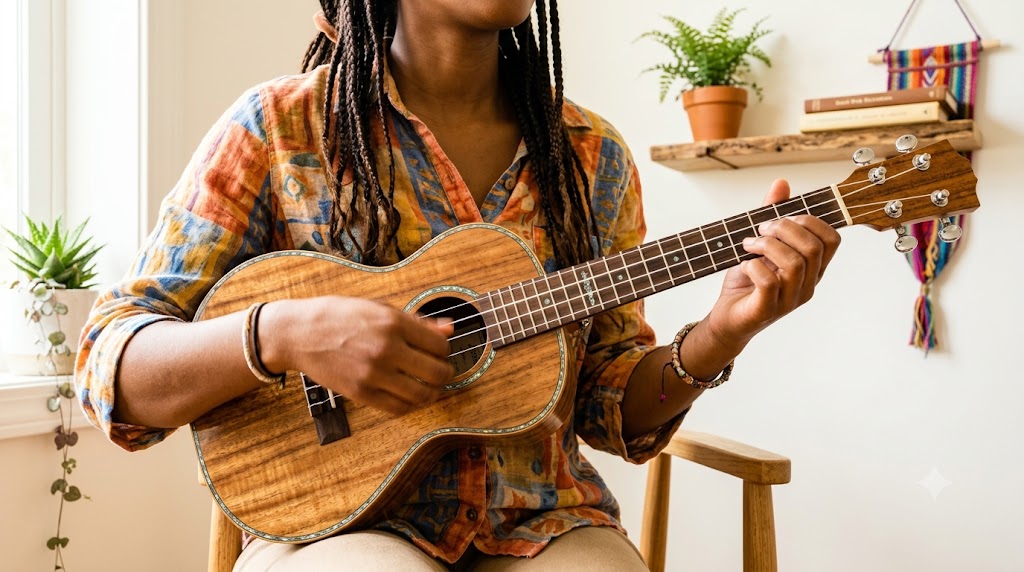
Ukuleles come in four primary sizes, but beginners generally choose between the three most common traditional models: Soprano, Concert, and Tenor. Each size offers a slightly different feel, fretboard spacing, and tonal tone.
Choosing the right fit comes down to your hand size, finger thickness, and the tone you prefer. The quick comparison table below outlines the differences so you can decide which one suits you best:
| Ukulele Size | Average Length | Fretboard Feel | Sound Profile | Best Suited For |
| Soprano | 53 cm (21 inches) | Compact fret spacing; requires smaller finger adjustments | Classic, bright, high-pitched traditional ukulele sound | Children, smaller hands, or anyone wanting maximum portability |
| Concert | 58 cm (23 inches) | Moderate fret spacing; comfortable for most adult fingers | Balanced, warm tone with slightly more volume than Soprano | Most adult beginners; the most versatile starting choice |
| Tenor | 66 cm (26 inches) | Roomy fretboard spacing; closest to acoustic guitar feel | Deeper, richer resonance with fuller projection | Players with larger hands or adults wanting more finger room |
For most adults starting out, a Concert ukulele strikes the perfect sweet spot between physical comfort and that traditional acoustic ukulele warmth. However, if you have larger hands, stepping up to a Tenor can give you the extra breathing room you need across the frets.
Do I need expensive gear to start?
Starting out on the ukulele is surprisingly light on the wallet. You do not need top-shelf equipment or hundreds of dollars in gear to get a proper start.
A reliable, good-quality beginner ukulele from a reputable brand usually costs between $60 and $150. In this price range, you get an instrument made with straight fretwork and reliable tuning pegs that hold pitch properly. It is best to avoid ultra-cheap instruments priced around $20 or $30. These cheap models are often closer to toys than genuine instruments. They suffer from high string action—meaning the strings sit too high off the fretboard—making them uncomfortable to press down, and they rarely stay in tune for more than a few minutes.
Alongside your ukulele, you only need two basic accessories:
- A simple clip-on digital tuner (around $15 to $20)
- A padded gig bag (often included with the instrument)
When you are ready to build proper playing habits, taking structured weekly lessons is the most reliable path forward. Current rates for individual ukulele lessons generally range from around $100 to $130 per hour.
Several factors influence where a teacher’s rate falls within that $100 to $130 per hour window:
- Teacher Experience and Qualifications: Tutors with music performance degrees or decades of teaching experience naturally charge higher rates.
- Lesson Duration: Many beginners start with 30-minute individual sessions ($50 to $65 per half hour), which work out to the same hourly rate while keeping weekly costs manageable and keeping attention sharp.
- In-Person vs Online: In-person private sessions at a dedicated studio or in-home setup often sit at the higher end of the range compared to online lessons due to location and studio overheads.
Do I need to read sheet music?
A common worry among new music students is whether they need prior experience reading traditional notation (treble clef and dots on five staff lines). For the ukulele, the simple answer is no.
Ukulele music for beginners relies almost entirely on two straightforward, visual reading systems:
- Chord Diagrams: Simple grid pictures showing exactly where to place your fingers on the four strings to form a chord.
- Ukulele TAB (Tablature): Four horizontal lines representing the four strings, with numbers on the lines indicating which fret to press.
Because chord diagrams and TAB are purely visual, virtually every beginner learns to read them within the first five minutes of their first lesson. You do not need to memorize staff lines or note values to start strumming complete songs right away.
What can I actually learn in ukulele lessons?
While self-teaching apps and online videos exist, structured lessons provide hands-on feedback that stops bad physical habits before they turn into permanent muscle memory. In your early lessons, a qualified teacher guides you through fundamental building blocks, including:
- Holding Posture and Hand Alignment: Supporting the instrument against your body comfortably without strangling the neck or straining your wrist.
- Fretting Technique: Pressing clean notes right behind the fret wire using the tips of your fingers to eliminate buzz.
- Core Chord Vocabulary: Mastering the foundational chord set—C major, G major, A minor, and F major. These four simple chords unlocked literally hundreds of famous pop, rock, and folk tunes.
- Strumming Patterns and Timing: Developing a relaxed wrist action and keeping steady time with basic down-and-up strumming movements.
The value of structured learning goes beyond just picking up chords. Research highlights how structured guidance impacts skill development. In a widely cited educational study on music learning, Professor Susan Hallam (Hallam, 2010, International Journal of Music Education) demonstrated that short, frequent, and structured music practice routines dramatically accelerate motor skill retention and auditory processing compared to unstructured solo attempts. Regular feedback ensures that your practice time builds accurate muscle memory efficiently.
How long until I can play songs?
Because the ukulele is so approachable, your progress starts accumulating almost immediately. While everyone learns at their own pace, a standard timeline with consistent practice looks like this:
Weeks 1 to 2
You learn how to tune your ukulele, hold it comfortably, and press down notes cleanly. You master your first two basic chords (usually C and Am) and strum through very simple rhythmic patterns.
Months 1 to 2
You expand your chord library to four or five core shapes (adding G and F). You practice transitioning between these shapes without stopping the rhythm, allowing you to play through full basic songs from start to finish while singing along softly.
Months 3 to 6
Your strumming becomes fluid, natural, and rhythmic. You start exploring varied strum patterns, muted beats, simple fingerpicking styles, and higher fret positions. At this stage, you have built a solid foundation that allows you to pick up new songs independently.
The ukulele is one of the most rewarding instruments you can pick up. Its gentle learning curve, affordable equipment entry point, and instant fun factor make it a fantastic choice for anyone wanting to experience the joy of playing music. By starting with a properly fitted Concert or Tenor instrument, learning via simple chord diagrams, and maintaining consistent weekly practice, you can easily master your favourite songs within a matter of weeks. If you are looking to start learn ukulele for beginners or want to book flexible beginner ukulele lessons, working with a dedicated tutor is the fastest way to build confidence, polish your technique, and enjoy making music from day one.
 September 30, 2026
Where Could I Find an Affordable Clarinet Teacher in Sydney?
TL;DR A limited monthly budget can still leave you with options for clarinet lessons in Sydney. Start with the price… September 26, 2026
Where to Actually Look Before You Buy an Instrument
The obvious first search usually isn't the right one. The instinct is almost always the same. A lesson gets booked,… September 23, 2026
What Should I Learn First on Piano? A Beginner’s Step-by-Step Guide
TL;DR Start by learning the keyboard pattern, a small group of notes, finger numbers and a steady beat. Practise a… September 23, 2026
How Much Does Logic Pro Cost for Beginners?
TL;DR Logic Pro is Apple's music production software for Mac. In Australia, Logic Pro for Mac costs $299.99 as a…