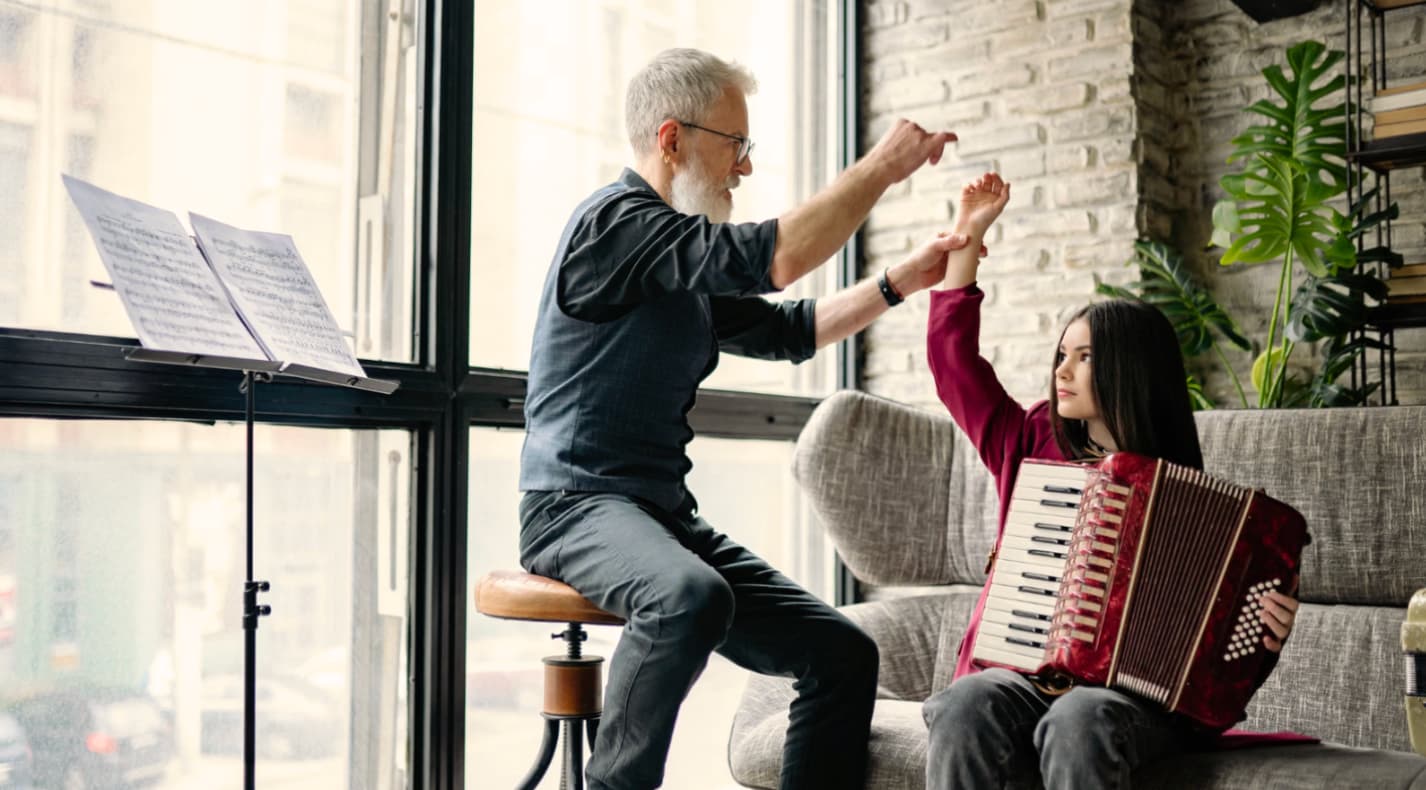
The accordion is approachable for beginners, but it can feel unusual at first. The right hand plays the melody, the left hand controls bass notes and chords, and the left arm moves the bellows. Each task is manageable on its own. The real challenge is combining them without rushing or tensing your shoulders.
For anyone considering accordion lessons in Sydney, it helps to understand where the difficulty comes from. Most beginners are simply coordinating several unfamiliar movements at once. Once those movements are separated and practised slowly, the accordion becomes more predictable.
TL;DR:
- You do not need music theory before you begin.
- Bass buttons and two-hand coordination usually take the most time.
- Many beginners can play a simple right-hand melody within a few weeks.
- Playing a complete beginner piece often takes a few months.
- Fifteen to thirty minutes of focused practice on most days is a useful starting point.
Accordion Myths vs Reality
| Myth | Reality |
| Accordion is too difficult for beginners. | Coordination is challenging at first, but most beginners improve steadily with regular practice. |
| You need music theory first. | Basic theory can be learned alongside playing. |
| Strong hands are essential. | Technique matters much more than strength. |
Can I Learn Accordion Without Music Theory?
Yes. You do not need to read music or understand key signatures and chord theory before starting. Early learning can focus on listening, simplified notation and clear finger patterns, with the explanation of why those patterns work added gradually.
The left hand looks more theoretical than it is. In the Stradella system, bass notes and ready-made major, minor and other chords follow a fixed pattern based on the circle of fifths. Beginners learn a few neighbouring shapes by touch rather than calculating each chord. You can start with the C bass and add nearby buttons gradually.
A real example comes from Irish-American button accordionist Joe Derrane, who was later named a National Endowment for the Arts National Heritage Fellow. In an NEA interview, Derrane recalled starting at age ten on a ten-button accordion. His teacher used numbered tablature to show which button to press and whether to push or pull the bellows, while concentrating on clean, precise notes. His experience shows how a beginner can develop practical playing skills before studying formal theory in depth.
Reading music still becomes useful when you want to learn from a wider range of sheet music, but it is not always an entry requirement. The AMEB NSW Accordion syllabus currently offers Repertoire exams from Preliminary to Grade 8 by video submission, without separately examining technical work, general knowledge, aural tests or sight-reading. That does not make notation unimportant, but it shows that performance skills and theory can be developed in stages.
What Is the Hardest Part of Learning Accordion?
Two things come up again and again with new students, and they usually show up at the same time.
The first is hand independence. Your right hand plays a melody it can see. Your left hand plays bass and chords it genuinely cannot see, because the buttons sit underneath your palm and forearm. You learn the left hand almost entirely by feel, which is a different kind of memory to reading a keyboard, and it takes real repetition before the two hands stop fighting each other. It is common for a student to play the left-hand pattern perfectly on its own, then have it fall apart the moment the right hand joins in. That is not a sign of a bad ear. It just means the two hands have only practised separately so far, which is a different skill to playing them together.
The second is belows control. The bellows supply the air that makes any sound at all, so how you manage their speed and direction affects volume, phrasing, and how in tune individual notes sound. Push too hard and a phrase sounds rushed and loud. Run out of bellows mid-phrase and the sound thins out or cuts off. On a piano or guitar, the instrument’s tone stays fairly consistent regardless of technique. On accordion, bellows work is part of the music itself, not a separate mechanical step.
A common beginner experience looks like this:
- The right-hand melody works by itself.
- The left-hand bass pattern works by itself.
- When both hands are combined, the rhythm becomes uneven.
- The student tries to fix the problem by playing faster.
- The coordination becomes less stable.
Pro tip:
- The solution is usually to make the task smaller.
- Practise one or two bars slowly.
- Play the right hand alone, then the left hand alone, then combine them without increasing the tempo.
The bass buttons become easier once their repeated pattern starts to feel familiar. On a standard bass system, nearby rows provide single bass notes and ready-made chord types.
Beginners do not need to memorise the entire layout. They can start around the C bass button, which is often textured or marked, and gradually add nearby chords.
Bellows control also improves through simple exercises. Holding one note while opening and closing the bellows slowly teaches steadiness. Adding a basic bass pattern then teaches the arm to move without disturbing the hand.
Most students say things “click” somewhere around the two to three month mark, once the left-hand shapes stop being something they think about and start being something their hand just does.
How Long Does It Take to Learn Accordion?
There is no single timeline. Progress depends on practice frequency, previous musical experience, the type and size of the accordion, and the music you want to play. The following milestones are a realistic guide, not a guarantee.
| Typical BeginnerTimeline | Possible beginner milestone |
| Week 1 to 2 | Hold the instrument comfortably, control the bellows without jerking, play single notes with the right hand |
| Week 3 to 6 | Play a simple full melody with the right hand alone |
| Month 2 to 3 | Add basic left-hand bass and chords under an easy right-hand melody |
| Month 4 to 6 | Coordinate both hands more smoothly across a handful of songs |
| Month 6 to 12 | Play a broader mix of beginner to early-intermediate pieces with steadier bellows control |
Every learner progresses differently, so these milestones should be treated as general expectations rather than fixed deadlines.
These numbers assume short, regular sessions rather than the occasional long one. A 10-year-old practising 20 minutes a day and a 45-year-old practising 20 minutes a day tend to land in roughly the same place after three months, even though the two of them get there in different ways. Prior musical experience can help, but it does not remove every challenge. Pianists often recognise the right-hand notes quickly. Guitarists may already understand chords, and drummers may have a strong sense of pulse. All still need to learn the accordion’s bellows and left-hand layout.
If your goal is casual playing at family get-togethers, that is realistic within a year. If you are aiming for AMEB exams or performance-level playing, that is a multi-year path, the same as it would be on any instrument.
What Should I Prepare Before My First Accordion Lesson?
You do not need to memorise the keyboard or study theory before your first lesson. Practical preparation is more useful.
Before your lesson, check these five things:
- Bring a playable instrument. Check whether the keys or buttons sound and whether the bellows hold air reasonably well.
- Know what type of accordion you have. Piano, chromatic button and diatonic accordions use different right-hand systems.
- Adjust the straps roughly. The instrument should sit securely without pulling your shoulders forward.
- Choose one or two goals. This could be a style, a song or simply learning for enjoyment.
- Bring your accessories. Include the case, straps and any sheet music you already have.
Do not worry if you have not bought an instrument yet. It is sensible to get advice before choosing the right accordion for a beginner because weight, keyboard size and bass range affect comfort. A large instrument is not automatically better.
It is also worth considering how much it costs to learn accordion in Sydney before buying. The instrument, case, straps, maintenance and lessons can all form part of the total budget.
What a first lesson may include
- Checking posture and strap position
- Opening the bellows without lifting the shoulder
- Finding the air button
- Playing three to five right-hand notes
- Locating the C bass button
- Trying a short melody or rhythm
The aim is to leave with a small task that can be repeated correctly at home, not to cover the entire instrument in one session.
How Much Practice Does the Accordion Require?
For a complete beginner, fifteen to thirty minutes of focused practice on five or six days each week is a practical starting point. Children or students using a heavy instrument may begin with shorter sessions. Adults can practise longer if they remain relaxed, but extra time is not useful once posture and rhythm begin to deteriorate.
A simple 30-minute accordion practice routine
| Time | Practice task |
| 5 minutes | Check posture and practise relaxed bellows movement |
| 5 minutes | Play a right-hand pattern or short melody |
| 5 minutes | Find bass and chord buttons without looking |
| 10 minutes | Practise one difficult section with both hands |
| 5 minutes | Play a complete piece and note what needs work |
This structure prevents a common problem: playing a piece from beginning to end repeatedly without fixing the difficult section. Practise slowly enough to identify whether the mistake comes from the melody, bass buttons, rhythm or bellows direction.
When learning accordion at home, stop if you notice sharp pain, numbness or increasing tension. Mild tiredness can occur while adjusting to the instrument’s weight, but pain should not be treated as a normal part of progress. Check the straps, instrument position and session length before continuing.
Three signs your practice is working
- You find familiar bass buttons with less searching.
- Bellows changes happen at planned points rather than when you run out of space.
- You can repeat a short section correctly several times.
The accordion is not effortless, but beginners do not need advanced theory, exceptional hand strength or hours of daily practice. They need a suitable instrument, patient repetition and a method for separating complex movements into smaller tasks.
Consistency counts for more than duration. A student who practises four short sessions a week for three months will generally get further than a student who fits the same number of minutes into two long weekend sessions, because the short daily version keeps the coordination fresh between lessons instead of forcing a partial relearn each time.
Like most instruments, the accordion becomes easier once the movements stop feeling new. The biggest difference between beginners who progress steadily and those who become frustrated is usually consistency rather than natural ability. A few focused practice sessions each week are often more valuable than one long session every now and then.Whether practising independently or working with a Sydney accordion teacher, the same principles apply: start slowly, stay relaxed and build one skill at a time.
 September 30, 2026
Where Could I Find an Affordable Clarinet Teacher in Sydney?
TL;DR A limited monthly budget can still leave you with options for clarinet lessons in Sydney. Start with the price… September 26, 2026
Where to Actually Look Before You Buy an Instrument
The obvious first search usually isn't the right one. The instinct is almost always the same. A lesson gets booked,… September 23, 2026
What Should I Learn First on Piano? A Beginner’s Step-by-Step Guide
TL;DR Start by learning the keyboard pattern, a small group of notes, finger numbers and a steady beat. Practise a… September 23, 2026
How Much Does Logic Pro Cost for Beginners?
TL;DR Logic Pro is Apple's music production software for Mac. In Australia, Logic Pro for Mac costs $299.99 as a…