It’s a fair question to ask before spending money on lessons. The clarinet is learnable, the internet is full of free tutorials, and plenty of beginners prefer to go at their own pace. But the instrument has a few specific quirks that make self-teaching genuinely harder than it looks, and the problems that develop in the first few months tend to stay for years if nobody catches them.
That being said, if you want to start finding options for good teachers, you can compare clarinet teachers and find a teacher that suits your goals.
What’s the Real Difference between Self-Learning and Taking Lessons?
Both paths will teach you clarinet. The difference is how long it takes, how much frustration you carry, and what your tone sounds like at the end of twelve months.
| Factor | Self-Teaching | With a Teacher |
| Cost | Low upfront — just the instrument and free resources | $40–$80 per half-hour lesson weekly |
| Embouchure feedback | None — you can’t hear your own problems | Corrected in real time, often in the first few lessons |
| Squeaks and tone issues | Diagnosed slowly, often incorrectly | Usually diagnosed in one lesson |
| Crossing the break | Common plateau point — can take months to get past | Targeted exercises cut this down to two to four weeks |
| Progress speed | Steady for the first month, then often stalls around month two | Continuous progress with clear short-term goals |
| Bad habits | Set quickly and hard to unlearn | Caught before they become habits |
| Motivation | Depends entirely on self-discipline | Weekly lessons create natural accountability |
| Flexibility | Practice whenever you like | Requires scheduling around lesson times |
The honest summary: self-teaching works well for theory and music reading. It works poorly for embouchure, tone, and anything that requires someone to watch your hands and mouth.
Why should I find a teacher?
The clarinet is not like guitar, where strumming a chord gives you instant feedback that you’ve done something right. The instrument only responds when your lip pressure, jaw position, and air support all line up at once. When something’s off, it produces a squeak which doesn’t tell you which of the three things went wrong.
This is the core problem with self-teaching clarinet:
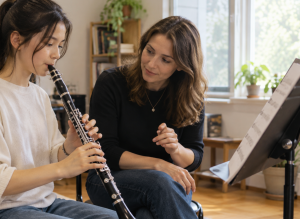
- Embouchure mistakes are invisible to you. You can watch your hands, but you can’t watch your own mouth. A teacher spots in thirty seconds what a YouTube video can’t diagnose at all.
- Bad habits compound fast. The most common self-taught error is biting and clamping the bottom jaw to get a sound out. It works temporarily, but it kills your tone and becomes almost automatic within a few weeks. Unlearning it later is genuinely hard.
- The break is where most self-taught players stall. Crossing from the lower to upper register requires coordinating several finger movements simultaneously without changing your embouchure or air. Most students need two to four weeks of focused, guided practice to get it clean. Without guidance, students often develop workarounds like over-blowing or biting the reed, which cause problems for years afterwards.
- Tone plateaus around month two. Without external feedback, small embouchure issues compound and tone stops improving even with more practice. It feels like you’re getting worse, but actually the same technical issue is just becoming more entrenched.
A teacher doesn’t just teach you what to do. They watch what you’re already doing and tell you what to change. That’s the thing the internet genuinely cannot replicate.
When should I start finding a teacher?
As soon as possible, which means before week three when bad habits start forming.
If you haven’t started yet: Start with a teacher from lesson one. The first two weeks set your embouchure, and getting those physical habits right from the beginning is significantly easier than fixing them later. A bad early habit on clarinet isn’t a minor inconvenience, it can actively hold back your tone for years.
If you’ve been self-teaching for a few weeks: Now is still a good time. You’re still early enough that a teacher can correct what’s there without too much undoing. The longer you leave it, the more ingrained the patterns become.
If you’ve been self-teaching for two to three months and you’ve hit a plateau: This is actually the most common moment when self-taught players finally look for help. The squeaks haven’t improved, tone has stopped progressing, and the break feels impossible. A teacher can usually diagnose the issue quickly and that plateau is exactly what structured lessons are designed to break through.
If you played years ago and are picking it back up: You’ll likely progress two to three times faster than a true beginner because your muscle memory and music reading come back quickly. But your embouchure still needs to rebuild, and a teacher can make sure you’re not reinforcing old bad habits from the first go-around. Most returning players are back to their previous level within two to three months with guidance.
There’s no point in self-teaching waiting until you’ve “learned the basics” first. The basics are exactly what a teacher teaches best, and they’re exactly what’s hardest to self-correct once they’re wrong.
What you should learn first if you’re teaching yourself clarinet?
If you’re committed to starting alone, the order you learn things in matters more than what you learn. The single biggest mistake self-taught beginners make is jumping to songs too early, because songs feel like progress but they skip the foundation that makes everything else easier.
Step 1: Get your embouchure right first.
Understand what your bottom lip should be doing, how much mouthpiece to take in, and what steady air support actually feels like. There’s no shortcut here.
Step 2: Produce clean, sustained notes before anything else.
Spend the first week just on long tones in the lower register. One clean, even note held for several seconds is more valuable than playing three songs badly.
Step 3: Learn the chalumeau register thoroughly.
Get comfortable with every note in the lower register before you touch the upper register at all. Scales, long tones, simple exercises, all in the lower range until it feels genuinely easy.
Step 4: Keep your tone even before speeding up.
Get your scales clean and treat long tones as a daily non-negotiable rather than something you do when you feel like it.
Step 5: Leave the break until you’re ready.
The transition to the upper register can wait until the lower register feels comfortable, which for most self-taught players takes two to three months. Rushing it is the single fastest way to develop the bad habits that are hardest to fix later.
Can I switch to lessons after self-teaching for a while?
Yes, and it’s more common than you’d think. Most teachers are used to taking on students who’ve had a few months of self-directed practice, and a good one won’t make you feel bad about the habits you’ve picked up. What they will do is spend the first lesson or two identifying what’s working and what needs to change before moving forward.
The main thing to expect is some undoing before you progress. If you’ve been self-teaching for two to three months, there’s a reasonable chance you’ve developed at least one compensating habit. Most common habits include biting the reed, holding tension in the jaw, or using finger pressure to cover for air support problems. These aren’t character flaws, they’re just what happens when the instrument isn’t giving you feedback and you find what works in the short term. A teacher will spot them quickly and give you specific fixes.
A few things that help the transition go smoothly:
- Be upfront about your background. Tell your teacher how long you’ve been playing, what you’ve been working from, and where you feel stuck. The more context they have, the faster they can help.
- Don’t be discouraged if early lessons feel remedial. Going back to long tones and basic embouchure work after you’ve already been playing songs is frustrating, but it’s the fastest path forward.
- Expect two to four weeks of adjustment. Most switchers find that once the foundational issues are corrected, they progress noticeably faster than someone starting from scratch because the motivation is already there and the instrument isn’t completely foreign.
Where do most self-taught clarinet beginners get stuck?
The stuck points are predictable, and they almost always happen in the same order.
The first is the squeak phase. The first two to three weeks where the reed and embouchure aren’t cooperating yet. Most self-taught players get through this on stubbornness alone, which is fine.
The second stuck point is where it gets costly. Around month two, tone stops improving. You’re playing more notes, getting through more songs, and putting in the practice time but something sounds off and you can’t identify what. This is almost always a small embouchure issue that has quietly become a habit. Without someone watching, it’s nearly impossible to self-diagnose because the problem is in how your mouth feels, not how the note sounds to you in the room. By the time most self-taught players notice the plateau, the habit is already set.
The third stuck point is the break, which is the transition between the lower and upper registers. Crossing it cleanly requires coordinating several finger movements at once without disturbing your embouchure or air support. Self-taught players often get partway there and then stall for months, or develop a workaround like overbowing or biting that gets them over the break but creates a new problem. None of these stuck points are insurmountable alone, but all three of them dissolve quickly with a teacher. That’s the honest trade-off.
Self-Teaching vs Lessons: Which One Is Right for You?
To be honest, neither path is wrong. It’s just that they just suit different people in different situations. The more useful question isn’t which one is better in theory, but which one actually matches how you learn, what your goals are, and how much time you’re realistically willing to invest.
Self-teaching makes sense if you’re disciplined enough to practice consistently without external accountability, have a strong ear, and are approaching clarinet casually without a specific performance goal in mind. It also works reasonably well if you’ve played another wind instrument before, since embouchure and air support won’t be completely foreign concepts. The trade-off is slower progress, a higher chance of developing habits that are hard to undo, and no one to tell you why the squeak keeps happening.
Lessons make sense if you’re a complete beginner, have a specific goal you’re working toward, or have already been self-teaching and feel like you’ve stopped improving. They’re particularly worth it in the first six months, when the foundational habits are still being set and small corrections make a disproportionate difference to where you end up twelve months later. For children especially, the structure and weekly accountability of lessons is often what keeps motivation alive past the early frustrating stage.
The middle path which is starting with a teacher for the first three to six months, then continuing independently once the fundamentals are solid works best for most adult beginners. You get the early technical guidance when it matters most, and the freedom to go at your own pace once the foundation is there.
 September 30, 2026
Where Could I Find an Affordable Clarinet Teacher in Sydney?
TL;DR A limited monthly budget can still leave you with options for clarinet lessons in Sydney. Start with the price… September 26, 2026
Where to Actually Look Before You Buy an Instrument
The obvious first search usually isn't the right one. The instinct is almost always the same. A lesson gets booked,… September 23, 2026
What Should I Learn First on Piano? A Beginner’s Step-by-Step Guide
TL;DR Start by learning the keyboard pattern, a small group of notes, finger numbers and a steady beat. Practise a… September 23, 2026
How Much Does Logic Pro Cost for Beginners?
TL;DR Logic Pro is Apple's music production software for Mac. In Australia, Logic Pro for Mac costs $299.99 as a…