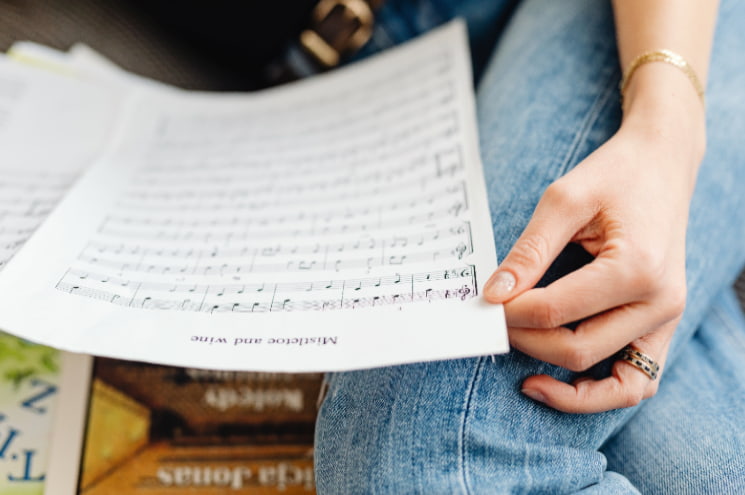
Why Reading Music Isn’t as Hard as You Think
Stepping into the world of music theory can feel like trying to learn a completely foreign language. Many new musicians delay learning an instrument simply because they are intimidated by reading notation.
The truth is, sheet music is just a highly visual map designed to tell your fingers exactly what to do.
Once you understand the basic layout, the symbols transform from confusing marks into a straightforward, logical system. Developing this skill early on is an incredible way to build your confidence. Enrolling in personalised piano lessons can give you the hands-on guidance needed to turn these written symbols into real music.
A Practical Skill—Not a “Gift”
For generations, music notation has been taught in rigid ways that focus on boring memorisation instead of creative fun. This leaves a lot of aspiring players feeling like they just lack “natural talent.”
But reading music is a practical skill, not a genetic trait. It is exactly like learning how to read a book or follow a transit map.
How the Music Page Actually Works:
Think of a sheet of music as a simple grid for time and pitch:
Time (Left to Right): The horizontal layout shows the steady flow of time as you play through a piece.
Pitch (Up and Down): The vertical layout simply tells you how high or low a note sounds.
Once your brain recognises this basic coordinate system, the anxiety fades away. You stop looking at a chaotic field of black dots and start seeing a beautifully organised set of musical instructions!
How to read sheet music for beginners
The foundation of all sheet music is the staff, which consists of five horizontal lines and four open spaces. Think of the staff as a musical ladder. Every single line and space represents a specific pitch. If a note is placed on a low line, it represents a deep, bass frequency. As notes climb higher up the lines and spaces, the pitch becomes brighter and sharper. This visual mapping means you can instantly tell the direction of a melody just by glancing at the shape of the line, even before you know the exact names of the notes.
To give these lines and spaces specific meaning, we place a symbol called a clef at the very beginning of the staff. The clef acts as a master key or a visual cipher that tells you exactly which notes belong to which lines. For higher-pitched instruments and melodies, we use the treble clef. For lower-pitched instruments and basslines, we use the bass clef. Together, these two grids form a massive ecosystem that can map every single sound an instrument can produce.
Learning to navigate this grid without constantly second-guessing yourself is all about breaking down the visual information into small, digestible chunks. Instead of trying to memorise all eleven lines and spaces simultaneously, smart players focus on identifying a few key “landmark notes.” Once you can locate these landmarks instantly, you can easily deduce any other note on the page simply by counting up or down one step at a time.
Tips for Notation Beginners
- The Staff is a Ladder: The higher up a note sits on the horizontal lines, the higher the physical pitch will sound on your instrument.
- Memorise the Landmark Acronyms: Use simple word associations to identify line and space notes instantly without counting from the bottom every time.
- Rhythm is Separate from Pitch: A note’s position tells you what key or string to press, while the shape of the note tells you how long to hold it down.
Understanding the Clefs: High Notes vs. Low Notes
To give you a clear structural overview of how written music is organised, we have broken down the two primary clefs that form the foundation of music notation.
| Clef Symbol | Alternate Name | Instrument Examples | Vocal / Pitch Range |
| Treble Clef | The G Clef | Violin, Flute, Guitar, Right-Hand Piano | High-pitched melodies, soprano ranges, and crisp acoustic frequencies. |
| Bass Clef | The F Clef | Cello, Bass Guitar, Drums, Left-Hand Piano | Low-end rhythmic foundations, deep basslines, and rich harmonic structures. |
Music theory basics for songwriting
Once you can confidently identify the pitch of a note, the next step is understanding how long to hold it. This is where note anatomy comes into play. Every note on a page is made up of three distinct visual components: the note head (the oval shape), the stem (the vertical line attached to the head), and the flag (the little tail waving off the end of the stem). By altering these three components, composers can visually communicate incredibly precise rhythmic durations.
For example, a completely hollow oval with no stem is called a whole note, and it represents a long, sustained sound that lasts for four full beats. If you add a vertical stem to that hollow oval, it becomes a half note, cutting the duration down to two beats. Fill that oval in completely with solid black ink, and it transforms into a quarter note, which lasts for exactly one beat. By breaking down rhythm into these simple geometric fractions, reading a complex groove becomes as straightforward as basic addition.
The true magic happens when pitch and rhythm merge together on the grid. Suddenly, you aren’t just playing random sounds; you are executing a perfectly synchronized dance of time and frequency. Your left brain manages the mathematical precision of the rhythm, while your right brain channels the emotional expression of the melody. This incredible dual-brain activation is exactly why studying music notation has been shown to drastically improve cognitive focus, spatial memory, and creative problem-solving skills in both children and adults.
How to Read the Treble Clef Instantly Using Acronyms
Step 1: Read the Spaces to Spell “FACE”
The treble staff features four open spaces between the lines. Starting from the absolute bottom space and moving upward, the notes spell out the word F – A – C – E perfectly.
Step 2: Use the Line Acronym for the Border Notes
The staff features five horizontal lines. Starting from the bottom line and moving to the top, memorise the phrase: Every Good Boy Does Fine to instantly identify the line notes (E, G, B, D, F).
Step 3: Spot Middle C on Its Ledger Line
Middle C sits on its own miniature, isolated horizontal line directly underneath the main staff. Think of it as a floating stepping stone that bridges the gap between the treble and bass clefs.
Why is music theory important
Many people assume that learning music theory will restrict their natural creativity or make their playing sound overly robotic. However, being able to read sheet music actually gives you a massive advantage over musicians who rely entirely on raw ear placement or internet tabs. It allows you to sight-read brand new pieces instantly, communicate complex arrangements with other band members without confusion, and understand the architectural secrets behind your favorite songs. It transforms you from a passive player who merely mimics sounds into an independent musician who truly understands the inner mechanics of the art form.
When you can read notation fluently, you are no longer limited by what you can memorise or what you can find in a video tutorial. You gain full access to centuries of written music, from classical concertos to modern pop arrangements, jazz leads, and cinematic scores. You can open up a book of music you have never heard before in your life and bring it into existence using nothing but the visual instructions printed on the page. That level of artistic independence is incredibly liberating and completely shifts how you interact with your instrument.
Ultimately, sheet music is not a set of rigid rules designed to hold you back; it is a profound tool of liberation designed to preserve and communicate human emotion across generations. It bridges the gap between the composer’s mind and your fingertips. By embracing this visual language in an encouraging, practical environment, you strip away the intimidation and open up a lifetime of musical exploration. If you are ready to turn these visual landmarks into real physical fluency, pairing your study with professional piano lessons will provide the personalised feedback, rhythmic exercises, and structural support required to read fluidly and perform with genuine artistic power.
 September 30, 2026
Where Could I Find an Affordable Clarinet Teacher in Sydney?
TL;DR A limited monthly budget can still leave you with options for clarinet lessons in Sydney. Start with the price… September 26, 2026
Where to Actually Look Before You Buy an Instrument
The obvious first search usually isn't the right one. The instinct is almost always the same. A lesson gets booked,… September 23, 2026
What Should I Learn First on Piano? A Beginner’s Step-by-Step Guide
TL;DR Start by learning the keyboard pattern, a small group of notes, finger numbers and a steady beat. Practise a… September 23, 2026
How Much Does Logic Pro Cost for Beginners?
TL;DR Logic Pro is Apple's music production software for Mac. In Australia, Logic Pro for Mac costs $299.99 as a…