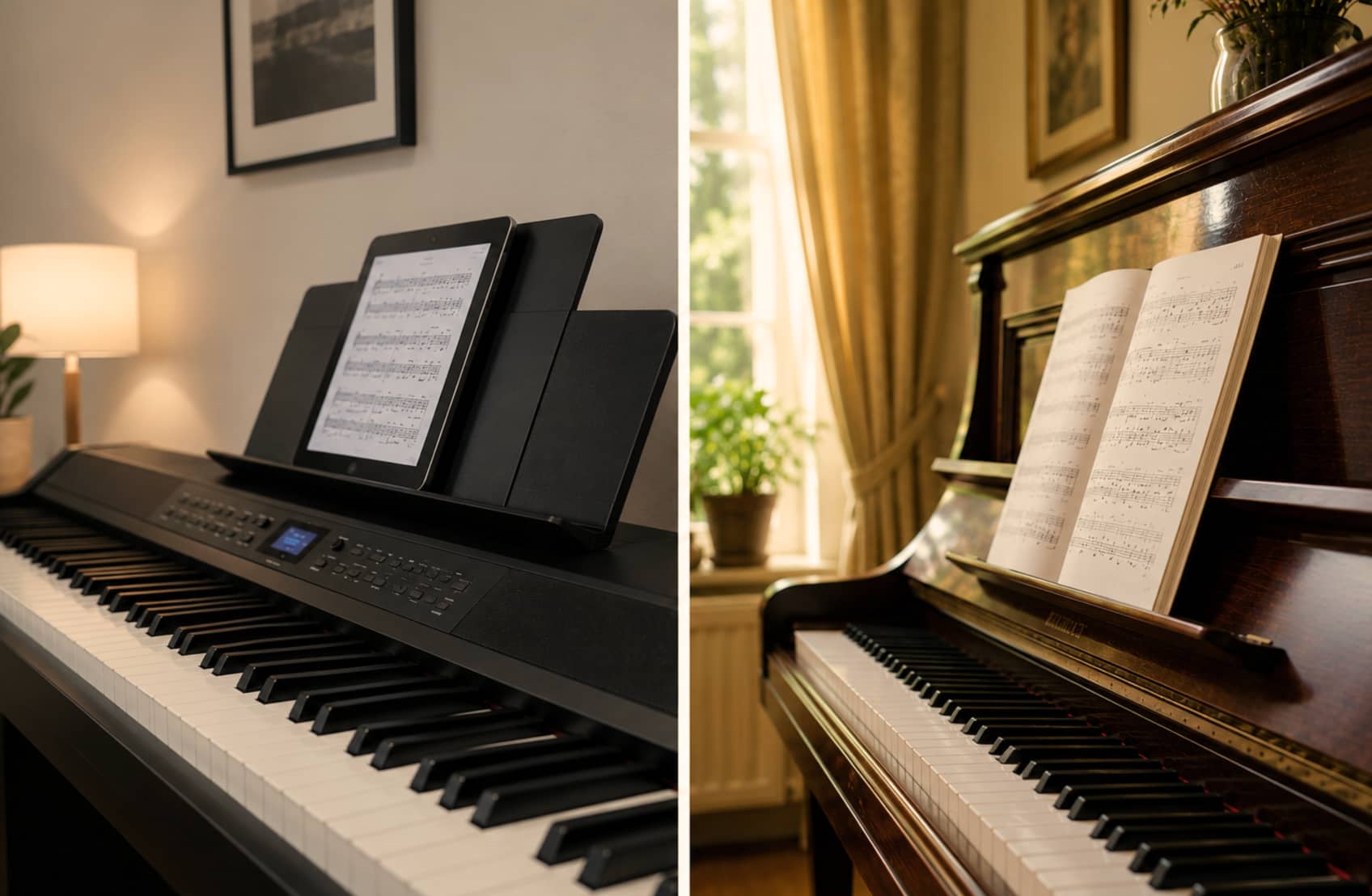
Choose an acoustic piano if you want the authentic feel, tonal nuance, and long-term value that comes from a real string instrument, and you have the space and budget to maintain one. Choose a digital piano if you need volume control, portability, low maintenance, or you’re working with a tighter budget where a quality digital outperforms a bottom-tier upright. There’s also a third option worth knowing about: hybrid pianos that combine acoustic action with digital sound, and silent systems that add digital capability to a true acoustic piano. If you’re starting out and want guidance on which suits your situation, piano lessons include advice on instrument choice as part of the early lesson plan.
What’s the actual difference between a digital and acoustic piano?
An acoustic piano produces sound mechanically through hammers striking steel strings, with the vibrations amplified by a wooden soundboard that fills the entire instrument. A digital piano uses sensors under the keys to trigger recorded or modelled piano samples played through speakers. Both feel similar at the keyboard if the digital has weighted keys, but they’re fundamentally different instruments under the surface.
The mechanical difference matters more than people expect. An acoustic piano action has hundreds of moving parts per key, with the hammer, dampers, and let-off mechanisms all contributing to how the note responds to your finger pressure. A digital piano simulates this response electronically, with the best models using weighted hammer actions that approximate the feel but don’t physically connect to a string. When you press a key on an acoustic piano, you’re triggering a physical chain of events. When you press a key on a digital piano, you’re triggering a sensor reading.
A useful way to think about it: an acoustic piano is closer to a violin in that the instrument actively shapes the sound based on physical interaction. A digital piano is closer to a high-quality playback system that responds to your input. Neither framing makes one better, but it explains why pianists describe them so differently.
Does an acoustic piano really sound better than a digital piano?
In most cases yes, particularly for advanced playing where tonal nuance and dynamic range matter, but the gap narrows significantly at the higher end of the digital market. A well-maintained acoustic piano in the $5,000 plus range produces resonances, overtones, and sympathetic vibrations that even premium digital pianos struggle to fully replicate. A budget acoustic piano under $2,500 can be outperformed by a quality $3,000 digital in terms of sheer playability.
The technical reason: when you play a note on an acoustic piano, the struck string vibrates, but it also causes other strings to resonate (sympathetically) through the soundboard, particularly when the sustain pedal is down. You can demonstrate this by holding down the sustain pedal silently and striking a low note hard. The high strings will ring in response, producing overtones that no speaker can fully replicate because the sound is coming from multiple physical sources at once, not from a stereo recording.
Digital piano technology has made huge progress in modelling these resonances mathematically, with the best models simulating sympathetic resonance, damper resonance, and key-off sounds. But there’s still a difference experienced players notice immediately: the acoustic piano feels alive under your fingers in a way the digital doesn’t, because the soundboard literally vibrates against your hands and the room itself resonates with the sound.
Which should beginners in Sydney choose?
For most Sydney beginners, a quality digital piano with weighted keys is the smarter starting point because it removes friction in the early months when commitment isn’t yet established. Once a student has been playing for a year or two and has confirmed they’re sticking with piano, upgrading to an acoustic or hybrid makes sense if the space, budget, and noise situation allow.
The reasoning behind starting digital:
- Lower upfront cost lets you discover whether the student enjoys piano before committing $5,000 plus
- Volume control means practice doesn’t disturb housemates or neighbours
- No tuning costs in the first 12 to 24 months
- Easier to move if you change houses or rentals
- Reasonable resale value if the student decides piano isn’t for them
The exceptions worth considering: if the student is already showing serious commitment from previous instruments, if you have the space and budget upfront, or if the family already owns a piano that just needs tuning, starting on acoustic is fine. Some Sydney parents in suburbs like Strathfield, Chatswood, and the Northern Beaches inherit family pianos that with $300 of tuning and basic regulation become perfectly serviceable starter instruments.
The mistake to avoid: don’t buy the cheapest possible keyboard with unweighted plastic keys and expect it to support real piano development. Unweighted keys teach habits that have to be unlearnt once the student progresses, and the lack of dynamic response prevents proper technique from developing. A weighted-key digital piano in the $1,200 to $2,500 range or a properly tuned acoustic upright is the genuine starting point. Anything below that is a toy, not an instrument. Read more about the difference between keyboards and digital pianos and the importance of weighted keys.
What about the feel of the keys?
Acoustic pianos have a complex mechanical action that responds to subtle differences in finger pressure, weight transfer, and release speed. Digital pianos use weighted key actions that simulate this feel, with quality varying significantly from entry-level keyboards (light, unresponsive) to premium hybrid models with full acoustic actions and digital sound generation.
The key differences in feel:
- Weight and resistance: Acoustic keys feel heavier through their full travel because they’re physically moving a hammer assembly
- Escapement: Acoustic actions have a small “give” point near the bottom of the keystroke that lets you play repeated notes quickly, which mid-range digitals don’t fully replicate
- Response time: Acoustic pianos respond instantly because the action is mechanical; digital pianos have a tiny latency that’s imperceptible to most players but exists
- Resonance through the keys: Acoustic players feel the soundboard vibrating up through the keys, which digitals can’t reproduce
For beginners learning piano lessons in Sydney, this difference matters less than experienced players assume. The fundamentals of finger independence, hand position, and basic technique develop similarly on both. Where it starts to matter is around AMEB Grade 4 or 5, when subtle dynamic control and tonal shading become part of the assessment.
How much maintenance does an acoustic piano really need?
An acoustic piano needs tuning once or twice a year (twice if you play seriously or live in a climate with humidity swings), plus periodic regulation work every five to ten years to keep the action playing properly. Sydney’s coastal humidity makes annual tuning the realistic minimum, with two tunings per year recommended for serious players or pianos in well-used family homes.
The maintenance costs to budget for:
- Tuning: Around $200 to $350 per visit in Sydney depending on the technician and piano condition
- Regulation: Every five to ten years, $400 to $1,200 depending on what needs adjusting
- Voicing: As needed, $200 to $500 per session
- Major repairs: Hammer replacement or string replacement runs $1,000 plus when eventually needed
Digital pianos skip all of this. They never need tuning, don’t react to humidity, and require no mechanical maintenance. The trade-off is that digital pianos have a finite lifespan of around 10 to 15 years for the electronics, after which the speakers, sensors, or board may fail and repairs cost more than replacement. An acoustic piano cared for properly can last 30 to 50 years and still be worth restoring beyond that.
Why does space matter for choosing between digital and acoustic?
Acoustic uprights weigh roughly 200 to 300kg and need to sit against an interior wall away from windows and air conditioning vents. Grand pianos require even more dedicated floor space. Digital pianos weigh 25 to 80kg depending on the model and can be positioned almost anywhere, including against external walls or in apartments with limited floor space.
This matters more in Sydney than people initially realise. Sydney apartments and smaller houses in suburbs like Newtown, Bondi, and the Inner West often don’t have a practical wall for a 250kg upright. Even if you have the space, getting an acoustic piano up two flights of stairs in a narrow Victorian terrace adds $400 to $800 in specialist moving costs on top of the purchase price.
A digital piano can be carried up by two people, doesn’t react to nearby windows or balcony doors, and can sit in a room where an acoustic piano would slowly go out of tune from temperature swings. For Sydney apartment dwellers, this practical consideration often outweighs the sound quality difference at the beginner stage.
Will a digital piano be good enough for AMEB or ABRSM exams?
Yes, a quality digital piano with weighted keys is acceptable for practice toward AMEB and ABRSM exams, but the exams themselves are sat on acoustic pianos at the examination venue. This means students who only practise on digital may need a few sessions on an acoustic before the exam to adjust to the heavier action and different sound response.
The risk for exam-focused students is what’s sometimes called the “digital piano crutch effect.” Digital pianos can hide weaknesses in touch sensitivity, pedalling technique, and dynamic control because the sound output is more forgiving than an acoustic piano’s. A student who plays a perfectly even mezzo-forte on their digital might find that the same touch on an acoustic produces wildly uneven dynamics, because the acoustic responds to subtleties the digital smooths over.
The practical fix for serious exam students: practise primarily on whatever piano you have, but try to get regular sessions on an acoustic piano in the lead-up to exams. Many Sydney piano teachers will let students practise on the studio’s acoustic piano outside of lesson times for a small fee, and some music schools across the Eastern Suburbs, North Shore, and Hills District offer practice room rentals at modest hourly rates.
What’s a hybrid piano and is it worth the price?
A hybrid piano combines an authentic acoustic piano action (with real hammers and the full mechanical complexity) with digital sound generation through speakers and headphones. The most advanced models pair the action from a manufacturer’s upright or grand piano with high-end digital sampling, producing an instrument that feels almost identical to an acoustic but offers volume control and headphone playing.
The trade-off is price. Hybrid pianos typically cost between $7,000 and $20,000 depending on the model, which puts them above mid-range acoustics but below premium grands. For Sydney apartment dwellers who want acoustic feel without the noise concerns, or for serious students who need to practise late at night without disturbing neighbours, hybrids can be the right answer despite the cost.
There’s also a separate category worth knowing about: silent systems on true acoustic pianos. These are upright or grand pianos with a normal acoustic action and strings, but with sensors and a mute rail installed so the piano can be played silently with headphones when needed. The acoustic sound is real when the mute is off, and digital sampling plays through headphones when it’s on. Silent systems add roughly $4,000 to $6,000 to the cost of an acoustic piano, but they give you the best of both worlds: a genuine acoustic instrument that can also be played at midnight without complaints from the neighbours.
Is a used acoustic piano cheaper than a new digital piano?
Yes, used acoustic pianos are often cheaper than new mid-range digital pianos in Sydney, but the savings can disappear quickly once you factor in moving costs, tuning, and potential repairs. A free or cheap upright on Sydney’s Facebook Marketplace might sound like a bargain, but many of these pianos have hidden problems that cost thousands to fix.
The common trap looks like this: a parent finds a “free piano, just collect it” listing in the Eastern Suburbs. They pay $400 to $800 for piano movers to transport it. They pay $250 for initial tuning. The technician then identifies that the action needs regulation work ($600 to $1,000), several hammers need replacing ($400), and the soundboard has a crack that affects tone permanently. They’ve spent $1,700 on a piano that still doesn’t play well, when a new digital piano with weighted keys would have cost $1,500 and worked perfectly from day one.
The fix is straightforward: get any used acoustic piano inspected by a piano technician before agreeing to take it, even if it’s free. A pre-purchase inspection runs $150 to $250 and tells you whether the piano is worth the hassle. The pianos worth taking are usually under 30 years old, have been kept in stable indoor conditions, and have no visible cracks in the soundboard or pinblock. Spinet pianos (very short uprights with indirect blow actions) are almost never worth the effort regardless of price, because their action design limits playability and they can’t be substantially improved.
The smartest things to do is speak to a piano teacher in Sydney for a direct recommendation on your situation.
 September 30, 2026
Where Could I Find an Affordable Clarinet Teacher in Sydney?
TL;DR A limited monthly budget can still leave you with options for clarinet lessons in Sydney. Start with the price… September 26, 2026
Where to Actually Look Before You Buy an Instrument
The obvious first search usually isn't the right one. The instinct is almost always the same. A lesson gets booked,… September 23, 2026
What Should I Learn First on Piano? A Beginner’s Step-by-Step Guide
TL;DR Start by learning the keyboard pattern, a small group of notes, finger numbers and a steady beat. Practise a… September 23, 2026
How Much Does Logic Pro Cost for Beginners?
TL;DR Logic Pro is Apple's music production software for Mac. In Australia, Logic Pro for Mac costs $299.99 as a…