Yes, and it’s one of the most common ways beginners start. The smartest approach is to practise on your keyboard at home and attend piano lessons where you play on a real piano regularly. That combination builds consistency at home while developing the dynamic control that a keyboard alone can’t teach you. The biggest risk of practising on the wrong keyboard isn’t learning the wrong notes. The real risk is never developing real dynamic control, which is one of the most important skills in piano playing and the hardest one to catch up on later.
Is a Keyboard the Same Thing as a Digital Piano?
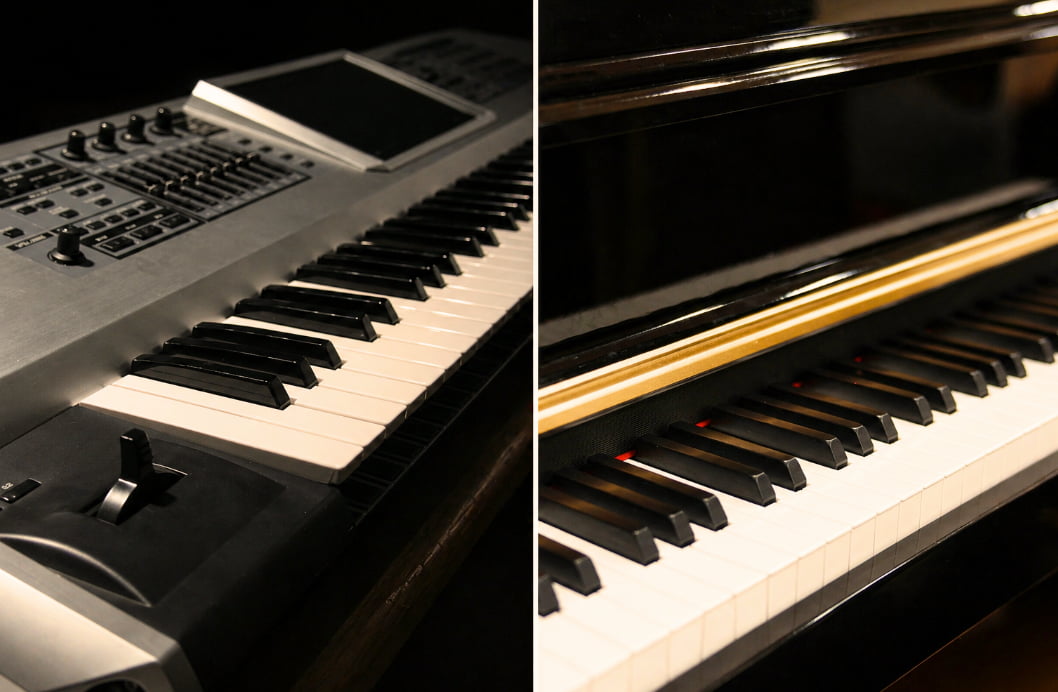
Not exactly, and the difference matters more than most beginners realise. A digital piano is designed specifically to replicate the experience of playing an acoustic piano: 88 weighted keys, graded hammer action, and a sound engine focused on piano tone. It’s a piano substitute.
A keyboard is technically a different instrument. Most keyboards have 61 or 72 unweighted keys, a wide range of built-in sounds (strings, organs, synths, drums), and are designed more like a synthesizer, typically played with chords in the left hand, melody in the right, and a lot of the sound design built into the instrument itself. That’s a legitimate instrument, but it’s not the same skill set as learning piano.
When most people ask “can I learn piano on a keyboard,” they usually mean whatever they have at home, and it could be either. A digital piano with 88 weighted keys: yes, absolutely. A 61-key unweighted keyboard: fine for learning note geography and basic patterns, but it’ll hold your technique back fairly quickly.
What’s the Minimum a Keyboard Needs for Piano Lessons?
For ongoing piano lessons, your keyboard should have:
- 88 keys or at minimum 76, and you’ll need the full range sooner than you think
- Weighted or hammer-action keys. This is the non-negotiable one
- Touch sensitivity (velocity sensitivity), so the keyboard responds to how hard you play, not just that you played
A sustain pedal input is also worth having from early on. It’s not essential in week one, but pedalling becomes part of the music fairly quickly and you don’t want to be practising without it.
Can a Beginner Start Piano Lessons Without Any Piano at Home?
Most teachers will work with what you have initially, but you’ll need something with weighted keys within the first month or two. Not because of tradition, but because technique literally can’t develop on an unweighted keyboard. Finger strength, evenness, and the ability to control dynamics all depend on practising against actual resistance.
Think of it this way: if you trained for a marathon exclusively on a trampoline, you’d develop cardiovascular fitness, but your legs would be completely unprepared for road running. Unweighted keys let you learn note names and basic patterns, but your hands won’t be ready for a real piano when you sit at one.
Why Do Acoustic Piano Keys Feel So Different From a Keyboard?
It’s not just the weight. It’s also the physical length and width of the keys, and most people don’t know this until they sit at a real piano for the first time. On an acoustic piano, the keys extend quite far back behind where you press them. That length changes the mechanics of how the key moves: pressing near the front versus further back requires different amounts of force, and the resistance distributes more evenly across the key surface. On a keyboard, the keys are considerably shorter, so pressing a black key or playing between black keys near the back of a white key can feel noticeably different to the same position on an acoustic.
Key width is another small but real difference. Most keyboards have keys that are slightly narrower than a standard acoustic piano. It’s not dramatic, but if you’ve spent months building muscle memory on a keyboard and then sit at a full-width acoustic, your hand spacing can feel slightly off at first, particularly on wider chord stretches or fast passages where precision matters. It settles quickly, but it’s worth knowing it exists.
This is one reason why students who’ve only ever practised on a keyboard sometimes find a real piano physically surprising, even if their weighted keyboard felt reasonably close at home. It doesn’t mean keyboard practice was wasted. It just means there’s a physical adjustment that takes a session or two. The students who adapt fastest are the ones playing on their teacher’s acoustic piano regularly during lessons, which is exactly why getting to your teacher’s studio matters even when you’re practising on a keyboard at home.
Are Digital Pianos Better Than Keyboards for Lessons?
For piano lessons specifically, a digital piano is almost always the better choice over a standard keyboard. The distinction comes down to key action. Digital pianos are designed to replicate the feel of an acoustic piano. Most have graded hammer action, meaning the lower keys feel heavier than the upper keys, which is exactly how an acoustic piano works.
A standard keyboard (even an expensive one) is usually built for portability and versatility across sounds, not for replicating piano touch. If piano lessons are the goal, a digital piano built for that purpose will serve you far better long-term.
There is one honest exception worth mentioning. If you’re aiming for a conservatory-level or elite performance path (think AMEB Grade 8 and beyond, or serious classical repertoire), a digital piano will eventually show its limits. Highly nuanced techniques, the finest dynamic control, and the physical resonance of an acoustic become harder to replicate at that level. For the vast majority of students learning piano in Sydney, that’s a long way off and not a reason to hold back from starting. But it’s worth knowing the ceiling exists.
Will a Teacher Actually Care What You Practise On?
A good teacher will ask what you’re practising on, because it directly affects what they can and can’t teach you. If you’re on a 61-key unweighted keyboard, they’ll know not to introduce certain repertoire that requires keys you don’t have, and they’ll likely flag the need to upgrade before technique work becomes the focus.
It’s not judgment. It’s logistics. The instrument shapes what’s teachable at any given stage.
How Much Should You Spend on a Keyboard for Piano Lessons in Sydney?
You don’t need to spend thousands. A solid beginner digital piano with weighted keys sits in the $400 to $800 range new, and you can often find quality secondhand options in Sydney suburbs like Newtown, Surry Hills, Chatswood, and Parramatta through Facebook Marketplace or Gumtree for significantly less.
If budget is tight, that secondhand market is genuinely worth exploring before buying a cheap unweighted keyboard new. A used Yamaha P-series or Roland FP-series in decent condition will outperform a brand-new budget keyboard every time for piano lessons.
Does Playing on a Keyboard Affect How Fast You Progress?
The area where it matters most is dynamics, and that’s also the area most people don’t realise they’re falling behind in. On a keyboard, especially one without touch sensitivity, every note comes out at roughly the same volume regardless of how hard or softly you press. You can practise for months, learn difficult pieces, and still have essentially no dynamic range when you sit at a real piano. The notes are right, the rhythm is right, but the music sounds flat because you’ve never actually had to control how hard your fingers play.
Dynamic control is what separates mechanical playing from musical playing. It’s what makes a quiet passage feel delicate and a loud passage feel powerful. On an acoustic piano, that control lives entirely in your hands and how you touch the keys. A keyboard with no touch sensitivity removes that feedback loop completely. You’re not developing the skill at all, just learning to play notes.
If your keyboard does have velocity sensitivity and weighted keys, this gap is much smaller. You’ll still notice a difference when you move to an acoustic, but your hands will have the muscle memory and the instinct for dynamic playing already in place.
What If You’re Renting or Can’t Have an Acoustic Piano?
This is genuinely common in Sydney, particularly in apartments across the Eastern Suburbs, Inner West, and North Shore where space and strata rules make an acoustic piano impractical. A quality digital piano is a completely legitimate long-term solution, not a compromise. Many advanced players and teachers use digital pianos as their primary instrument.
If noise is the concern, headphone capability (which most digital pianos have) solves that entirely. If space is the issue, a compact digital piano takes up far less room than an upright acoustic.
Does Keyboard Height and Posture Matter If You’re Not on a Real Piano?
Yes, and it’s something most beginners don’t think about until it causes a problem. The standard piano key height sits at around 74 to 80cm from the floor, and your stool height should be set so your forearms are roughly parallel to the keys with a slight downward angle. If your keyboard is sitting on a wobbly desk at the wrong height, you’re building posture habits around that setup, and when you eventually sit at an acoustic piano, everything feels off.
It’s worth setting your keyboard up at the correct height from day one. A proper keyboard stand with adjustable height costs very little and saves a lot of relearning later. Your teacher can check your positioning in the first lesson and give you a specific height to aim for at home.
What Happens When You Move From Keyboard to Piano Later On?
The biggest shock for most students isn’t the key weight. It’s the dynamics. On a keyboard it’s easy to practise with the volume turned down or headphones on. This means you’re never really developing your sense of how hard or softly you’re actually playing. On an acoustic piano, that control is entirely in your hands. The hammer is hitting a string and the room hears everything. Students who’ve spent months hiding behind a keyboard’s volume knob sometimes sit at a real piano and find their dynamic range has barely developed at all. Playing softly, building gradually into a louder passage, voicing one note above the others in a chord. These are physical skills that have to be practised against real resistance, and a keyboard without touch sensitivity doesn’t give you that.
It shows up most at performances. A student can know their piece cold, play it perfectly at home, and then sit at an acoustic piano in front of people and find the music sounds completely flat, because suddenly dynamic control is required and they’ve never actually developed it. That’s not a nerves problem. It’s an instrument problem.
Key weight is the other adjustment, but it’s usually the easier one to adapt to. The main differences when moving to an acoustic are:
- Dynamic control: no volume knob, no headphones; everything you play is heard, exactly as you play it
- Key weight: acoustics vary considerably in touch, and some feel noticeably heavier than even a good digital piano
- Sound projection: the room responds to the instrument in a way no speaker can replicate
- Pedal response: acoustic sustain pedals engage more gradually than most digital equivalents, which changes how you time your pedalling
None of these are permanent hurdles, but dynamics is the one that takes longest to fix if it’s been neglected. A few sessions on the acoustic and most students recalibrate on key weight. Dynamic range, if it hasn’t been developed, takes real focused work to build.
What’s the Smartest Setup If You Only Have a Keyboard at Home?
Practise on your keyboard at home, but go to your teacher’s studio once a week to play on a real piano. That’s genuinely the best of both worlds, and it’s a setup that works well for plenty of students across Sydney.
Here’s why it matters. Even a good weighted keyboard doesn’t feel exactly like an acoustic piano. The keys on an acoustic are heavier, the action is more complex, and the way the instrument responds to your touch is different in ways that are hard to replicate digitally. Critically, you can’t turn an acoustic piano down, which means every time you sit at your teacher’s piano, you’re practising real dynamic control, not just note accuracy. That weekly contact with the real instrument keeps your playing calibrated in a way that home keyboard practice alone can’t.
If you only ever practise at home on a keyboard and never sit at a real piano, the gap will keep catching you off guard. But if you’re at your teacher’s piano once a week, your hands remember what the real thing feels like, and your home practice stays connected to that physical reference point.
The One Mistake That Actually Holds People Back
It’s not starting on a keyboard. Almost everyone starts on a keyboard, and plenty of strong players come from that background. The mistake is staying on a keyboard that limits you for too long. We’re talking about one with no touch sensitivity, no real key weight, and a volume knob that lets you practise without ever actually controlling how you play.
A keyboard that responds to your touch supports real progress. One that doesn’t means you’re drilling notes but not developing musicality. If your keyboard is missing weighted keys and touch sensitivity, that’s worth fixing sooner rather than later, not because you need expensive equipment, but because the instrument you practise on shapes the skills you’re actually building.
Start with what you have. Upgrade when the instrument is the ceiling. Play on a real piano in your lessons the whole time. That’s genuinely the formula that works.
If you’re ready to get started, piano lessons in Sydney can be built around whatever you’re currently working with, keyboard at home, real piano in the room.
 September 30, 2026
Where Could I Find an Affordable Clarinet Teacher in Sydney?
TL;DR A limited monthly budget can still leave you with options for clarinet lessons in Sydney. Start with the price… September 26, 2026
Where to Actually Look Before You Buy an Instrument
The obvious first search usually isn't the right one. The instinct is almost always the same. A lesson gets booked,… September 23, 2026
What Should I Learn First on Piano? A Beginner’s Step-by-Step Guide
TL;DR Start by learning the keyboard pattern, a small group of notes, finger numbers and a steady beat. Practise a… September 23, 2026
How Much Does Logic Pro Cost for Beginners?
TL;DR Logic Pro is Apple's music production software for Mac. In Australia, Logic Pro for Mac costs $299.99 as a…