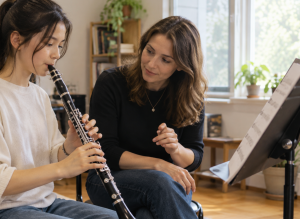
You don’t strictly need a teacher to learn saxophone, but saxophone lessons make a clear difference in how quickly you improve, how consistent your sound becomes, and whether you avoid bad habits early. The saxophone is easy to start but difficult to control properly, so without guidance, most players plateau sooner than expected. You can explore saxophone teachers in Sydney, try multiple teachers and see who suits you best.
Can you learn saxophone properly without a teacher?
Yes, you can learn saxophone on your own, but it’s difficult to build strong fundamentals without feedback.
You can get to a point where you can play basic material, but you won’t always know whether your technique is correct. That creates a gap between what feels like progress and what actually improves your sound.
A more effective approach is to combine self-practice with guidance so your technique stays aligned as you improve.
What do saxophone lessons actually change about your playing?
Saxophone lessons change how you produce sound, not just what you play.
A teacher focuses on the mechanics behind your tone:
- how your air moves through the instrument
- how stable your embouchure is
- how efficiently you articulate
When those are adjusted properly, everything else becomes easier to control.
Without that correction, progress tends to feel inconsistent. With it, your playing becomes more predictable and stable.
Why most saxophone players waste months learning the wrong way
Most players don’t fail because they aren’t practising. They fail because they are practising the wrong things.
A common example is articulation. Many players tongue from the roof of their mouth instead of the reed. It works at a basic level, so it feels correct, but it limits precision and makes faster or more controlled playing harder.
Tone development follows a similar pattern. Some players become technically capable and can play fast or accurately, but their sound stays thin and one-dimensional. They often get stuck in one style because they haven’t developed the flexibility needed for a fuller tone.
The problem is that none of this feels wrong while it’s happening. You can sound decent and still be building limits into your playing.
That’s why feedback matters. Catching these issues early changes how your sound develops and prevents long-term constraints.
Why does saxophone sound unstable at the beginning?
It sounds unstable because airflow and embouchure are not working together yet.
Most beginners either overcompensate with pressure or don’t support the air properly. That creates a tone that feels inconsistent across notes.
Once airflow becomes steady and the embouchure stabilises, the sound evens out. The fastest improvement comes from controlling the air rather than forcing the sound.
What mistakes hold self-taught saxophone players back the most?
The biggest mistakes are not obvious at first, which is why they stick.
You’ll usually see things like:
- uneven airflow between notes
- tension building in the hands or shoulders
- relying on pressure instead of control
Individually they seem minor, but together they reduce flexibility and control.
Fixing them is less about practising more and more about identifying what needs to change.
What actually separates fast progress from slow progress on saxophone?
The difference is not effort. It’s feedback.
Players who improve quickly tend to correct mistakes early. Players who improve slowly tend to repeat the same issues without realising it.
You can see it in how they practise:
Fast progress usually looks like:
- small adjustments happening regularly
- tone improving gradually but consistently
- practice sessions having a clear focus
Slow progress often looks like:
- the same problems showing up repeatedly
- tone changing day to day
- practising without knowing what to fix
The key is shortening the feedback loop. The faster you correct mistakes, the faster you improve.
What bad saxophone progress actually feels like
Bad progress feels like you’re putting in effort but not moving forward.
You might notice your tone still sounds thin after months, or that your higher notes feel unreliable. Articulation might feel messy even though your fingers are fast enough, and your sound never quite matches what you expect.
The frustrating part is that it doesn’t feel like you’re doing anything wrong. You’re practising, but the results don’t reflect it.
This usually comes from hidden technique issues. Once those are identified and corrected, progress becomes noticeably smoother and more predictable.
When do most saxophone players hit a plateau?
Most players hit a plateau once they move past basic sound production.
At that point, improvement depends on refining tone and control rather than just playing notes. Without knowing what to adjust, it’s easy to repeat the same patterns without progress.
That’s usually where guidance becomes valuable. One correction can unlock progress again.
What happens over 3–6 months with vs without a saxophone teacher?
With a teacher, progress tends to stabilise. Without one, it often becomes inconsistent.
Over 3–6 months with a teacher:
- tone becomes fuller and more controlled
- embouchure stabilises
- fewer bad habits develop
- progress builds steadily
Over 3–6 months without a teacher:
- tone improves but stays inconsistent
- technique issues build quietly
- progress slows after early gains
- habits become harder to fix
The difference is direction. Effort alone isn’t enough if it’s not guided.
Is embouchure the hardest thing to fix later on?
Yes, embouchure is one of the hardest things to fix once it becomes habitual.
It affects tone, tuning, and endurance, so even small inefficiencies have a noticeable impact. Changing it later requires slowing down and rebuilding control deliberately.
Getting it right early avoids that process entirely.
Do you need weekly saxophone lessons to improve?
No, weekly lessons are not required, but they are the most reliable way to stay consistent.
Regular feedback keeps your practice focused and prevents small issues from building up. Even occasional lessons can still help if they are used well.
Consistency matters more than frequency alone.
How do you know if you actually need saxophone lessons?
You likely need lessons if your progress feels inconsistent or your sound isn’t improving.
Typical signs include:
- tone that doesn’t stabilise
- fatigue when playing
- difficulty controlling higher notes
- feeling stuck despite practising
These usually point to technique issues rather than lack of effort.
How do you know if a saxophone teacher is actually good?
A good teacher actively changes how you play, not just what you play.
You should notice your sound improving within the lesson itself. They should explain what needs to change and guide you through it.
If lessons feel passive, progress usually slows. A strong teacher gives direction and correction.
Is it worth paying more for a better saxophone teacher?
Yes, paying more for a better teacher is usually worth it because it improves efficiency.
Better teachers identify problems quickly and fix them properly. That reduces wasted time and prevents long-term issues.
Cheaper lessons can still help, but progress is often slower if technique isn’t corrected well.
Can a bad saxophone teacher slow your progress?
Yes, a bad teacher can slow your progress significantly.
If lessons lack structure or correction, you may reinforce inefficient technique without realising it.
The solution is to switch to a teacher who focuses on fundamentals and progression rather than just playing through material.
What should a saxophone lesson actually include to be effective?
A strong lesson should develop technique and apply it immediately.
You should be working on tone, airflow, and embouchure while applying those improvements to actual playing. That connection is what makes progress feel real.
If lessons focus only on songs, improvement becomes uneven. The most effective saxophone lessons balance technical work with musical application.
 September 30, 2026
Where Could I Find an Affordable Clarinet Teacher in Sydney?
TL;DR A limited monthly budget can still leave you with options for clarinet lessons in Sydney. Start with the price… September 26, 2026
Where to Actually Look Before You Buy an Instrument
The obvious first search usually isn't the right one. The instinct is almost always the same. A lesson gets booked,… September 23, 2026
What Should I Learn First on Piano? A Beginner’s Step-by-Step Guide
TL;DR Start by learning the keyboard pattern, a small group of notes, finger numbers and a steady beat. Practise a… September 23, 2026
How Much Does Logic Pro Cost for Beginners?
TL;DR Logic Pro is Apple's music production software for Mac. In Australia, Logic Pro for Mac costs $299.99 as a…