The right clarinet teacher is one who improves your sound, technique, and consistency over time, not just someone with strong credentials. If you’re looking for clarinet lessons, choosing the right teacher early will shape how efficiently you improve and whether you build the right habits from the start.
What actually makes a good clarinet teacher?
A good clarinet teacher is someone who can hear what’s going wrong and explain how to fix it in a way you can actually apply.
That doesn’t mean constant correction. It means clear, targeted feedback that connects what you’re doing to what you’re hearing. Over time, that builds control rather than guesswork.
After a lesson, you should usually be able to tell what improved, what still needs work, and what to practise next. Sometimes the change is immediate. Other times the value is understanding the issue so your practice starts working properly.
If you’re leaving lessons without a clear direction, the teaching is likely too general.
How do you compare clarinet teachers properly?
You should compare clarinet teachers based on what happens in a lesson, not just what’s written about them.
A trial lesson shows how quickly a teacher identifies issues, how clearly they explain them, and whether your playing starts to make more sense. That tells you far more than qualifications alone.
If you’re weighing up options, it helps to look through clarinet lessons in one place rather than relying on bios. The real difference shows up in how the lesson actually runs.
Should you choose a clarinet specialist or a general music teacher?
You should choose a clarinet specialist if you want reliable technique and consistent sound.
Clarinet is sensitive to small technical errors, especially around embouchure, airflow, and voicing. A general music teacher can help you get started, but they often don’t go deep enough into those mechanics.
If your goal is casual playing, either can work. If you want control across registers and a stronger foundation, a specialist is the better option.
Why being a great clarinet player doesn’t mean they’re a great teacher
A great clarinet player is not automatically a great teacher.
Playing is about execution. Teaching is about diagnosis and communication. Some players can perform at a high level but struggle to explain what they’re doing or adapt to different students.
A good teacher understands how people actually learn. They can spot habits early, adjust their explanation, and focus on what matters most at your stage.
When choosing a teacher, look beyond how well they play. Pay attention to how well they explain and guide.
What should a great first clarinet lesson actually look like?
A great first clarinet lesson should quickly identify your main limitation and give you a way to improve it.
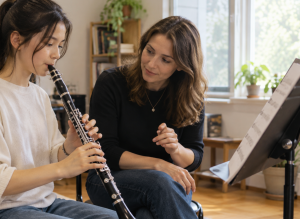
It shouldn’t feel like a casual play-through. A strong teacher listens closely, checks your setup, and focuses on what’s affecting your sound or control the most.
A typical first lesson includes:
- checking embouchure and airflow
- assessing posture and hand position
- testing how you move between notes
- introducing one or two targeted exercises
You should leave knowing what to work on. If the lesson feels vague, progress usually follows that pattern.
Why just playing through songs in lessons is a bad sign
If most of your lesson is spent repeating songs, it’s usually not an effective use of time.
Practising pieces is something you can already do yourself. The role of a teacher is to identify why something isn’t working and fix that cause.
A strong teacher will often shift away from the piece and focus on the underlying issue. Once that improves, the music becomes easier.
If lessons stay focused on repetition without explanation, progress tends to stall. The solution is to find a teacher who focuses on fixing the cause, not just improving the result.
How do you know if a clarinet teacher can actually fix your tone?
You know a clarinet teacher can fix your tone if their feedback leads to clearer, more controlled sound over time and gives you a specific way to practise it.
Tone depends on embouchure, air support, voicing, and setup. A strong teacher isolates which factor is limiting you and shows you what to adjust.
In a good lesson, you’ll usually notice:
- your sound becoming more stable
- notes responding more easily
- clearer understanding of what to change
Improvement won’t always be instant, but the direction should be clear. If nothing changes over time, the issue is usually diagnosis.
Why you can’t reliably fix your own playing on clarinet
You can improve on your own, but you can’t reliably identify what needs fixing.
The main issue is perception. You don’t hear yourself the same way others do, which makes it difficult to judge tone and consistency accurately.
A teacher provides an external perspective and identifies the cause of issues. Without that, improvement becomes trial and error.
If you want to improve efficiently, you need both practice and accurate feedback.
Should a clarinet teacher help with reed choice?
Yes, a good clarinet teacher should help with reed choice because it affects how the instrument responds.
If the reed is too hard, playing feels resistant. If it’s too soft, tone becomes unstable. A teacher doesn’t need to overfocus on gear, but they should recognise when your setup is limiting your progress.
This shows whether they’re paying attention to the full picture, not just what you’re playing.
Why does the clarinet “break” reveal how good a teacher is?
The clarinet break reveals teaching quality because it requires coordinated technique, not just repetition.
Moving between registers involves simultaneous changes in embouchure, air speed, and voicing. This is where many players lose control, and where teaching quality becomes obvious.
A weaker approach relies on repetition. Students are told to keep practising scales and hope it improves. While this can help slightly, it often leaves the core issue unresolved.
A stronger teacher treats the break as a system.
They will:
- explain what physically changes between registers
- isolate airflow and voicing before combining them
- give exercises focused specifically on the transition
- help you recognise what correct control feels like
This removes guesswork. Instead of hoping it improves, you understand what needs to change and why.
If a teacher can guide you through this clearly, it’s a strong sign they understand the instrument at a deeper level.
What red flags should you avoid when choosing a teacher?
The biggest red flag is a lack of correction.
If mistakes are not addressed, they become habits that slow your progress.
Other warning signs include:
- lessons that feel unstructured
- too much talking and not enough listening
- jumping into songs too early
A good lesson should feel focused and purposeful.
How important is lesson format and location?
Consistency matters more than format.
In-person lessons allow for more detailed sound correction, but only if you attend regularly. Online lessons can still work well if the teaching is clear and structured.
The best format is the one you can stick to.
How much do clarinet lessons in Sydney cost?
Most clarinet lessons in Sydney cost between $90 and $120 per hour.
This usually reflects experience and teaching quality. A more experienced teacher may cost more, but can often fix issues faster.
The key factor is progress. If you’re improving consistently, the lessons are worth it.
How to tell if a clarinet teacher is actually progressing you properly
A good clarinet teacher produces steady progress over time, even if it’s not dramatic every lesson.
Progress isn’t always immediate. Some lessons focus on correcting technique, which can feel slower at first. Over time, the instrument should start to feel easier and more controlled.
You should notice:
- more stable tone
- easier response
- fewer repeated mistakes
If nothing is changing over time, the lessons may not be targeting the right areas.
A simple /10 scorecard for judging a clarinet teacher
If you’re unsure how to judge a teacher after a lesson, this quick scorecard can help. Give them one point for each:
- Clear communication
- Lessons are engaging and not stressful
- Specific deep knowledge is communicated
- Good habits are enforced early
- A clear practice plan is given
- Clear north stars for your stage of learning
- The lesson adapts to you
- Problems are diagnosed properly
- You understand your playing better
- Progress feels more efficient over time
A strong teacher will usually score around 7 to 10. If it’s consistently lower, it’s worth trying someone else.
How to tell if your child’s clarinet teacher is actually effective
A teacher is effective if your child is improving and understands what they’re working on.
Progress should show up gradually in tone, control, and confidence.
If your child can explain what they worked on, the teaching is structured. If not, it may be too general.
What’s the best way to choose the right clarinet teacher in Sydney?
The best way to choose the right clarinet teacher is to prioritise what matters most to you and then try a lesson.
There’s no perfect way to guarantee the right choice immediately. What matters is narrowing your options based on teaching quality, experience, location, and price, then testing the fit.
A trial lesson gives you the clearest answer. Most of the time, you’ll find someone who works well for you. If not, it simply means you need a better match.
If you want to start comparing options, you can compare clarinet teachers and find a teacher that suits your goals.
 September 30, 2026
Where Could I Find an Affordable Clarinet Teacher in Sydney?
TL;DR A limited monthly budget can still leave you with options for clarinet lessons in Sydney. Start with the price… September 26, 2026
Where to Actually Look Before You Buy an Instrument
The obvious first search usually isn't the right one. The instinct is almost always the same. A lesson gets booked,… September 23, 2026
What Should I Learn First on Piano? A Beginner’s Step-by-Step Guide
TL;DR Start by learning the keyboard pattern, a small group of notes, finger numbers and a steady beat. Practise a… September 23, 2026
How Much Does Logic Pro Cost for Beginners?
TL;DR Logic Pro is Apple's music production software for Mac. In Australia, Logic Pro for Mac costs $299.99 as a…