The best beginner clarinet to buy in 2026 is the Yamaha YCL-255, priced around $850–$1,100 AUD at Australian retailers, which most Sydney woodwind teachers recommend as the safest first purchase. The Buffet Prodige is the strongest step-up alternative for committed beginners, and the Jupiter JCL-700N is the budget pick for families wanting to limit upfront spend. The Backun Alpha is a genuine alternative to the YCL-255 in the same tier. Anything under $400 typically has leaking pads and bent keys out of the box, which makes the clarinet feel impossible to play and kills most beginners’ motivation within a term. If you’re starting clarinet lessons in Sydney, the right beginner instrument matters more than people think because clarinet is so embouchure-dependent that a poorly built horn will sabotage even good technique.
What’s the best beginner clarinet at each price point?
The Yamaha YCL-255 is the default Sydney recommendation in the sub-$1,500 range. It’s consistent, well-built, and every clarinet teacher in Sydney knows it, which matters when you’re troubleshooting issues in your first year. The Backun Alpha is the most credible alternative in the same tier. Below them, the Jupiter JCL-700N handles the budget bracket competently. Above them sit Yamaha’s wood student models and the Buffet E11.
The realistic options at each price tier:
- Under $500. Skip new clarinets entirely. Hire or buy second-hand. Anything new at this price will have leaking pads and tuning problems that make the instrument fight you constantly.
- $700 to $900. Jupiter JCL-700N. Decent build, reliable for the first two years, and Jupiter’s distributor support in Australia is solid.
- $850 to $1,100. Yamaha YCL-255 sits in the sweet spot here. The standard NSW school band recommendation, recognised by every teacher, and holds resale value better than most other beginner clarinets. The Backun Alpha sits in the same range and is worth play-testing alongside it.
- $1,200 to $1,500. Buffet Prodige. Bore inspired by Buffet’s E13 model, ABS resin construction for durability, and a slightly more refined tone than the YCL-255. Worth it if the player is genuinely committed past year one.
- $1,700 to $2,300. Yamaha YCL-450 or Buffet E11. Step-up student models with wood bodies that bridge the gap between student and intermediate.
- $2,400 and above. Intermediate or professional territory. Wasted on a true beginner. Save the money for lessons.
Check current prices with Sydney retailers like Sax & Woodwind (Camperdown), Turramurra Music, and Music Junction before buying, as pricing shifts and bundle deals are common.
Why does clarinet quality matter so much for beginners?
Clarinet tone production depends on the entire instrument sealing properly, and cheap clarinets fail at this in invisible ways. When a pad leaks even slightly, individual notes go stuffy or refuse to sound, and beginners assume the problem is their embouchure. They then spend weeks trying to fix a technique problem that’s actually a build problem, which usually ends with them quitting because “they can’t play the clarinet.”
The internet woodwind community has a phrase for these instruments – “clarinet-shaped objects” – because they look right but don’t function as proper instruments. The common failures are pad seating that lets air escape, tone holes drilled to imprecise specifications that affect pitch, key mechanisms that bind under pressure, and barrels that produce a thin, hollow tone. A well-built beginner clarinet costs more upfront but lasts five to ten years with basic care. A cheap import usually gets refused by techs as not worth repairing, or gets replaced entirely within six months.
This matters more on clarinet than on most instruments because beginners can’t reliably distinguish between an instrument problem and a technique problem in their first year. An experienced player can play almost anything in tune; a beginner is at the mercy of whatever the clarinet does on its own.
Should you play three clarinets before buying one?
Yes, even within the same model. Two Yamaha YCL-255s pulled off the same shelf can feel different in resistance, tone, and intonation, and the variation tends to be wider on Buffet models than on Yamaha. Most experienced Sydney clarinet teachers will tell you the same thing: don’t buy a clarinet you haven’t played, and ideally play two or three of the same model before choosing.
Why this matters more than on most instruments: clarinet tone production is so embouchure-dependent that small variations in bore, tone hole placement, and pad seating produce real audible differences between individual instruments. Yamaha’s quality control is among the tightest in the industry, so variation between two YCL-255s is small but real. Buffet’s variation is wider, which is why advanced players routinely play through several R13s before picking one.
What to actually do when you’re testing:
- Play the same passage on each clarinet. A simple scale or a fragment of a piece you know. Variations in tone and response become obvious when the music is identical.
- Test the break specifically. Cross from throat A to B on the staff and back. Some clarinets handle the break cleanly, others stuff up the response in the middle register.
- Check intonation across registers. A chromatic tuner or tuning app helps. Poor intonation is normal on cheap clarinets and unacceptable on good ones.
- Consult a teacher. Even a 30-minute paid consult with a teacher who knows the model is worth the money before dropping $1,000+.
For Sydney buyers, this means visiting a music store in person at least once before purchasing. Online-only purchases are fine for accessories but risky for the instrument itself.
What’s the difference between ABS resin, synthetic blends, and wood?
ABS resin (and similar synthetics) is the right choice for almost every beginner clarinet, and wood is genuinely better for advanced players but worse for first-year students. The standard line that “wood always sounds better” is partly true and mostly irrelevant to beginners.
The three material categories in plain terms:
- ABS resin. A thermoplastic polymer that’s durable, weatherproof, and dimensionally stable. Doesn’t crack with temperature changes, handles being thrown in a school bag, and produces a perfectly acceptable tone for beginner playing. The Yamaha YCL-255, Buffet Prodige, and Jupiter JCL-700N all use ABS or a close variant.
- Proprietary synthetic blends. The Backun Alpha uses a proprietary synthetic material designed for resonance and durability. Manufacturers in this category aim to offer some of the tonal benefits of wood without the cracking risk.
- Wood (grenadilla). The professional standard, used in the Buffet R13, Yamaha YCL-650, and most pro clarinets. Warmer, richer tone, but cracks if exposed to temperature extremes and costs significantly more. The Yamaha YCL-450 and Buffet E11 are the entry-level wood options.
For Sydney school band students playing in hot summer fetes, cold winter assembly halls, and the back of buses on the way to competitions, synthetic-bodied clarinets are simply the correct call. Wood clarinets in those conditions risk cracking within a year or two, and the repair cost often exceeds the value of the instrument. Save wood for when the player has the technique to actually hear the tonal difference, which is usually around AMEB Grade 4 or 5.
What features should a beginner clarinet have?
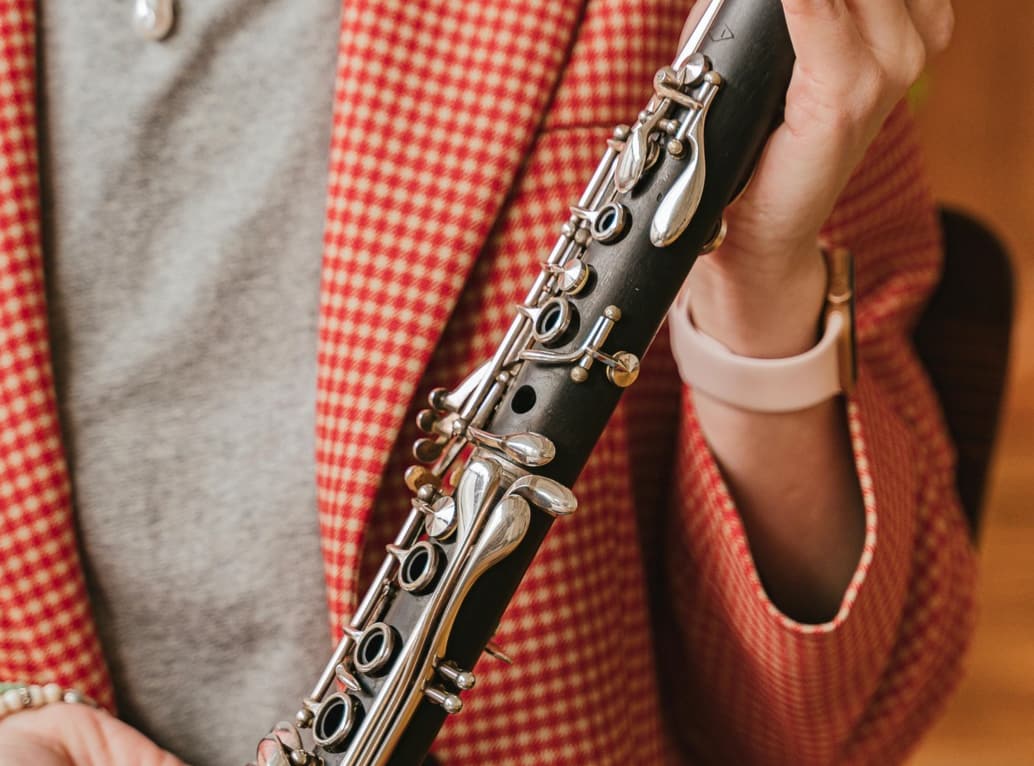
A beginner clarinet should be a B flat clarinet with a Boehm system 17-key, 6-ring layout, an ABS resin or synthetic body, nickel-plated nickel silver keys, and an adjustable thumb rest. These specs are the standard for every reputable student clarinet, and they exist for good reasons.
The features that actually matter:
- B flat tuning. The standard key for beginner clarinet. All method books, school band parts, and AMEB exam pieces are written for B flat.
- Boehm system, 17 keys, 6 rings. The standard fingering system used in Australia, the UK, and the US. Avoid German system (Oehler) clarinets, which use different fingerings and are rare here.
- ABS resin or synthetic body. Cheaper than wood, more durable, less prone to cracking. The right choice for school-aged students.
- Adjustable thumb rest. Lets the instrument fit your hand instead of forcing your hand to fit the instrument.
- Undercut tone holes. Improves intonation. Most quality student clarinets have this; cheap imports often don’t.
Features you don’t need yet include silver-plated keys, grenadilla wood bodies, French-cut barrels, and aftermarket mouthpieces. These are intermediate-level concerns and won’t help a first-year player.
How much should you actually spend on a first clarinet?
Most Sydney beginners should spend $850 to $1,100 AUD on their first clarinet, landing on either the Yamaha YCL-255 or the Backun Alpha. Below $700 you start risking build quality issues that will sabotage practice. Above $1,500 you’re paying for features that beginners can’t yet make use of. The exception is hire, which makes sense if you’re not yet sure the player will continue past six months.
Spending more doesn’t accelerate learning in the first year. A $3,000 intermediate clarinet won’t help a beginner sound better, because tone production at the early stage comes from embouchure and air, not the instrument. The bigger risk is spending too little, which is where most new buyers actually lose money. A $200 clarinet that no tech will repair, then gets replaced after a year, is a $500 mistake. A YCL-255 that lasts five years works out to a couple of hundred dollars per year and holds resale value at the end.
Yamaha and Buffet Crampon clarinets are known for holding their value in the Australian resale market, which means you can typically recoup a meaningful portion of the purchase price when the player upgrades or moves on. No-name brands have effectively zero resale value, which is part of why they’re a false economy even at lower upfront prices.
Should you buy new or second-hand?
Buying second-hand is a strong option if a woodwind technician inspects the clarinet before you pay, but a poorly chosen used clarinet can be worse than no clarinet at all. The risk is that pad condition and key alignment are invisible without a play test under playing pressure, and beginners can’t tell the difference between a bad clarinet and their own developing technique.
Where second-hand makes sense:
- Serviced instruments from a music retailer. Most Sydney shops sell trade-ins after a full service. Expect to pay a discount of 30–50 percent off new pricing, usually with a short warranty included.
- Ex-rental instruments at the end of a hire period. Often sold at a discount with a credit applied from previous rental payments. Quality is usually decent because they’ve been maintained between hires.
- Older Yamaha or Buffet student models. The Yamaha YCL-250 (the predecessor to the YCL-255) and the Buffet B12 are both legitimate older student models that play well after a service.
Where second-hand goes badly:
- Marketplace listings under $300. Almost always counterfeit or unserviced imports.
- Estate sales without a play test. A clarinet that’s sat in a cupboard for ten years usually needs a couple of hundred dollars of pad and cork work before it plays.
- Wood clarinets without crack inspection. Cracks in the upper joint can cost more to repair than the instrument is worth.
If you’re buying second-hand, take the clarinet to a Sydney woodwind tech for a play test before paying. Most charge a small fee for a quick inspection and it pays for itself many times over.
Is it worth hiring a clarinet before buying?
Hiring is a smart first move if you’re genuinely unsure whether clarinet will stick, since the upfront cost is low and most Sydney rental programs let you upgrade or exit cleanly. Hire typically runs $40 to $70 per month for a beginner-level instrument, with some retailers requiring a deposit plus the first month’s rent. Most rent-to-own programs in Sydney credit a portion of your rental payments toward a future purchase.
The trade-off is that long-term, hiring costs more than owning. Twelve months of hire at $55 a month equals roughly $660, which is most of the way to buying a Yamaha YCL-255 outright. The decision comes down to commitment confidence. If the player is enthusiastic and likely to continue past six months, buying makes sense early. If you’re testing the waters with a child who hasn’t yet shown sustained interest, hiring lets you exit without a large sunk cost.
A reasonable rule of thumb: hire for the first three to six months, then buy outright once the player has clearly committed. The hire credit usually softens the eventual purchase price.
What accessories does a beginner clarinet player need?
A beginner clarinet kit needs reeds, cork grease, a swab, a mouthpiece patch, and a music stand. Total cost in Sydney is around $80 to $150 for everything beyond the clarinet itself. Most starter clarinets come with a basic mouthpiece, ligature, and case included, so you don’t need to buy those separately in year one.
The realistic starter accessories:
- Reeds (10-pack). Vandoren or Rico in strength 2 or 2.5 for most beginners. Around $35 to $50 per box. Lasts three to four months for a beginner.
- Cork grease. $8 to $12 per tube, lasts six to twelve months.
- Swab. $10 to $20. A pull-through cloth for drying the bore after each session. Skip this and pads degrade fast.
- Mouthpiece patch. $4 to $6. A small adhesive cushion that protects the mouthpiece from teeth marks and improves grip.
- Music stand. $25 to $40 for a collapsible one. Fine for years.
- Reed case. $15 to $25. Stores reeds flat so they don’t warp.
You don’t need an upgraded mouthpiece, a fancy ligature, a wood barrel swap, or a metronome app subscription in year one. Beginners who upgrade gear early are almost always trying to solve a technique problem with equipment, which rarely works.
What buying mistakes catch parents out the most?
The single most common mistake is buying a no-name “clarinet kit” off Amazon or Kmart in the week before school band starts. These instruments look reasonable in photos, often come with a case and accessories, and cost around $200 to $300. They almost always have leaking pads, bent keys, and tone hole problems that make proper playing impossible. By month three, the student is either quitting in frustration or the parents are buying a real clarinet anyway.
Other mistakes that catch families out:
- Buying without asking the store’s repair tech. Most Sydney music stores have a workshop attached. Ask the technician which clarinets they service the least and which models keep coming back for repair. They’ll give you the honest answer the sales floor won’t.
- Buying without checking the school’s recommendation list. Some NSW schools have specific brand or model requirements. The school band director will tell you what they actually want before you spend.
- Skipping the case quality check. Cheap clarinet kits come with soft cases that don’t protect against being thrown in a school bag. A hard case is non-negotiable for school-aged players.
- Falling for “complete kits” with mute, music stand, and tuner included. These bundles often indicate a low-quality clarinet padded with cheap accessories.
- Buying without the player present. The player needs to physically hold the clarinet and check that the thumb rest hits comfortably and the lower joint keys are reachable, especially for younger students with smaller hands.
- Buying right before school starts. Two to three weeks before term lets you book the clarinet in for a pre-sale tech check, which catches factory issues before the student starts struggling with them.
How do you know when a clarinet needs servicing?
A beginner clarinet needs a basic service annually, which costs around $100 to $180 in Sydney. The bigger question is recognising signs that a service is overdue, because most beginners assume technique problems are their fault when half the time it’s the instrument falling out of adjustment.
The clearest signs your clarinet needs a tech, not more practice:
- Specific notes suddenly sound airy or refuse to speak. Almost always a pad leak. Common notes to fail are middle B flat and throat A.
- Keys feel sluggish or sticky. Springs weakening or pivot screws loosening. Quick fix at a tech.
- Cork joints feel either too tight or too loose. Cork needs regrease or replacement.
- The clarinet has a smell when assembled. Build-up in the bore, requires a deep clean.
- Pad squeaks when keys release. Pads drying out or coming loose from the cup.
Annual maintenance usually includes pad inspection, key oiling, cork regreasing, and a full play test across registers. Clarinets that go three or more years without service usually develop problems that cost significantly more to fix than the cumulative service costs would have been, and they’re particularly sensitive because pads degrade faster than the valve mechanisms on brass instruments.
So what’s the actual best beginner clarinet to buy?
For most Sydney beginners in 2026, the Yamaha YCL-255 at around $850–$1,100 AUD is the best buy. It has every right beginner feature, consistent Yamaha quality control, strong resale value, and any Sydney woodwind teacher will recognise it immediately. The Backun Alpha is a genuine alternative in the same tier and worth play-testing alongside it. If you want a step up with a more refined bore design, the Buffet Prodige (with its E13-inspired bore) is worth the extra spend. If budget is the priority, the Jupiter JCL-700N is genuinely competitive and won’t hold a beginner back through their first two years. Hiring a Yamaha or Jupiter at $40 to $70 per month is the smartest move if commitment is uncertain.
The best step is booking clarinet lessons with an experienced teacher and getting their opinion for your specific situation – hand size, lung capacity, and motivation all factor in. They’ll usually give you the best recommendation based on your unique situation.
 September 30, 2026
Where Could I Find an Affordable Clarinet Teacher in Sydney?
TL;DR A limited monthly budget can still leave you with options for clarinet lessons in Sydney. Start with the price… September 26, 2026
Where to Actually Look Before You Buy an Instrument
The obvious first search usually isn't the right one. The instinct is almost always the same. A lesson gets booked,… September 23, 2026
What Should I Learn First on Piano? A Beginner’s Step-by-Step Guide
TL;DR Start by learning the keyboard pattern, a small group of notes, finger numbers and a steady beat. Practise a… September 23, 2026
How Much Does Logic Pro Cost for Beginners?
TL;DR Logic Pro is Apple's music production software for Mac. In Australia, Logic Pro for Mac costs $299.99 as a…