A Sydney teacher’s honest answer, and what you actually get for your money in 2026
Yes, saxophone lessons are worth it for beginners, more so than for almost any other instrument. The saxophone is unusually punishing to self-teach because the three things that make or break a player (embouchure, air support, and tonguing) are invisible from the outside and almost impossible to diagnose from a YouTube video. A qualified Sydney saxophone teacher will fix issues in week two that a self-taught player spends two years working around. At $90 to $120 per hour in Sydney for a properly qualified teacher, a beginner who takes weekly lessons for six months will reach a level that a self-taught player typically takes two to three years to match, if they don’t quit first.
This page covers what lessons actually do for a beginner, what they cost in Sydney, when self-teaching is enough, and how to know if you’re getting your money’s worth. If you’re ready to start, compare saxophone lessons in Sydney and see who suits you best.
What do saxophone lessons actually fix that self-teaching can’t?
There are four things every beginner saxophonist gets wrong, and three of them are invisible to the player. A teacher who has heard 500 beginners knows the sound of each problem within the first ten seconds of you playing a note, and can usually fix it the same lesson. Self-taught players spend months on the wrong adjustment because they’re guessing at what the problem is.
The four core areas where a teacher saves you years:
- Embouchure. The way your lips, jaw, and tongue form a seal around the mouthpiece determines tone, intonation, and how long you can play without fatigue. Most self-taught players bite too hard or roll the bottom lip too far in, which gives a thin, pinched tone that gets worse the higher you play. A teacher fixes this in 15 minutes. Without one, you’ll build it into muscle memory and need months of unlearning later.
- Air support. Saxophone tone comes from fast, focused air supported by your diaphragm, not from blowing harder. Beginners almost universally blow with their throat and chest, which produces a weak, breathy sound and makes them light-headed within minutes. A teacher will show you what proper support feels like in one lesson.
- Tonguing. The articulation that separates notes, tip of the tongue lightly touching the reed, is something you can’t see and almost nobody figures out from videos. Self-taught players usually either don’t tongue at all (everything slurs together) or tongue too hard with the middle of the tongue (notes start with a thud).
- Posture and hand position. The saxophone hangs from a neck strap and is held at a specific angle. Wrong angle, wrong strap height, or wrong thumb position causes pain within months and limits speed forever.
These four fundamentals are the entire reason saxophone teachers exist for beginners. Everything else, reading music, scales, songs, theory, you can supplement with books and YouTube. The physical mechanics of producing a good sound, you really can’t.
What’s the easiest saxophone to start on?
The alto saxophone is the most common starting instrument and the one most Sydney teachers recommend for beginners. It’s small enough for younger players to hold comfortably, requires less air than the tenor, and sits in a register that’s forgiving for developing embouchures. Most school band programs in NSW use alto for beginners for exactly these reasons.
The four main saxophone types beginners encounter:
- Soprano saxophone. Straight (although you can get curved), smallest, highest-pitched. Looks beautiful but is genuinely difficult to play in tune. The most experienced players in the world still find soprano intonation hard. Not a starter instrument.
- Alto saxophone. Curved, mid-sized, pitched in E♭. The default beginner choice. Balanced air requirements, comfortable hand position, plenty of repertoire across classical, jazz, pop, and band music.
- Tenor saxophone. Curved, larger, pitched in B♭. The classic jazz tone people picture when they think “saxophone.” Requires more air and is physically heavier, but adults with reasonable lung capacity can absolutely start here.
- Baritone saxophone. Very large, low-pitched. Requires significantly more air and is rarely a first instrument unless you specifically want to play it.
For kids under 12, alto is almost always the right starting point. For adults, alto and tenor are both reasonable. Pick the one whose sound you actually want to produce, because motivation matters more than theoretical ease.
How much do saxophone lessons cost in Sydney?
Saxophone lessons in Sydney range from around $90 per hour to $120+ for very experienced teachers. This is not including many unqualified or inexperienced teachers offering for $30/hour or $40/hour/. There are some teachers with a low rate but genuinely good experience and credentials, so be aware of that. But many charging less than others are doing so perhaps for a reason. Read ‘how much do saxophone lessons cost in Sydney?’ for more detail.
Online lessons usually cost $10 to $15 less per hour. For saxophone specifically, in-person lessons in the first year are strongly preferable because a teacher needs to physically see your embouchure and posture. Online works well from intermediate level onwards.
The cost ladder in Sydney generally looks like this: unqualified or self-taught teachers around $40 per hour; teachers with a music degree (but not specifically saxophone) at $50 to $90; saxophone-majored teachers at $90 to $120; working professionals with significant performance careers at $120-150+.
When are lessons genuinely worth it, and when can you skip them?
Lessons aren’t always the right call. Here’s an honest breakdown of when they’re worth every dollar and when you can reasonably get away without.
Lessons are clearly worth it if:
- You’re a complete beginner and have never played a wind instrument. The fundamentals are simply too physical to figure out alone.
- You’re learning for kids under 14. Children develop habits faster than adults and unlearn them slower, so a teacher in year one prevents a decade of compensation.
- You want to play in a school band, jazz ensemble, or community group. Group playing exposes weaknesses fast and a teacher can prep you for the specific challenges.
- You’re preparing for AMEB exams or HSC Music. The repertoire, scales, and aural requirements need structured guidance.
- You’ve been self-teaching for 6+ months and feel stuck. This is the most common reason adults come to a teacher, and progress usually accelerates dramatically.
You can probably skip lessons (at least initially) if:
- You already play clarinet, flute, or another reed/wind instrument at a competent level. Many of the fundamentals transfer and you can probably get the basics from YouTube and a good method book.
- You’re an experienced musician on another instrument (especially trumpet, oboe, or bagpipes) and you understand air support and embouchure principles. You’ll still benefit from occasional lessons but weekly may be overkill.
- You’re picking up saxophone purely as a hobby, with no goals beyond playing for fun at home, and you’re patient enough to live with slower progress.
Even in the “skip” cases, most players eventually book a few lessons once they hit a plateau. A single one-hour diagnostic lesson with a qualified teacher will usually identify three to five things you’re doing wrong that you can then work on alone for months.
What does a typical beginner practice routine look like?
Daily practice matters more than long practice. Twenty minutes a day for six days beats two hours once a week, every time, because embouchure development depends on consistent muscle conditioning. A beginner who practices 20 minutes daily will outperform one who practices 90 minutes twice a week within three months.
A realistic 20-minute beginner practice routine:
- Long tones (5 minutes). Holding single notes for as long as your breath lasts, focusing on steady tone and pitch. This is the single most important exercise for tone development and the one beginners skip most often because it’s boring.
- Scales and basic technique (5 minutes). Major scales starting with C, F, and G. Slow tempo, even tonguing. This builds finger memory and intonation simultaneously.
- A piece you’re working on (8 minutes). Whatever song or etude your teacher has assigned, broken into small sections. Two bars at a time, slowly, until they’re clean, then connect them.
- Something fun (2 minutes). Anything you genuinely enjoy playing, even badly. This is the reward that keeps daily practice sustainable.
Most beginners give up not because they can’t physically do the work but because they treat practice as an all-or-nothing thing. Twenty consistent minutes is infinitely better than waiting for the perfect 90-minute window that never arrives.
What are the most common beginner mistakes?
Five mistakes show up over and over in first-year saxophonists, and most of them are preventable with a teacher or even a checklist:
- Reed strength too high. Beginners often start on a 2.5 or 3 reed. A 1.5 or 2 reed is the right strength for the first year, especially for kids. Some adults can maybe pull off a 2.5 reed but harder reeds make the saxophone fight back, which forces biting and ruins embouchure development.
- Mouthpiece position wrong. The mouthpiece needs to go into your mouth at a specific depth (roughly where the reed starts curving away from the mouthpiece). Too shallow and the tone is thin; too deep and it squeaks uncontrollably.
- Neck strap too low. The saxophone should come up to your mouth, not your mouth down to the saxophone. Most beginners wear the strap too long, which forces them to crane their neck forward. Bad for tone, bad for posture, bad for long-term spine health.
- Mouthpiece bent or neck bent. You need to make sure the neck and mouthpiece of the saxophone come up so that it fits to your mouth perfectly while keeping a neutral straight position. You should not be bending your head or neck to get to the mouthpiece.
- Skipping long tones. Long tones are boring, which is why beginners skip them. They’re also the single fastest way to develop tone and breath control. Five minutes a day for three months will transform your sound.
- Practicing too fast. Almost every passage is best learned at half the target tempo, then gradually sped up. Beginners want to play full speed immediately, make mistakes, and bake those mistakes into muscle memory.
How to choose a saxophone teacher
The difference between a good and bad saxophone teacher matters more than for almost any other instrument. Here’s what to actually look for:
- Qualification in saxophone specifically, not just “music.” Saxophone-specific training means the teacher has spent thousands of hours on the embouchure, tone, and reed work you’re about to start. A teacher who majored in jazz guitar and “also teaches sax” will miss things that a saxophone specialist catches in week one.
- Experience teaching beginners. This sounds obvious but isn’t. Brilliant professional saxophonists are sometimes terrible at teaching beginners because they’ve forgotten what it feels like not to know. Ask how many absolute beginners they’ve taken from zero to AMEB Grade 1 in the last two years.
- A studio that’s actually convenient. A teacher 45 minutes across Sydney sounds fine until you’ve cancelled three lessons because of traffic. Pick someone you can realistically get to weekly.
If you’re researching options in Sydney, look at saxophone teachers in Sydney and book a first lesson with multiple to see who you like best.
What about online saxophone lessons or apps?
Online lessons and apps have a place, but not as a replacement for a teacher in your first year.
Apps and YouTube channels (Better Sax, Sax School Online, free YouTube tutorials) are genuinely useful as supplements. They’re excellent for learning specific songs, drilling scales, and watching how working professionals approach things. They’re not designed to give you personalised feedback, and they can’t see what you’re doing wrong.
Live online lessons over Zoom or Google Meet are a reasonable middle option from intermediate level onwards. For beginners, video latency and audio compression genuinely affect what the teacher can hear, and the things they most need to hear (subtle tone problems, breath placement) are exactly what gets lost. If online is your only option, fine, but expect slower progress than in-person.
The honest hybrid that works for most students: weekly in-person lessons in the first year, supplemented by apps and YouTube for fun, then transition to fortnightly or monthly in-person check-ins from year two onwards once the fundamentals are locked in.
What does a typical first saxophone lesson look like?
If you’ve never had a music lesson before, here’s what to expect from a good first lesson:
- Conversation first. A decent teacher spends the first ten minutes understanding why you want to play, what music you actually like, and what your goals are. Anyone who skips this and dives straight into scales is teaching by rote.
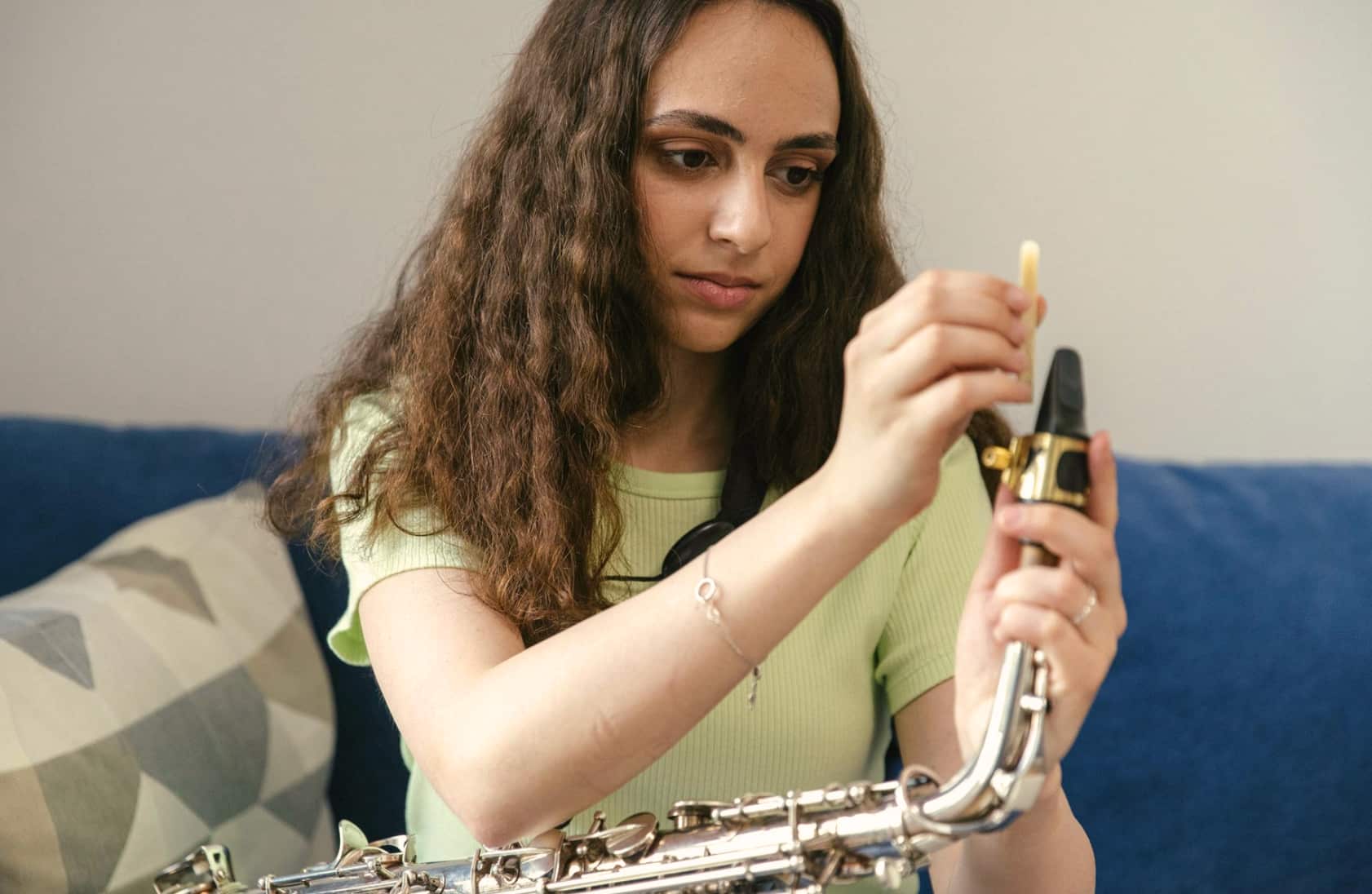
- Instrument check. The teacher checks your saxophone (or the one you’re hiring), reed strength, mouthpiece, and neck strap height. Most beginners arrive with at least one thing badly set up, and fixing it makes everything easier.
- First sound. You’ll produce your first note within 15 minutes. Probably not a beautiful one, but a real saxophone note. This part is genuinely exciting.
- Three or four core principles. The teacher will introduce embouchure shape, posture, finger position, and basic breath support. You won’t master them (that takes weeks), but you’ll know what you’re aiming for.
- A clear practice plan for the week. A specific 15 to 20 minute daily routine. Vague homework (“just practice!”) is a red flag.
Walking out of a first lesson, you should feel two things: slightly overwhelmed in a good way, and clear on exactly what to do this week. If you walk out feeling confused or like the teacher rushed through everything, try someone else.
So, are saxophone lessons worth it for beginners?
For the vast majority of beginners, yes. The saxophone rewards good fundamentals more dramatically than almost any instrument, and the fundamentals are nearly impossible to self-correct because you can’t see them. A qualified teacher will get you to a level in six months that takes self-taught players two to three years, and the player you become at the end of those six months will sound dramatically better.
The cost is real. $90 to 120 per hour in Sydney adds up, but compared to the cost of a saxophone itself ($1,500 to $3,000 for a decent beginner alto) and the time you’re already investing in practice, lessons are the highest-leverage spend in the whole journey. Skipping them to save money is the classic false economy: cheap now, expensive later, and the unlearning is harder than the original learning.
The most useful first step for anyone weighing it up is a trial lesson with a qualified teacher. You’ll know within an hour whether saxophone is for you and whether you click with the teacher you’ve chosen.
Frequently asked questions
How often should a beginner take saxophone lessons? Weekly is the standard for the first year and produces the fastest progress. Fortnightly works if budget is tight, but expect roughly half the rate of improvement. Less than fortnightly tends not to be worth the disruption, since most of the value comes from regular feedback before bad habits set in.
What age can kids start saxophone lessons? Most teachers start kids at around 9 or 10, when they’re physically big enough to comfortably hold an alto saxophone and have enough lung capacity. Younger kids (6 to 8) can sometimes start on a curved soprano or alto with a strap modification, but it’s worth checking with a teacher first.
Do I need to buy a saxophone before my first lesson? No. Most good Sydney teachers either have hire instruments available or can point you to a music retailer that does. Hire is typically $40 to $70 per month and lets you start lessons without committing to a $1,500+ purchase before you know you’ll stick with it.
Is the saxophone harder than the clarinet or flute? Saxophone is generally considered the easiest of the three to get a basic sound on, harder than clarinet for advanced tone production, and significantly easier than flute (where producing any sound at all takes most beginners weeks). For a complete beginner with no wind instrument experience, alto saxophone is the most forgiving start.
What saxophone accessories does a beginner actually need? A neck strap (the one that came with your instrument is usually fine for the first year), a box of reeds in 1.5 or 2 strength, cork grease, a cleaning cloth, a teeth pad for the motuhpiece, and a music stand. Total cost around $80 to $120. Mutes, fancy mouthpieces, and ligature upgrades can wait until at least year two.
 September 30, 2026
Where Could I Find an Affordable Clarinet Teacher in Sydney?
TL;DR A limited monthly budget can still leave you with options for clarinet lessons in Sydney. Start with the price… September 26, 2026
Where to Actually Look Before You Buy an Instrument
The obvious first search usually isn't the right one. The instinct is almost always the same. A lesson gets booked,… September 23, 2026
What Should I Learn First on Piano? A Beginner’s Step-by-Step Guide
TL;DR Start by learning the keyboard pattern, a small group of notes, finger numbers and a steady beat. Practise a… September 23, 2026
How Much Does Logic Pro Cost for Beginners?
TL;DR Logic Pro is Apple's music production software for Mac. In Australia, Logic Pro for Mac costs $299.99 as a…