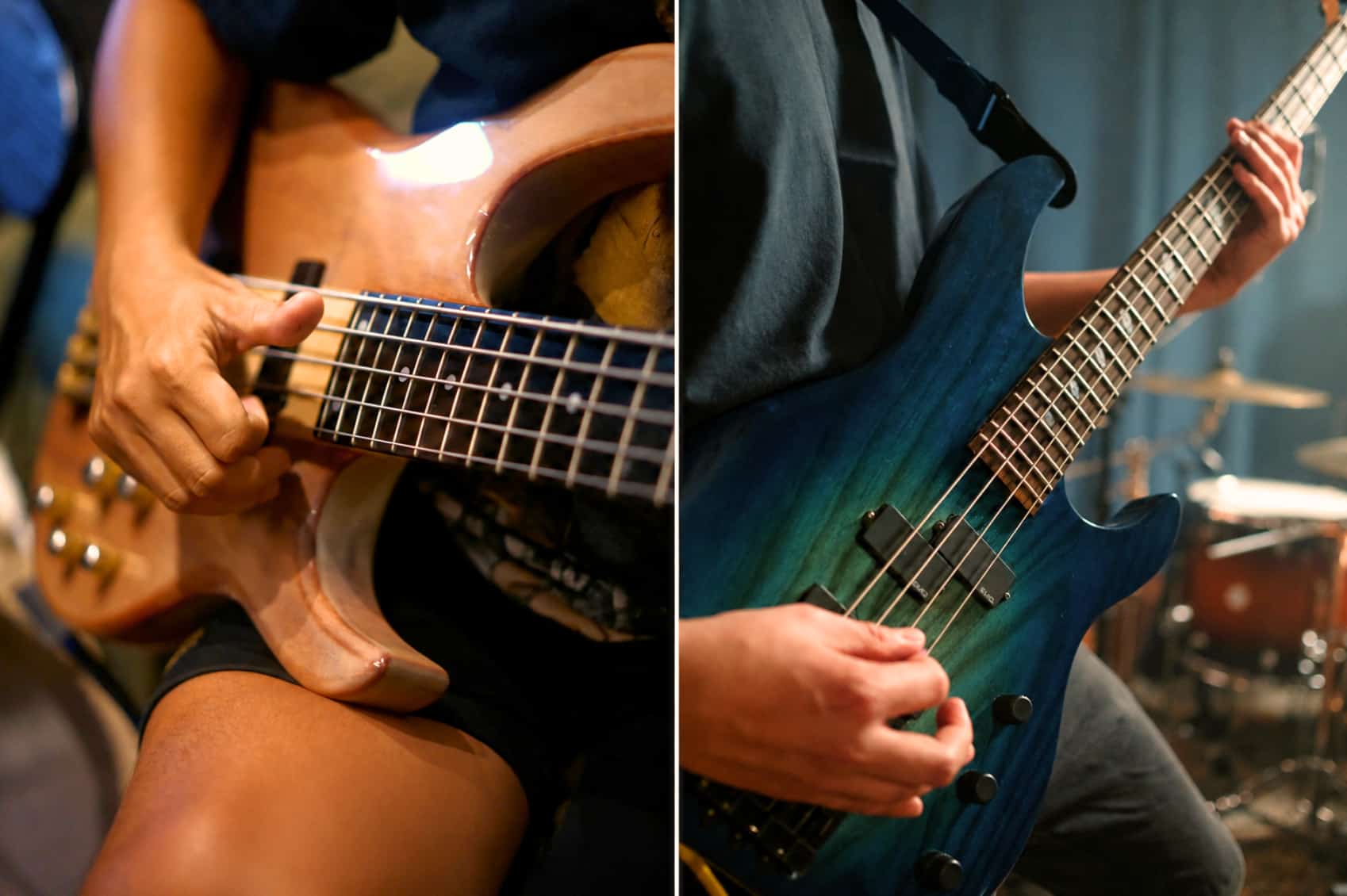
For most beginners, a 4-string bass guitar is the better choice. It’s lighter, has wider string spacing that’s easier on developing hands, builds stronger fretboard knowledge, and matches the standard most teachers and learning resources use. The case for starting on a 5-string is real but narrow: if you specifically want to play metal, modern gospel, R&B, or progressive styles that consistently use the low B string, starting on 5 makes sense. If you’re somewhere in the middle or unsure, 4-string is the safer call. If you’re starting out in Sydney and want help deciding which suits the music you actually want to play, bass guitar lessons include guidance on instrument choice as part of your first few weeks.
Is a 4-string or 5-string bass guitar easier for beginners?
A 4-string is genuinely easier for beginners and most experienced teachers will steer you there first. The neck is narrower, the strings are spaced more comfortably for developing hands, the bass weighs less for the long practice sessions ahead, and almost every beginner lesson resource (tabs, songbooks, online courses) is written assuming you have four strings.
The 5-string isn’t dramatically harder, but the differences add up early on. The neck width increases by around 6 to 10mm to fit the extra string, which feels significant to a beginner whose hand strength and finger independence are still developing. Right-hand muting becomes more complicated because there’s another ringing string to control. And the visual layout of the fretboard gets busier, which can slow down note recognition in the first few months.
It’s worth noting that the vast majority of recorded bass history was made on 4-string instruments. Jaco Pastorius, James Jamerson, Paul McCartney, Carol Kaye, and Geddy Lee all built their reputations on 4-string basses, and Victor Wooten still reaches for his 4-string Fodera more often than any of the extended-range basses he owns. The 4-string isn’t a stepping stone, it’s the standard the instrument was built around.
What’s the actual difference between a 4-string and 5-string bass?
A 4-string bass is tuned E-A-D-G from low to high, while a 5-string adds a low B string below the E, giving you B-E-A-D-G. The extra string gives you access to five additional low notes (B, C, C#, D, D#) without needing to detune your bass.
A few practical differences worth knowing before you decide:
- Neck width: 5-string necks are wider to accommodate the extra string
- String spacing: Some 5-strings keep standard spacing (wider neck), others compress the spacing (narrower neck, trickier for slap technique)
- Weight: 5-strings are typically heavier by 200 to 400 grams, which matters across a 2-hour rehearsal
- Cost: A comparable quality 5-string usually costs around 20% more than the 4-string version, and replacement strings cost more too
There’s also a less common 5-string variant tuned E-A-D-G-C that adds a high C string instead of a low B, used mainly by players who solo a lot and want to reduce shifting. Unless you specifically want this, the low B configuration is what people mean by “5-string bass.”
Who should actually start on a 5-string bass?
You should start on a 5-string if you already know the music you want to play frequently uses notes below the low E. The clearest cases are modern metal (especially anything in drop tunings or with extended low ranges), modern gospel and R&B (where the low B gets used regularly), and progressive rock or fusion where bass lines extend below standard 4-string range.
The reasoning is practical: if you start on 4-string knowing you’ll switch to 5-string within a year or two, you’re building muscle memory you’ll have to partially rebuild. The fretboard map shifts (what was your E string becomes your second-lowest string), your right hand has to learn new anchoring habits, and the techniques you’ve drilled into reflex have to be re-examined. Starting on the instrument you’ll actually use long-term avoids that transition cost.
Players who built their sound around the 5-string include John Patitucci, Anthony Jackson (who actually pioneered the 6-string, but his 5-string contrabass work shaped modern bass language), and the modern gospel scene built on players like Sharay Reed. If those names mean something to you and that’s the music you want to play, the 5-string makes sense from day one. If you don’t recognise the names, that’s a strong signal that 4-string is where you should start.
What’s the “proximity” benefit of a 5-string bass?
The proximity benefit is the ability to play certain notes without shifting your hand position, because the same note exists on multiple strings within easy reach. A 5-string essentially gives you a second fretboard map where notes you’d normally have to shift down for are right under your fingers.
A concrete example: if you’re playing a groove in the upper register and need to drop to a low F#, on a 4-string you have to shift your hand down to the second fret of the E string. On a 5-string, that same F# is sitting on the seventh fret of the B string, right where your hand already is. Multiply that across a whole song and the proximity advantage adds up. Less shifting means cleaner playing, smoother transitions, and more energy for the parts of the music that matter.
This benefit really shines when playing chords on bass. A 4-string forces you to play extended chord voicings without the root because there’s no room for a low bass note underneath. A 5-string lets you keep the root in the bass while extending the chord upward, which produces a fuller harmonic sound. This is one of the reasons solo bassists like Steve Bailey moved toward extended-range instruments, and why session players in modern worship and R&B contexts consistently choose 5-string. For someone playing in a traditional band where the bass plays single-note lines, this advantage matters far less.
Will a 5-string bass make me a worse player?
A 5-string can stall your fretboard development if you lean on it as a shortcut instead of a tool. Because so many notes are available without shifting, players who start on 5-string sometimes never properly learn the full range of the bass, particularly the higher positions on the lower strings. This isn’t an inevitable problem, but it’s a real one teachers notice.
The trap looks like this: a 5-string player learns to find every low note on the B string and never explores playing those same notes higher up on the E or A strings. When they pick up a 4-string later, they suddenly can’t find their way around because the muscle memory and visual cues they relied on aren’t there anymore. They’ve built efficiency at the cost of breadth.
The fix is straightforward: whether you play 4 or 5 string, drill fretboard knowledge across all strings deliberately, not just in the positions your music naturally lands in. A 4-string forces this practice through necessity. A 5-string requires you to choose it. Both can produce excellent players, but the 4-string makes the discipline harder to avoid.
Can I just detune my 4-string to get the lower notes?
You can, but it creates trade-offs that often make a proper 5-string the cleaner solution. Dropping your E string to D (drop D tuning) gives you two extra low notes (D and D#) and works fine for songs written in that tuning. Going further with BEAD tuning (where your E becomes a B and you lose the high G entirely) gives you the same low range as a 5-string, but you lose the upper range a 4-string usually provides.
For occasional song-by-song detuning, this works well and many bassists do it. The problem comes when you’re switching tunings constantly during a setlist or playing styles that consistently demand the low range. At that point you’re either retuning between every song (impractical live) or playing the whole set in a non-standard tuning that limits other songs (impractical musically). If your music genuinely lives below low E most of the time, a 5-string is the better instrument for the job.
Do I need a 5-string for slap bass?
No, 5-string isn’t required for slap technique and many slap players actively prefer 4-string. The wider string spacing on a 4-string makes slapping and popping easier because there’s more room for your thumb and fingers to move cleanly between strings. Some 5-strings keep similar spacing by widening the neck, but others compress spacing to keep the neck manageable, which makes slap technique noticeably trickier.
Marcus Miller, the player most associated with modern slap bass, built his entire signature sound on a 4-string Fender Jazz Bass and continues to play 4-string as his primary instrument. Larry Graham, who essentially invented slap bass technique, also played 4-string throughout his career-defining work. If slap-heavy funk, R&B, or fusion is your main interest, start on 4-string and don’t worry about adding the fifth string until you’ve developed the technique. The low B isn’t where slap bass mostly lives anyway.
What beginner bass brands are worth looking at?
The major manufacturers most Sydney music shops carry produce reliable entry-level basses that play well once properly set up. Fender’s Squier line, Ibanez’s SR and GSR series, Yamaha’s TRBX range, and Sterling by Music Man all offer beginner-friendly 4-string and 5-string options in the $400 to $900 AUD range that will serve a beginner for years.
What to actually focus on when comparing beginner basses:
- Setup quality: A well-set-up budget bass plays better than a poorly-set-up expensive one
- Neck profile: Some beginner basses have thinner necks that suit smaller hands, others go wider
- Weight: Pick the bass up and hold it for two minutes before deciding (you’ll be holding it for hours later)
- Active vs passive electronics: Passive is simpler for beginners and never runs out of battery
The brand matters less than the individual instrument’s setup and fit. Two basses from the same model line can play very differently depending on the factory they came from and how they’ve been handled in transit. This is why buying from a music shop that sets up every bass before sale matters more than chasing a specific brand name.
How much does a beginner bass guitar cost in Sydney?
A decent beginner 4-string bass guitar in Sydney costs between $400 and $800 AUD for a quality entry-level instrument with proper setup. A comparable 5-string typically runs $500 to $1,000 AUD because of the extra hardware and slightly more complex construction. Anything significantly cheaper usually has setup issues that make playing harder than it needs to be, particularly action that’s too high and frets that aren’t properly finished.
Most Sydney music shops across the Inner West, North Shore, and Eastern Suburbs carry beginner-friendly basses in this range, and many offer setup services that make a real difference to playability. A $500 bass set up properly will outplay a $700 bass straight out of the box, every time. If you’re buying second-hand through marketplace listings, factor in around $80 to $150 for a setup adjustment by a local tech, because a used bass that’s been sitting unused for a year almost always needs neck relief, intonation, and string changes before it plays well.
Where can I get bass guitar lessons in Sydney?
Sydney has a strong network of bass guitar teachers across the Inner West, Eastern Suburbs, North Shore, and Strathfield areas, with lessons typically running 30 to 60 minutes weekly. The best teachers for beginners are usually those who play bass primarily rather than guitarists who teach bass on the side, because the right-hand technique, groove development, and timing focus on bass differ meaningfully from guitar.
If you’re choosing between 4-string and 5-string and aren’t sure which suits the music you want to play, working with a teacher in the first month often clarifies the decision faster than any amount of online research. A teacher can hear what genres you naturally gravitate toward, watch how your hands physically interact with each instrument, and recommend the path that fits both your goals and your physical setup.
 September 30, 2026
Where Could I Find an Affordable Clarinet Teacher in Sydney?
TL;DR A limited monthly budget can still leave you with options for clarinet lessons in Sydney. Start with the price… September 26, 2026
Where to Actually Look Before You Buy an Instrument
The obvious first search usually isn't the right one. The instinct is almost always the same. A lesson gets booked,… September 23, 2026
What Should I Learn First on Piano? A Beginner’s Step-by-Step Guide
TL;DR Start by learning the keyboard pattern, a small group of notes, finger numbers and a steady beat. Practise a… September 23, 2026
How Much Does Logic Pro Cost for Beginners?
TL;DR Logic Pro is Apple's music production software for Mac. In Australia, Logic Pro for Mac costs $299.99 as a…