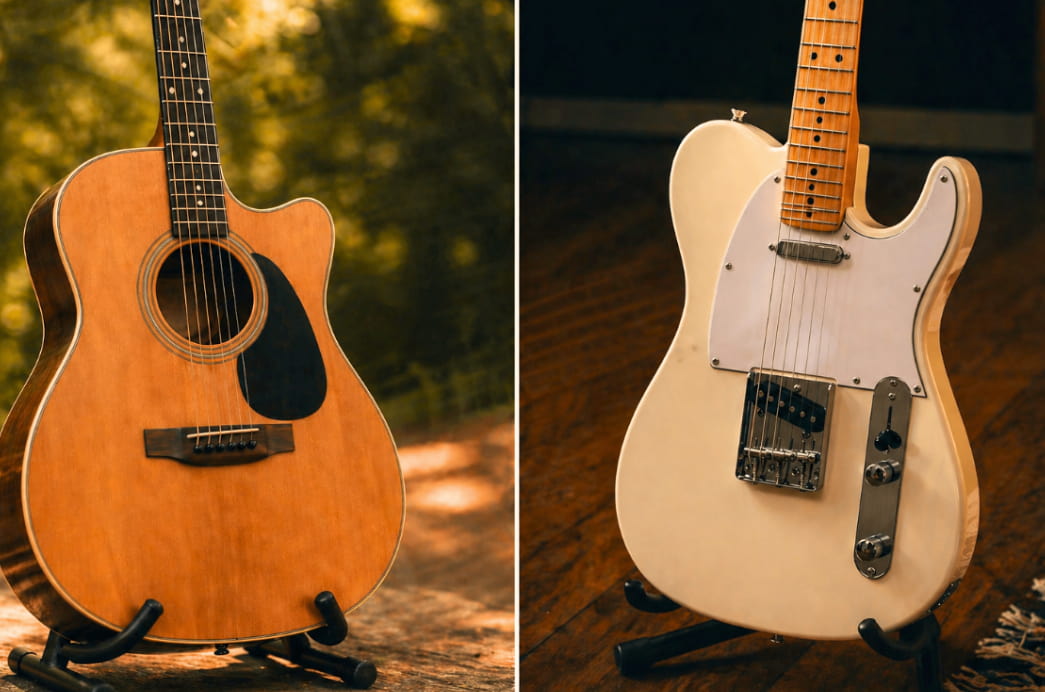
If you want to progress quickly as a beginner, electric guitar is physically easier to play than acoustic — the strings are lighter, the action is lower, and it takes significantly less hand strength and stamina to fret notes cleanly. That’s not an opinion, it’s just how the instruments work. Whether that makes electric the right starting point for you depends on what music you want to play, but the idea that acoustic is the better starting point for all beginners is one of the most persistent myths in guitar teaching. If you’re looking into guitar lessons, understanding this distinction before you buy anything will save you a lot of frustration.
Electric vs Acoustic Guitar for Lessons: Quick Comparison
Electric guitar for lessons:
- Lighter strings and lower action make fretting physically easier from day one
- More expensive as you have to buy an amp and lead cable to get proper sound
- Less hand stamina required, so you can practise longer before fatigue sets in
- Faster early progress for most beginners because the physical barrier is lower
- Best for rock, blues, metal, funk, R&B, and jazz
- Requires an amp, cable, and basic gear budget
- Lighter strings are more likely to shift under fingers, which can make chords sound out of tune while you’re still developing fretting accuracy
Acoustic guitar for lessons:
- No extra gear needed, pick it up and play anywhere
- Acoustic guitar is cheaper than an electric guitar plus an amp
- Heavier strings and higher action require more hand strength and build calluses faster
- Physical difficulty can slow early progress and discourage beginners before they build repertoire
- Best for folk, singer-songwriter, country, pop strumming, and fingerpicking styles
- More forgiving of technique errors due to natural resonance
The short answer: electric is easier to play and most beginners progress faster on it. Start electric if you want to play electric music. Start acoustic if acoustic is the sound you’re actually chasing and want a cheaper option.
Does Starting on Electric Guitar Actually Help You Progress Faster?
For most beginners, yes. Because the strings are lighter and the action is lower, you can practise for longer before hand fatigue sets in. More practice time with less physical frustration means you cover more ground in the early weeks, which is when the habit of picking up the guitar either forms or doesn’t. Students who hit a wall of finger pain and hand soreness on acoustic in week two often put the guitar down and don’t come back. Students on electric tend to get past that initial stage and into actual music faster.
There are also techniques that are simply easier to learn on electric first. String bending is a good example — bending notes is a core part of rock, blues, and lead guitar playing, and on an acoustic the heavier strings make getting a bend in tune significantly harder. On electric, lighter strings mean you can actually hear and feel whether your bend landed on the right pitch, which is how the ear gets trained. Trying to learn bending on acoustic is like learning to parallel park in a truck — possible, but unnecessarily difficult when a smaller car is available.
The myth is that this makes electric a shortcut that produces weaker players. It doesn’t, it just produces a different kind of challenge earlier. Because electric strings are so responsive, small technique errors are more audible on a clean tone through an amp: unwanted string noise, imprecise muting, sloppy pick attack. On acoustic, the fuller natural resonance masks some of that. So electric actually demands more technical precision from early on, just without the added physical difficulty of heavier strings.
What electric doesn’t develop as quickly is raw grip strength. That matters if your long term goal includes acoustic guitar at a high level. But for the majority of beginners whose goal is to play the music they love and stick with it, the easier physical entry point of electric is a genuine advantage, not a compromise.
Does It Actually Matter Which Guitar You Start With for Guitar Lessons?
It matters more than people expect, but for different reasons than most assume. The common advice is “start acoustic because it builds finger strength.” That’s not wrong, but it’s incomplete. The real question is whether the instrument you’re practising on connects to the music you’re motivated to play. A student who wants to play Arctic Monkeys practising on a steel-string acoustic every day is fighting their own motivation from week one.
The guitar you start on shapes what you naturally gravitate toward, how quickly you build a practice habit, and which technical skills get drilled first. Those early weeks matter more than people realise because that’s when the habit either forms or doesn’t.
Is Acoustic Guitar Actually Harder for Beginners?
Yes, and by a meaningful margin. Acoustic guitars have higher string action and heavier gauge strings than most electrics. That combination means your fretting hand has to work significantly harder to press notes down cleanly, chord transitions require more grip strength, and your fingers fatigue faster during practice. On an electric, the lower action and lighter strings let you fret with much less pressure, which means you can practise longer before your hands give out and you build muscle memory more quickly because the physical barrier is lower.
This is why the “start acoustic to build strength” advice is only half right. Yes, acoustic builds hand strength faster. But it also slows early progress because beginners spend energy fighting the instrument instead of learning music. A student on electric can get through more material in the same time, stay motivated longer in each session, and reach the point where playing actually feels rewarding sooner. The hand strength comes eventually on electric too, just through a more gradual path that doesn’t chew through beginners before they’ve had a chance to fall in love with playing.
The one honest downside: if you eventually want to play acoustic at a high level, you’ll need to put specific time into it. Skills transfer well between the two, but acoustic has its own physical demands that electric practice doesn’t fully prepare you for.
What Does It Actually Cost to Start on Electric vs Acoustic in Sydney?
The guitar price difference between a decent beginner electric and acoustic isn’t huge – both sit in the $200 to $400 range new for something playable. The real cost difference is what comes with each.
Starting on acoustic, all-in budget roughly looks like (essentials bolded):
- Guitar: $200 to $400
- Guitar setup by a luthier: $60 to $80
- Capo, picks, spare strings: $30 to $50
- Rough Total: $300 to $500
Starting on electric, all-in budget roughly looks like (essentials bolded):
- Guitar: $250 to $450
- Practice amp: $100 to $200
- Cable: $20 to $40
- Guitar setup: $60 to $80
- Picks, spare strings: $20 to $30
- Rough Total: $450 to $800
That gap is real and worth knowing upfront. It’s not a reason to avoid electric if that’s the music you want to play, but going in expecting to just buy the guitar and nothing else is how beginners end up playing electric unplugged through nothing, which defeats the purpose. Budget for the full setup from the start and the electric path is straightforward. Budget only for the guitar and you’ll hit friction on day one.
What Style of Music Do You Actually Want to Play?
This is the most important question and most beginners skip it. The instrument should match the genre, not the other way around.
Acoustic guitar is the natural home for:
- Singer-songwriter and folk styles
- Fingerpicking and classical-adjacent playing
- Strumming-based pop and country
- Campfire and social playing situations
Electric guitar suits:
- Rock, blues, metal, and punk
- Funk and R&B
- Jazz (semi-hollow electrics)
- Any style where effects, tone, and amp sound are part of the music
If you want to play Fleetwood Mac, an acoustic makes sense. If you want to play Jimi Hendrix, starting on acoustic and planning to switch later means you’re delaying the actual skills you need: bending strings, using a pick with precision, working with an amp and tone controls.
One option worth knowing about if you’re genuinely torn: semi-hollow body electric guitars. They have the playability of an electric (lighter strings, lower action) but a hollow or partially hollow body that gives a warmer, slightly more acoustic-like tone. They work well across jazz, blues, and classic rock, and for someone who likes the sound of acoustic but wants the physical ease of electric, it can be a practical middle ground.
Can You Switch From Acoustic to Electric Later Without Starting Over?
Yes, and the transition is smoother than most people expect. The foundational skills (chord shapes, scales, strumming patterns, music reading or tab, picking technique) transfer almost entirely. The adjustment when switching to electric is mostly about touch and volume control. Electric strings respond to much lighter pressure, so students coming from acoustic tend to over-fret and play too hard initially. That settles within a few sessions.
Going the other direction, electric to acoustic, takes a bit longer. The increased string tension and action require the fretting hand to adapt, and students often find barre chords significantly harder on acoustic than they were on electric. It’s not a major setback, just an adjustment period of a few weeks.
How Much Does the Setup of the Guitar Matter for Beginner Guitar Lessons?
More than the acoustic vs electric debate, honestly. A poorly set up guitar with high action, poor intonation, and cheap tuners will make learning painful and demoralising regardless of whether it’s acoustic or electric. A well set up guitar in either category will be a pleasure to play from day one.
This is where budget decisions get complicated. A $200 acoustic from a big box store with no setup work done is often harder to play than a $300 electric that’s been professionally set up. Bxuy a mid-range instrument and get it set up by a luthier before your first lesson. That single step makes more difference to playability than the brand or even the price point.
Do You Need an Amp if You Start on Electric Guitar?
Yes, and it’s worth being honest about what that means for a complete beginner. The electric guitar setup – amp, cable, potentially a tuner pedal – adds a layer of decisions that an acoustic doesn’t have. New players can genuinely waste early practice time figuring out why their amp sounds bad, why there’s buzzing in the signal, or which settings to use, instead of just playing. That friction is real and it’s worth planning for before you buy.
The practical solution is to keep it simple from the start. A small 10 to 20 watt solid state practice amp with a built-in tuner, a single cable, and nothing else covers everything a beginner needs. Avoid the rabbit hole of effects pedals until you’re at least six months in – they add cost, complexity, and distraction when what you actually need is repetition. For students in apartments across Sydney’s St George area, inner west, or the city who are worried about noise, most small practice amps have a headphone output so you can play silently. Once the setup is dialled in and simple, electric guitar practice is no more complicated than acoustic.
One counterintuitive point worth knowing: an unplugged electric guitar is actually quieter than an acoustic. If you live in an apartment or share walls, late-night practice on an unplugged electric disturbs less than strumming acoustic chords in the same room. Plug in with headphones and you’re completely silent. This is a practical advantage that rarely gets mentioned when people compare the two.
Which Guitar Is Better for Taking Lessons as an Adult Beginner?
Adult beginners are in a slightly different position to kids. They usually have a clearer sense of what music they want to play, stronger motivation when the material connects, and less patience for practising something that doesn’t feel relevant to their actual goal. For that reason, adult beginners in particular benefit from starting on whichever instrument matches their taste rather than defaulting to acoustic because it’s considered the “proper” starting point.
Adults also tend to have more sitting tolerance for technical practice, which means the initial finger soreness on acoustic is manageable if the repertoire is engaging. But there’s no developmental reason an adult needs to start acoustic before electric. A teacher running guitar lessons in Sydney who tells every adult beginner to start acoustic regardless of their goals is applying a one-size rule to a question that genuinely depends on the individual.
What Do Most Guitar Teachers Actually Recommend?
Most experienced teachers don’t have a blanket answer, and that’s a good sign. The ones who say “always start acoustic” are usually applying an old-school approach that made more sense when electric guitars and amps were expensive and less accessible. The ones who say “always start electric because it’s easier” are prioritising comfort over long-term development.
The conversation a good teacher has with a new student covers what music they want to play, what their practice environment looks like, how much they want to spend, and what their timeline is. From that, the instrument recommendation follows naturally. If a teacher skips that conversation and gives you a guitar recommendation in the first thirty seconds, it’s worth asking why.
Is a Classical Guitar a Good Option for Beginners?
Classical guitar often gets recommended to beginners because nylon strings are softer on the fingers than steel strings. That part is true. But classical guitar is a genuinely different instrument in terms of technique, posture, and repertoire. The neck is wider, fingerstyle technique is built in from the start, and a lot of the chord shapes and strumming approaches that work on steel-string acoustic or electric don’t translate directly.
If someone wants to play classical music, a classical guitar with a teacher who specialises in that style is the right path. If someone just wants an easier entry point into guitar and classical guitar gets recommended purely for the soft strings, that’s mismatched advice. A well set up steel-string acoustic or electric will serve a beginner better than a classical guitar they’re not actually interested in playing.
What’s the Honest Verdict on Electric vs Acoustic for Beginners?
At its core, this isn’t really a technical decision. It’s a commitment decision dressed up as one.
Acoustic asks for more effort upfront. The physical discomfort is real in the first few weeks, and the payoff takes longer to feel. Electric removes that early friction but requires more active discipline from your teacher to make sure technique doesn’t slide. So the most useful question isn’t “which guitar is better for beginners”, but rather: am I “am I more likely to quit because it’s physically hard, or because it feels slow and unrewarding?” Despite the potentially slightly higher upfront cost, electric guitar seems to be better option for most beginners.
If you genuinely don’t know yet, acoustic is a reasonable default because it’s versatile across styles and doesn’t require additional gear. But if you already know you want to play electric music, don’t talk yourself into acoustic to “build a foundation first.” The foundation gets built on whichever guitar you actually pick up consistently, and that’s almost always the one connected to music you care about.
For students across Sydney, whether you’re in the Hills District, Inner West, North Shore, the Shire, or St George, the clearest starting point is a conversation with a teacher before you buy anything.
Find a teacher offering guitar lessons in Sydney and ask for detailed advice.
 September 30, 2026
Where Could I Find an Affordable Clarinet Teacher in Sydney?
TL;DR A limited monthly budget can still leave you with options for clarinet lessons in Sydney. Start with the price… September 26, 2026
Where to Actually Look Before You Buy an Instrument
The obvious first search usually isn't the right one. The instinct is almost always the same. A lesson gets booked,… September 23, 2026
What Should I Learn First on Piano? A Beginner’s Step-by-Step Guide
TL;DR Start by learning the keyboard pattern, a small group of notes, finger numbers and a steady beat. Practise a… September 23, 2026
How Much Does Logic Pro Cost for Beginners?
TL;DR Logic Pro is Apple's music production software for Mac. In Australia, Logic Pro for Mac costs $299.99 as a…