If you’re unsure what instrument to learn, don’t start with “what sounds cool”. Start with function. Every instrument has a job in the mix — some lead, some support harmony, some control rhythm, and some anchor the low end. Once you know the role, you can pick something that matches how you want to show up in music: front and centre, quietly essential, or driving everything underneath.
Bowed Strings
Violin teaches you to be the lead voice. Its main function is carrying melody — it sits high enough to cut through an ensemble, it can move quickly, and it can sound both delicate and intense. In orchestras it often holds the main themes, fast passages, and the parts that create forward motion. If you want an instrument that frequently “speaks” and shapes the musical direction, violin is built for that role.
Viola puts you in the role of harmonic glue. It usually lives in the inner voices, filling the space between the highs and lows and making the whole string section sound rich and complete. It often carries harmony, chord movement, and supporting lines that give music warmth. You might not always notice a viola part on its own, but when it’s missing, the sound feels thinner. Its function is subtle but essential.
Cello gives you a voice that can support and sing. Its function is unique because it sits in a register that feels close to the human voice. It can play bass movement and harmony support, but it can also carry long, lyrical melodies with serious emotional weight. In ensembles it often holds counter-melodies and supportive lines that make the music feel deeper and more grounded. It’s the “heart” instrument in many arrangements.
Double bass trains you to be the foundation. In orchestra it reinforces the lowest notes, giving the music weight and stability. In jazz it’s even more direct: the bass defines the pulse and outlines the harmony, which is why the whole band feels different when the bass is strong. Its function isn’t to grab attention — it’s to make everything else feel confident and locked in.
Plucked Strings
Acoustic guitar trains you for accompaniment and rhythm. Its main function is providing chord structure and groove under vocals or other lead instruments. It’s the instrument that makes a song feel “complete” even with minimal arrangement. In practical terms, acoustic guitar is a one-person rhythm section: you can support a singer, lead a singalong, or hold a whole performance by yourself.
Electric guitar is about tone, texture, and lead expression. It can function as rhythm (chords and patterns), but in modern music it often becomes the identity of the track — riffs, textures, and solos that sit above the mix like a second voice. Because the sound is shapeable through amps and effects, electric guitar frequently handles the “colour” role as well as the lead role. It’s the instrument that can change the mood instantly.
Bass guitar puts you in charge of groove and movement. Its function is linking rhythm and harmony: it locks with the drums to create pocket, while outlining the chord progression so the music feels structured. A good bassline makes everything sound tighter and more expensive, even if it’s simple. You might not always be the loudest instrument, but you’re often the one controlling how the music feels in the body.
Ukulele gives you quick access to supportive harmony. Its function is light chordal accompaniment with a bright, upbeat character. It’s excellent for strumming patterns, rhythmic bounce, and supporting vocals without overpowering anything. That’s why it works so well for casual playing, group music, and anyone who wants to start making songs quickly. Functionally, it gets you participating fast.
Harp is about atmosphere and harmonic shimmer. In ensembles, the harp’s function is usually colour rather than drive — arpeggios that create motion, glissandos that mark big moments, and textures that make music feel cinematic. It’s often used to highlight transitions, soften an entry, or add sparkle above or between other instruments. If you want an instrument that makes the whole sound feel more magical and spacious, that’s what harp does best.
Woodwind
Flute trains you for bright melodic lines and agility. Its function is usually melodic: it adds lift and clarity in the upper register and can move quickly with clean articulation. In ensembles it often carries light themes, decorative runs, and high colour that floats above the rest of the texture. It can also blend softly when needed, but its core job is to add brightness and motion.
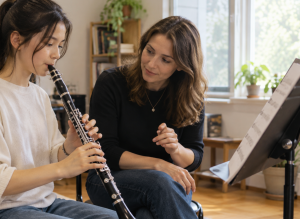
Clarinet gives you a flexible middle voice. Its function shifts depending on the ensemble: it can blend into harmony, double melodies, or step forward for solos with a warm, expressive tone. Because it spans a wide range, it can act as both a supporting instrument and a melodic one. In practical terms, clarinet is the “connector” woodwind — it fills gaps, strengthens harmony, and becomes a lead voice when the arrangement calls for it.
Saxophone trains you for expressive lead presence. In jazz and contemporary music, saxophone often functions as the headline voice — hooks, solos, and melodic statements that feel direct and emotional. Its tone has a voice-like quality, and it sits in a range that reads clearly to listeners, which is why it’s such a strong feature instrument. Functionally, saxophone is often the “main character” when it’s present.
Oboe gives you a signature voice that cuts through. Its function is delivering clear, penetrating lines that stay audible even in dense ensemble writing. Its tone is distinctive — most people can identify it immediately — which is why composers often use it for exposed solos and memorable melodic moments. In orchestras it’s also used as a tuning reference because it sits so clearly in pitch centre. Functionally, it’s precision and identity.
Bassoon trains you for low-end support with character. It often functions as the bass voice of the woodwinds, reinforcing harmony and giving depth without the brightness of brass. It also gets featured moments because its tone has personality — it can sound playful, dry, or deeply lyrical depending on context. Functionally, it’s both a structural support instrument and a colour instrument in the low register.
Recorder builds clear melodic fundamentals. Historically it’s a melodic woodwind, but in modern learning its function is often educational: it teaches breath control, pitch accuracy, phrasing, and reading without complex mechanics. It’s a clean way to build core musical skills that transfer well to other woodwinds. Functionally, recorder is a strong starting platform for musical literacy.
Brass
Trumpet trains you for projection and punch. Its function is to cut through and deliver strong melodic statements — fanfares, hooks, bright lead lines, and high harmonies that energise the arrangement. In bands it often carries the melody or the parts that make the section sound powerful and confident. Functionally, trumpet is the “signal”: it announces and leads.
Trombone gives you power plus expressive movement. It often functions as harmony support in the brass section, thickening chords and adding authority, but it also has the slide — which creates a smooth, vocal-like phrasing and the ability to glide between notes. In jazz and contemporary styles it can be both rhythmic and melodic. Functionally, it’s weight and expressiveness in one.
French horn trains you for warm harmonic glue and cinematic tone. Its function in orchestral writing is often to bridge sections — it blends with strings, woodwinds, and brass, making transitions feel smooth and rich. It supports harmony with warmth, and it also delivers those heroic, expansive lines that feel instantly “film score”. Functionally, it’s the instrument that deepens and elevates the whole sound.
Euphonium gives you a lyrical brass voice. In concert bands, it often functions as a “singing” instrument — warm melodic lines, smooth phrasing, and supportive harmonies that don’t feel sharp or aggressive. It can sit inside the texture or step forward as a melodic feature. Functionally, it brings melody-quality warmth to the low brass range.
Tuba trains you to anchor the entire foundation. Its function is bass: it supports harmony, reinforces rhythm, and gives the ensemble physical weight. In bands and orchestras it’s the bottom pillar — if it’s solid, everything above it sounds more stable. Functionally, it’s the ground. It makes big music feel big.
Percussion
Drum kit puts you in charge of time and energy. Its function is defining groove, controlling dynamics, and managing transitions — builds, drops, fills, and the overall shape of a song. Even if the rest of the band plays well, the music only feels tight when the drums are consistent and locked in. Functionally, drum kit is the engine and the steering wheel.
Percussion covers texture, accents, and impact. Its function in ensembles is often to add definition and colour — tuned percussion lines, rhythmic patterns, cymbal swells, and accents that make moments land. It can be subtle atmosphere or dramatic punctuation. Functionally, it’s the layer that makes an arrangement feel complete and dynamic.
Keyboard
Piano trains you for full musical control. Its function is unique because it can handle melody, harmony, and rhythm at once. That makes it one of the best instruments for understanding musical structure, supporting singers, and learning how songs are built. In ensembles, piano can be rhythmic, harmonic, melodic, or all three depending on style. Functionally, it’s the all-in-one toolkit.
Accordion gives you portable harmony with a distinctive sustained tone. Like piano, it can handle chords and melody, but it adds a breath-driven sustain that creates a very specific sound and feel. Its function is often to fill space, drive rhythm, and carry melody at the same time — especially in folk, pop, and dance styles where that sound is part of the identity. Functionally, it’s a mobile accompaniment engine with personality.
Voice
Singing trains you for the most direct musical role: the narrative lead. In most modern music, the voice is the focal point — it carries melody, delivers lyrics, and shapes emotion in a way listeners connect with instantly. Other instruments support it, answer it, or create space around it. Functionally, singing is the story, not just the sound.
A simple way to choose
If you want to lead, look at violin, flute, trumpet, saxophone, or singing. If you want to support and strengthen the whole sound, viola, clarinet, French horn, or piano are strong fits. If you want to drive rhythm and feel, drum kit, bass guitar, or double bass are the natural choices. If you want colour and atmosphere, harp, oboe, and percussion are hard to beat.
Visit Sydney Music Lessons and select which instrument you want lessons for to find a map of teachers to compare based on location, prices and more.
 September 30, 2026
Where Could I Find an Affordable Clarinet Teacher in Sydney?
TL;DR A limited monthly budget can still leave you with options for clarinet lessons in Sydney. Start with the price… September 26, 2026
Where to Actually Look Before You Buy an Instrument
The obvious first search usually isn't the right one. The instinct is almost always the same. A lesson gets booked,… September 23, 2026
What Should I Learn First on Piano? A Beginner’s Step-by-Step Guide
TL;DR Start by learning the keyboard pattern, a small group of notes, finger numbers and a steady beat. Practise a… September 23, 2026
How Much Does Logic Pro Cost for Beginners?
TL;DR Logic Pro is Apple's music production software for Mac. In Australia, Logic Pro for Mac costs $299.99 as a…