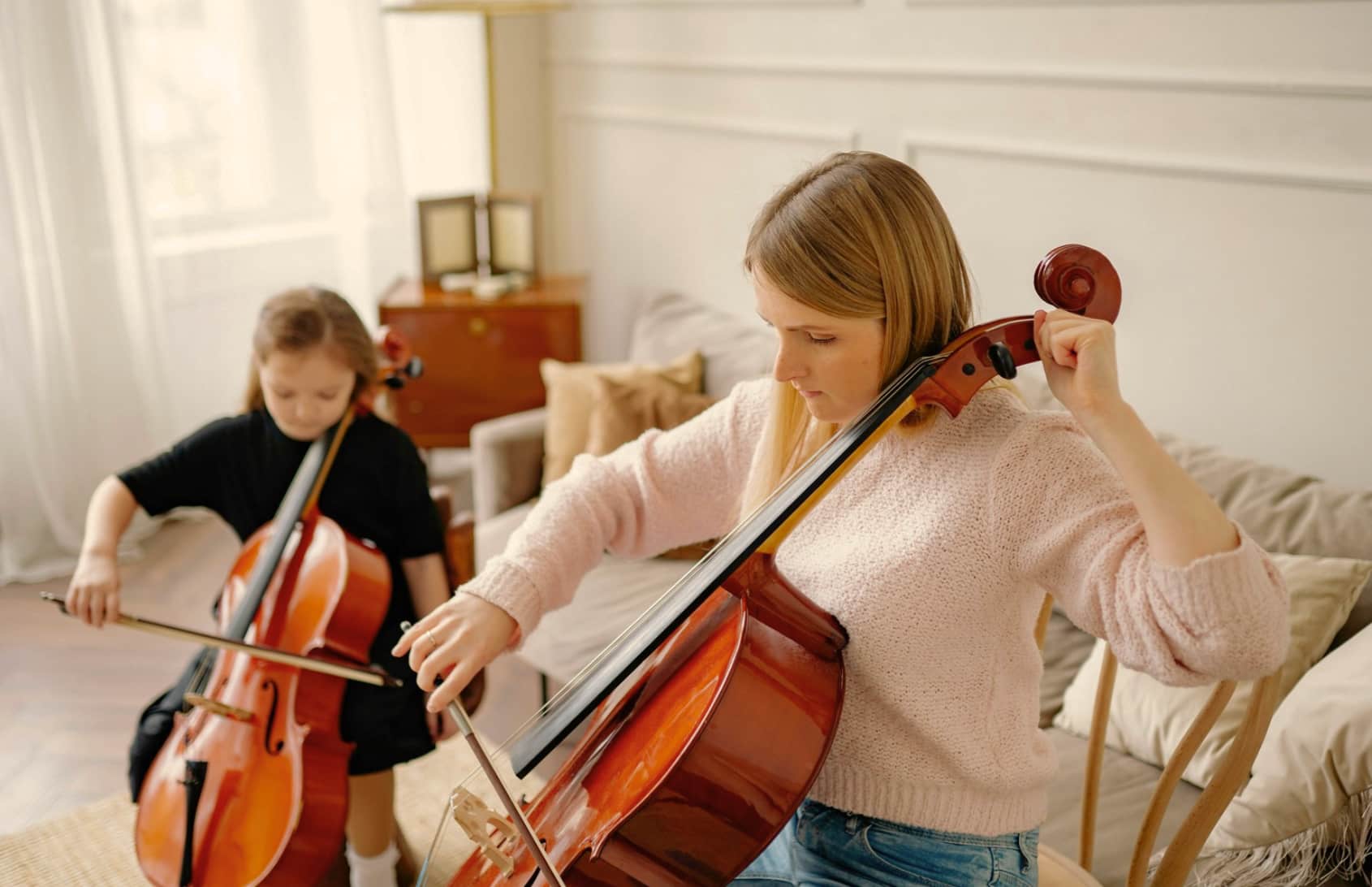
Cello lessons in Sydney typically cost between $90/hour and $110/hour with experienced teachers. Group lessons run cheaper at around $50 per student, while in-home private lessons can usually carry a $10 to $20 premium for travel. However, private lessons are far more valuable, as much more is learnt with one-on-one attention and feedback.
Pricing depends mostly on the teacher’s experience, lesson length, format, and your suburb in Sydney. The cheapest option isn’t always the best value, since a less experienced teacher often takes twice as long to fix the same technique issues. Look for cello lessons that show detailed pricing and teacher profiles so you can pick someone who actually fits your goals.
What’s the average cost of cello lessons in Sydney?
The average cost of cello lessons in Sydney sits at around $100/hour with an experienced teacher. Beginner-level pricing with newer teachers can start lower, but you have to be careful that your teacher knows what they’re doing and will correct bad habits early on. It’s hard to say how good a teacher is until you try them, so we recommend trying multiple teachers and seeing who suits you best. Commonly, a teacher who does have good experience and credentials will not be charging less than $80-90 hour, so be cautious if the price is below that.
Do you need to buy a cello before starting lessons?
No, you don’t need to own a cello before your first lesson, and most teachers actually prefer you wait until they can advise you on the right size and quality. A good teacher can run your first lesson on their own instrument or use the time to cover music fundamentals like reading rhythm, posture concepts, and bow mechanics on a borrowed cello. From there, they’ll help you decide whether to buy or hire, what size you need, and which models to avoid.
This matters more on cello than most instruments because cellos come in fractional sizes (1/8, 1/4, 1/2, 3/4, full) and the wrong size genuinely holds a student back. A child sized for a 1/2 cello playing on a 3/4 will develop reach problems and tension that takes months to undo. Buying before lessons also exposes you to the risk of grabbing a poorly set up instrument, since beginner-grade cellos often need a luthier to adjust the bridge, soundpost, and strings before they’re properly playable. Most Sydney teachers have a preferred local luthier they’ll point you toward, and that recommendation alone can save you a few hundred dollars in unnecessary fixes. Booking the first lesson before the instrument is the right order.
Why do cello lesson prices vary so much?
Cello lesson prices vary because teaching cello well requires more specialised expertise than most parents realise, and that expertise costs money. A teacher who’s spent ten years performing professionally and another five teaching has built up a level of diagnostic skill that genuinely shortcuts a student’s progress, and they price accordingly.
The main factors driving price differences are teacher experience, qualifications (Conservatorium training, AMEB examiner status, professional orchestra positions), lesson length, location, and whether the lessons are in person, online, or the teacher is travelling to you. Sydney suburbs also affect pricing, with teachers in the Eastern Suburbs, Lower North Shore, and Inner West typically charging more than those in outer suburbs, partly because of demand and partly because of studio rent. The honest reality is that a $80 lesson and a $120 lesson aren’t so different when you look at it side by side, but the gap usually shows up overtime in how quickly your student progresses and whether bad habits are caught before they cement.
Are cello lessons more expensive than other instruments?
Cello lessons are generally the same or higher than other instrument lessons in Sydney, sitting alongside violin, viola, and double bass. The reason isn’t snobbery, it’s supply. There are fewer qualified cello teachers than piano or guitar teachers, and the technical demands of teaching cello (bow hold, posture, intonation, vibrato) require more individual attention than instruments where progress is more visual.
Cello requires a lot of physical correction cello playing requires, especially in the first year. A piano student can practise badly and still produce recognisable music, while a cello student practising badly often produces an unpleasant tone that highlights technique issues immediately. Tone production on cello works a bit like balancing pressure on a paintbrush. Too much force crushes the sound, too little leaves it unstable, and the control comes from balance rather than effort. That feedback loop is part of why cello teachers spend more lesson time on physical mechanics.
Should you pick the cheapest cello teacher you can find?
No, the cheapest cello teacher is rarely the best value, especially for beginners. Cello has a steep technical foundation in the first year, and a teacher who’s underpriced is often either inexperienced or supplementing income from another field, which usually means slower progress and more entrenched bad habits.
The honest framing is that you’re not really paying for the lesson hour, you’re paying for the years of training that let the teacher diagnose your problem in thirty seconds instead of three lessons. A $50 lesson with a teacher who can’t spot a tense bow hold can cost more in the long run than a $100 lesson with a teacher who fixes it on day one. That said, “expensive” doesn’t automatically mean “good” either. Some teachers charge premium rates but are better players than they are teachers, so evaluate your teacher see whether they truly meet you in the middle to guide you properly or if they make you feel sort of dumb and inferior around them.
How long should beginner cello lessons be?
1 hour lessons are always recommended as you never know what progress you can get in the last 15 minutes of a lesson. There are people that do 45 minute lessons weekly, and as long as they practice a lot in between lessons that’s fine too. But 1 hour is definitely the best for fast progress and if you want to take it seriously. Many teachers also don’t offer below 1 hour lessons, but you can find some that do.
For very young children, half-hour lessons are fine since their attention span and physical stamina cap out around the 30-minute mark. As soon as they can handle 45 minutes however, you should opt for that. Keep in mind though, a shorter lesson with deliberate practice afterwards usually beats a longer lesson where the student is mentally checked out half the time. A teacher can only get them to pay attention so much, it’s up to the student as well to concentrate.
Are online cello lessons cheaper than in-person?
Online cello lessons are typically 10 to 20 percent cheaper than in-person lessons in Sydney, usually sitting around $70-80 hour with an experienced teacher. The savings come from teachers not needing studio space and not having travel time between students.
Online lessons work well for intermediate and advanced students who already have solid posture, bow grip, and basic technique. They’re harder for absolute beginners because a teacher physically adjusting your bow hand or shoulder position is genuinely useful in the first few months, and that’s hard to replicate over a webcam. If you’re going online as a beginner, a clear setup matters, including a side-on camera angle so the teacher can see both bow arm and left hand, decent audio that doesn’t compress out the cello’s lower frequencies, and a stable internet connection. For students in outer Sydney suburbs where local cello teachers are scarce, online lessons can be the difference between learning and not learning at all.
Online lessons also provide the ability to go with international teachers who are experts in their field. There is no other way to get lessons from such experts at a reasonable Sydney price, so you might as well use these teachers to help you progress.
What’s included in the cost of cello lessons?
The cost of cello lessons usually covers just the lesson time itself, with extras like exam preparation, accompanist fees, and performance opportunities sometimes priced separately. Most Sydney teachers include weekly written feedback or practice notes as part of the standard lesson fee, but not all do, so it’s worth asking upfront.
Things that are typically NOT included in the base lesson price:
- AMEB or Trinity exam fees: Around $130 to $300 depending on grade, paid directly to the exam board
- Accompanist fees for exams or performances: $80 to $150 per session
- Sheet music and method books: $30 to $80 per book, often required as the student progresses
- Cello hire or purchase: $40 to $80 per month for hire, $800 to $3,000 for a starter cello
Lessons fees aside, the bigger cost over a year often ends up being instrument-related. A poorly maintained or wrong-sized cello can hold a student back regardless of how good the teacher is, so factor in around $100 to $200 a year for basic maintenance like rehairing the bow and replacing strings.
Do prices change based on where you live in Sydney?
Yes, cello lesson prices vary noticeably across Sydney, with the Eastern Suburbs, Lower North Shore, and Inner West generally sitting at the higher end and outer suburbs running cheaper. A 1 hour lesson in Mosman or Bondi might cost $110, while the same lesson in Penrith or Campbelltown could be $60.
This isn’t just about teachers charging what the market will bear. Areas closer to the city tend to have a denser supply of conservatorium-trained teachers, music schools, and performance opportunities, which pushes both expertise and pricing upward. Outer suburbs often have fewer specialist cello teachers, which can mean either lower prices from generalist string teachers or having to travel inward for higher-quality instruction. In-home lessons partially solve this by bringing teachers to you, though the travel premium can offset the suburb-based discount. Online lessons remove the geography question entirely, which is why they’ve grown popular in suburbs like the Hills District, Sutherland Shire, and Western Sydney.
Is it worth paying for a more experienced teacher?
For most students, yes, paying for a more experienced cello teacher is worth it, particularly in the first two years when technique foundations are being set. The compounding effect of good technique versus bad technique over a few years is dramatic, and a teacher who catches a tense bow grip in week three saves you from a teacher trying to fix the same grip in year three.
Where the experience premium matters less is at the very advanced level, where the student is already self-correcting and mostly needs interpretive guidance and repertoire planning. At that point, a $130+ lesson with a world-class teacher might genuinely outperform a $100 lesson with a competent one, but the gap closes if you’re pursuing it as a hobby rather than a profession. The pragmatic middle ground is to start with a solid mid-range teacher (around $90 to $110 per hour) for the first few years, then either stay with them or step up to a specialist as your goals sharpen. Switching teachers mid-development is harder on a cellist than on a pianist, so picking well early matters more than people expect.
What does a cello lesson actually look like?
A typical 1-hour cello lesson includes a warm-up, technical work (scales, bow exercises, finger patterns), repertoire from current pieces, sight-reading, and often ear training or theory toward the end. The structure varies by teacher, but the underlying logic is the same: build physical skill first, then apply it to music.
Within a 60-minute lesson, the time usually breaks down something like this:
- 10 to 15 minutes: Posture check, warm-up scales, bow exercises
- 15 to 20 minutes: Technical work on a specific challenge (shifting, vibrato, bow distribution)
- 20 to 25 minutes: Working on repertoire pieces with detailed correction
- 5 to 10 minutes: Sight-reading, ear training, or theory depending on the student’s exam goals
- 5 minutes: Practice notes, homework setting, brief Q&A
The actual lesson is only part of the value, since most progress happens in the practice in between, but a good teacher uses the lesson to set up exactly what the student needs to focus on between sessions. For students preparing for AMEB exams or HSC performance, the technical and sight-reading components usually expand to take up a larger share of the lesson as the exam date approaches.
How long does it take to see real progress with cello lessons?
Most students show visible progress within three months and audible improvement in tone within six. By the one-year mark, a beginner taking weekly 1 hour cello lessons and practising 20 to 30 minutes a day should be playing simple pieces with reasonable intonation and bow control. Two years in, students are usually around AMEB Grade 2 or 3.
Progress depends heavily on practice consistency more than lesson length or price. A student practising 10 minutes daily will outpace one who does an hour the night before their lesson, because cello technique is built through repetition rather than crammed effort. The early stretch from zero to a clean open-string tone takes about four to six weeks for most beginners, and that’s where students who’ll thrive long-term tend to separate from those who’ll plateau. The reward window opens around month four or five, when the student starts producing tones they actually enjoy hearing, and from there motivation usually takes care of itself.
So what’s the smartest way to budget for cello lessons?
The smartest budgeting approach is to estimate your full first-year cost, including lessons, instrument, and extras, rather than just looking at the per-lesson price. A realistic year-one budget for a beginner in Sydney looks something like this: $3,600 to $4,400 for weekly 1-hour lessons across the year with an experienced teacher (based on around 40 lesson weeks once you account for school holidays), $480 to $960 for instrument hire (or $800 to $2,000 if buying), plus $150 to $300 for sheet music, accessories, and incidentals.
That’s a real number, and it’s worth seeing it upfront so you can decide what level of teacher and lesson frequency actually fits. If the full year sounds steep, fortnightly lessons at the start are a reasonable compromise, especially if the student is young and practising consistently between sessions. The biggest waste of money in cello lessons isn’t paying too much per hour, it’s paying for weekly lessons the student doesn’t practise for, since most of the value comes from what happens between lessons rather than during them. Booking a trial lesson with a cello teacher in Sydney before committing helps you assess the teacher and the format that suits your situation, which is usually a better starting point than just chasing the lowest hourly rate.
 September 30, 2026
Where Could I Find an Affordable Clarinet Teacher in Sydney?
TL;DR A limited monthly budget can still leave you with options for clarinet lessons in Sydney. Start with the price… September 26, 2026
Where to Actually Look Before You Buy an Instrument
The obvious first search usually isn't the right one. The instinct is almost always the same. A lesson gets booked,… September 23, 2026
What Should I Learn First on Piano? A Beginner’s Step-by-Step Guide
TL;DR Start by learning the keyboard pattern, a small group of notes, finger numbers and a steady beat. Practise a… September 23, 2026
How Much Does Logic Pro Cost for Beginners?
TL;DR Logic Pro is Apple's music production software for Mac. In Australia, Logic Pro for Mac costs $299.99 as a…