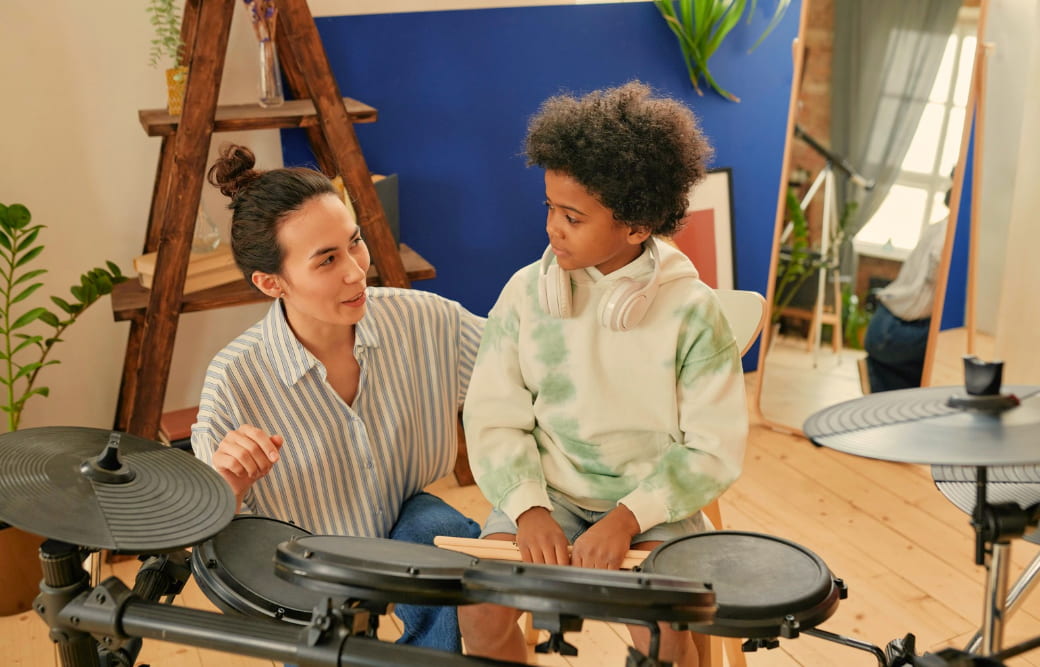
Yes, drum lessons are worth it for beginners if you want consistent timing, solid coordination, and a clear path forward. The right drum lessons are easy to find in Sydney, it’s just a matter of trying a few teachers and seeing who you connect with the most and is most conducive to your progress.
Most beginners can play a basic beat within days, but very few can keep it in time from start to finish of a song.
Are drum lessons worth it for beginners, or can you just teach yourself?
You can teach yourself at the start, but most beginners don’t know what to practise once the basics are covered.
Early progress feels fast because simple beats don’t expose mistakes. As soon as you try to improve, whether that’s speed, fills, or consistency, small issues start showing.
Things like gripping the sticks too tightly, drifting slightly off time, or losing coordination when a fill comes in are easy to miss when you’re focused on just getting through the beat.
A lot of players begin on their own, then look for lessons once they realise they’re guessing their way through practice. That’s where lessons become valuable.
How do you know if you need drum lessons early?
You need drum lessons early if your playing feels inconsistent or breaks down when things get slightly harder.
If you can’t stay in time through a simple song, or your coordination falls apart when you add even a small variation, that won’t fix itself easily.
Lessons are most useful at the point where you don’t know what’s actually causing the problem.
What do drum lessons actually improve first?
Drum lessons improve timing and coordination before anything else.
Most beginners don’t struggle with learning a beat. They struggle with playing it the same way every time. Lessons tighten that up first so your groove sits in the same place instead of shifting around.
Over time, that leads to:
- steadier timing with a metronome
- cleaner transitions between patterns
- more consistent sound between hits
In simple terms, drum lessons make your playing reliable before they make it more advanced.
Do drum lessons help you practise better or just give you more to do?
They help you practise better.
Most beginners aren’t short on effort. They just don’t know which specific mistake to fix next. Without that clarity, practice turns into repeating the same level of playing.
A good lesson filters your practice so you’re working on the one or two things that will actually move you forward.
Why do drum lessons help people improve faster?
Drum lessons help because they add structure and accountability.
When you’re learning on your own, it’s easy to avoid the parts that feel uncomfortable or frustrating. With lessons, you know you’ll be showing your progress, which changes how you practise.
That usually leads to more focused sessions and more consistent effort across the week, which is what drives improvement.
What do drum lessons teach that YouTube can’t?
They show you what’s actually happening in your playing.
YouTube can show you what to play, but it can’t tell you if you’re slightly rushing your snare, tightening your grip without realising, or losing control when something changes.
For example, many beginners rush slightly every time they hit a fill, but because the groove before it feels fine, they don’t notice it happening.
A teacher can pick that up straight away and correct it. They can also prevent issues before they turn into habits, which saves a lot of wasted time later.
What should a good drum lesson actually feel like?
A good drum lesson should feel focused and corrective, not just like playing along to songs.
After a lesson, you should:
- know exactly what you did wrong
- understand how to fix it
- have a clear exercise to work on
If a lesson feels like 30 minutes of playing without direction, you’re not getting much value.
Are there real benefits to learning drums on your own?
Yes, learning on your own can be more enjoyable and flexible.
You get the freedom to play what you want, when you want, without a schedule or pressure. For some people, that keeps motivation high in the early stage.
This works well up to a point. The problem is knowing when you’ve reached that point.
Once progress slows, most self-taught players don’t know what to adjust, which is where lessons start to make a difference.
Can a bad drum teacher make drum lessons not worth it?
Yes, the wrong teacher can slow you down.
If you’re not being corrected properly or you leave lessons without clear direction, progress becomes random.
Treat the first few lessons as a trial. If you’re not leaving with specific things to work on, it’s worth finding a better fit.
Do you need drum lessons long-term?
No, most beginners don’t need drum lessons forever.
A common approach is to take lessons long enough to build a foundation, then continue on your own, and return later if needed.
Even a short run of lessons can fix early issues with timing, coordination, and practice structure that would otherwise slow you down.
However, if you want the most consistent reliable progress, you should take lessons long-term, and most people do. As long as your teacher is at a higher ability than you and is communicating what you need to get better, it’s worth it.
Are drum lessons worth the money for beginners?
Yes, if the lessons change how you practise.
Paying for lessons without applying anything between sessions won’t do much. But if each lesson gives you a clear problem to fix and you actually work on it, you’ll improve much faster.
You’re not paying for the time itself. You’re paying to remove guesswork and avoid wasting months practising the wrong things. Think of it like you’re trading cash for ability.
Why does drumming feel easy at first, then suddenly hard?
It feels easy early because simple beats don’t expose problems.
You can play a basic groove quickly and it sounds close enough. Once you try to improve, timing and coordination become more demanding.
That’s where most beginners hit a wall, because the things that need fixing aren’t obvious anymore.
Why do beginners plateau on drums even when they practise regularly?
Beginners plateau because they repeat what feels comfortable instead of what needs fixing.
At the start, everything feels like progress. After that, improvement depends on identifying specific weaknesses.
For example, a beginner might:
- play the same groove every session
- avoid fills because they fall apart
- skip using a metronome because it feels harder
From their perspective, they’re practising consistently. But they’re reinforcing the same level of playing.
This is the difference between playing drums and training on drums.
Structured practice forces you to isolate weak points, slow things down properly, and rebuild patterns with control. Without that shift, practice time increases but skill level stays the same.
What if you have no natural rhythm?
You can still learn drums even if you think you have no rhythm.
Most beginners don’t lack rhythm, they’ve just never had to lock into a consistent pulse before. Once you train that deliberately, it improves quickly.
How can you improve without drum lessons if you stay self-taught?
You need to create your own feedback and structure.
Recording yourself is one of the best tricks to do this. Watching your playing back shows things you don’t notice in the moment, like timing issues or repeated patterns.
It’s not the same as having a teacher, but it helps alleviate the lack of feedback.
Are drum lessons worth it for beginners in Sydney?
Yes, mainly because consistency depends on convenience.
In Sydney, travel time and scheduling can make or break consistency. Even a 30 to 40 minute commute each way can be enough to stop lessons from becoming a routine, especially across areas like Western Sydney, the Northern Beaches, or the Sutherland Shire.
Finding a nearby teacher or an online option makes it easier to stay consistent, which is what actually drives progress.
How do you know if drum lessons are right for you?
They’re right for you if you want clear direction instead of guessing.
After a few lessons, you should understand what’s holding your playing back, know exactly what to practise, and feel more control over your playing.
If that’s happening, the lessons are doing their job.
Find drum lessons that actually help you improve
Getting better at drums comes down to making the right adjustments consistently.
If you want to build coordination, timing, and control from the beginning, compare drum teachers near you and finding one that can clearly show you what to fix each week is where most beginners start making real progress.
 September 30, 2026
Where Could I Find an Affordable Clarinet Teacher in Sydney?
TL;DR A limited monthly budget can still leave you with options for clarinet lessons in Sydney. Start with the price… September 26, 2026
Where to Actually Look Before You Buy an Instrument
The obvious first search usually isn't the right one. The instinct is almost always the same. A lesson gets booked,… September 23, 2026
What Should I Learn First on Piano? A Beginner’s Step-by-Step Guide
TL;DR Start by learning the keyboard pattern, a small group of notes, finger numbers and a steady beat. Practise a… September 23, 2026
How Much Does Logic Pro Cost for Beginners?
TL;DR Logic Pro is Apple's music production software for Mac. In Australia, Logic Pro for Mac costs $299.99 as a…