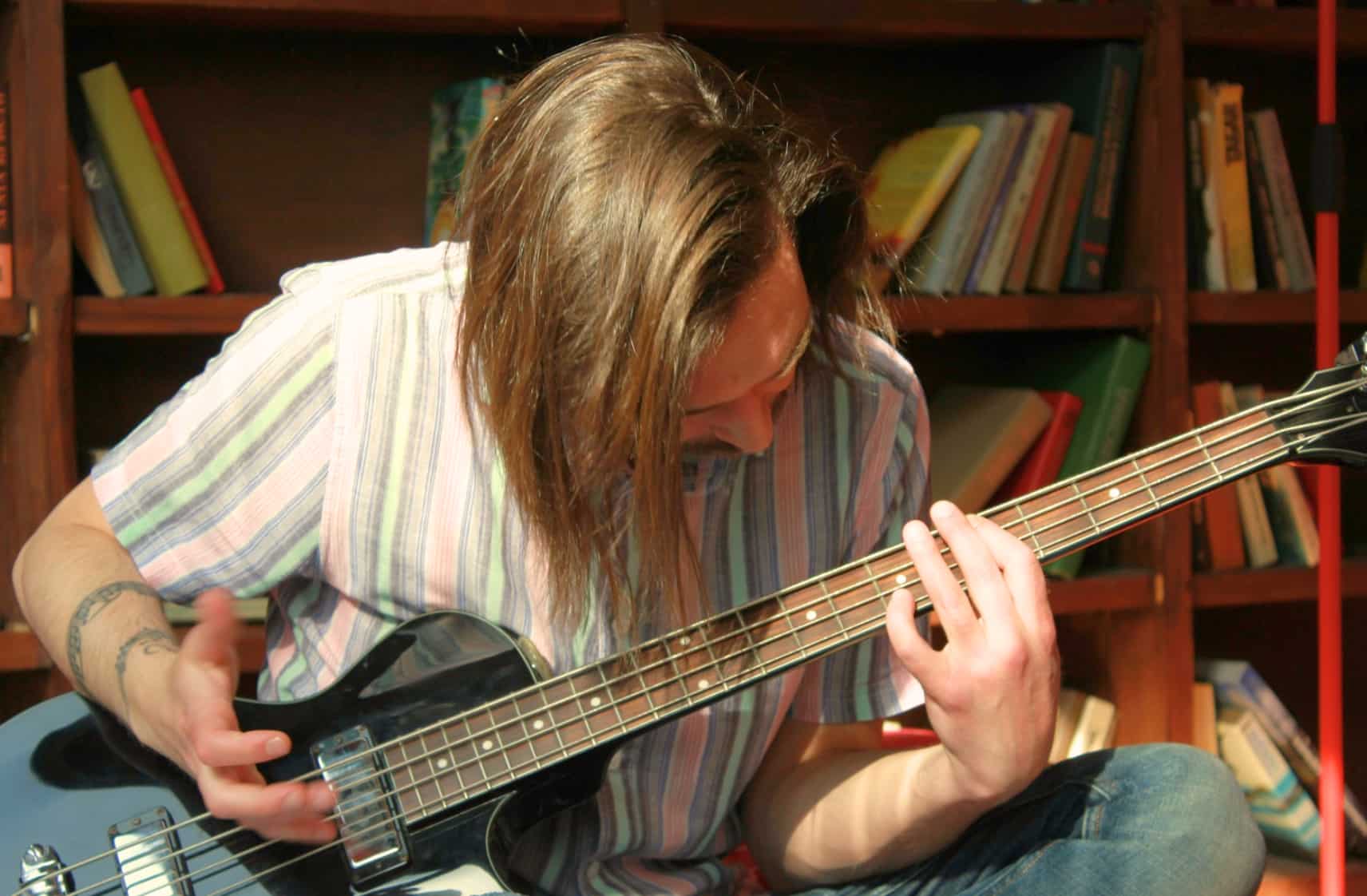
Bass guitar lessons are worth it for most beginners because they accelerate progress, build proper technique early, and help you sound musical faster rather than just playing notes.
If you’re starting out, exploring bass guitar lessons early gives you a clear structure from the beginning instead of figuring things out through trial and error.
What makes bass guitar lessons worth it for beginners?
Bass guitar lessons are worth it because they provide feedback, structure, and a clear progression path.
The biggest difference is correction. Tutorials can show you what to do, but they can’t tell you your technique is off. A teacher fixes issues like tension, buzzing, timing, and hand position early, before they become habits that slow you down later.
That alone can save months, sometimes years, of inefficient practice.
What do beginners actually learn in bass guitar lessons?
Beginners learn the physical and musical foundations needed to play bass properly in a real musical context.
Early lessons usually cover:
- Fretting hand positioning to reduce strain and buzzing
- Right-hand technique (fingerstyle or pick)
- Playing simple basslines using root notes
- Developing timing through rhythm exercises
- Understanding how bass fits with drums and harmony
You’re not just learning notes. You’re learning how to make those notes sit correctly in music.
Can you learn bass guitar without lessons?
Yes, but it’s slower and more inconsistent for most people.
Self-teaching often leads to:
- Poor timing that goes unnoticed
- Inefficient technique
- Gaps in knowledge
- Random progression without structure
It’s not that self-teaching doesn’t work, it’s that it relies heavily on your ability to self-correct, which most beginners can’t do accurately.
How quickly do beginners progress with bass guitar lessons?
Most beginners can play simple songs within a few weeks and hold a basic groove within two to three months if they practise consistently.
Lessons don’t create progress on their own. They point you in the right direction. Practice is what actually builds skill.
Bass is relatively quick to start, but developing feel and control takes time. Lessons help you get there faster, not skip the process.
Is it better to learn bass guitar with a teacher or on your own?
For most beginners, learning with a teacher is more efficient because the early stage is where habits are formed.
A teacher helps you get these right from the start:
- Right-hand technique
- Fretting position
- Timing and groove
- Musical context
You can learn on your own, but you’re more likely to plateau or develop habits that limit you later.
What should beginners expect from their first few lessons?
You’ll focus on building a foundation before jumping into complex songs.
Your first few lessons usually include:
- How to hold and position the bass
- Basic fretting and picking technique
- Simple exercises for coordination
- Introduction to rhythm or tabs
At the same time, a good teacher will shape lessons around your goals so you stay engaged.
Why bass guitar is harder than it looks
Bass is harder than it looks because the challenge isn’t complexity, it’s precision.
Each note you play has to be:
- In time
- Clean
- Controlled in length
- Supporting the harmony
Think of bass like the foundation of a house. If it’s slightly off, everything built on top feels unstable.
That’s why beginners who skip fundamentals often sound “off” even if they’re playing the right notes.
How lessons build timing and groove
Bass sits between rhythm and harmony, and that’s where most of the difficulty comes from.
Lessons develop groove through:
- Playing with a metronome
- Learning subdivisions (eighths, sixteenths)
- Controlling note length through muting
- Locking in with drum patterns
Most beginners think they’re in time because they’re close to the beat. But groove is more precise than that.
It’s about where your note sits within the beat, not just whether it lands on it.
This is one of the hardest things to self-correct, and one of the biggest advantages of lessons.
What real bass players say about lessons
Bass guitar lessons are widely considered worth it by real players, but only if you actually practise and have a good teacher.
Across experienced players, a few consistent patterns show up:
- You get out what you put in
- Feedback is the biggest advantage over self-teaching
- Even a few lessons can significantly improve your direction
- Progress is much faster compared to learning alone
Many players report spending years self-teaching, then making similar progress in a few months once they start lessons.
One of the biggest differences is accountability. Having a lesson coming up forces you to practise properly instead of just playing what you already know.
That said, the teacher matters. Without structure and useful feedback, lessons lose most of their value.
Lessons vs teaching yourself: what actually changes
The real difference isn’t access to information, it’s correction and direction.
When you teach yourself, you rely on your own judgement to decide if something is right. That works up to a point, but breaks down with timing, technique, and musical feel.
With lessons, three things change:
- You get real-time correction
- You follow a structured progression
- You fix problems early
Self-teaching is trial and error. Lessons are guided correction.
Both can work, but one wastes far less time.
How often should beginners have lessons?
Once per week is ideal for most beginners.
The balance matters:
- Too much time between lessons leads to loss of momentum
- Too many lessons without practice leads to poor retention
A strong structure is:
- One lesson per week
- 20–30 minutes of daily practice
Consistency matters more than long sessions.
What kind of bass guitar do beginners need?
You don’t need expensive gear to start.
A basic setup is enough:
- Electric bass
- Small amp
- Cable and tuner
What matters more is setup. If the strings are too high, playing becomes unnecessarily difficult.
A poorly set-up bass can make beginners feel like they’re struggling when the instrument is the real issue.
Can adults benefit from lessons?
Yes, and adults often progress well early on.
Adults usually bring:
- Better focus
- Clearer goals
- More consistent discipline
The main challenge is physical, such as finger strength and calluses, which develop over time.
Bass is one of the more accessible instruments for adult beginners because you can start sounding musical relatively quickly.
How does music theory fit into lessons
Music theory directly improves how you play bass because the instrument sits between rhythm and harmony.
Even basic theory helps you:
- Understand chord movement
- Choose better notes
- Play more musically
Good lessons introduce theory in context, not as abstract information.
Over time, this shifts you from copying notes to understanding what you’re playing and why.
Are online lessons as effective as in-person?
Yes, but in-person lessons are generally better for beginners.
In-person lessons allow:
- Physical correction of technique
- Clearer communication
- Faster feedback
Online lessons can still work well with a good teacher, especially if your setup allows them to see your hands clearly.
What’s the best way to practise between lessons?
Short, focused sessions are more effective than long, inconsistent ones.
A good structure is:
- Focus on what your teacher corrected
- Practise slowly and cleanly
- Use a metronome
- Avoid just replaying familiar material
Most beginners avoid using a metronome, but it’s one of the most important tools for bass.
Why even a few lessons can be enough
You don’t need years of lessons for them to be valuable.
Even a few sessions can:
- Fix major technique issues
- Give you clear direction
- Identify weaknesses
From there, many players continue learning on their own and return occasionally for guidance.
This is one of the most efficient ways to learn.
Are bass guitar lessons worth the cost?
Yes, if you use them properly.
The value comes from:
- Avoiding wasted time
- Building correct habits
- Staying consistent
Lessons don’t replace practice. They make practice more effective.
So are bass guitar lessons actually worth it?
For most beginners, yes. Not because you need them, but because they remove guesswork and speed everything up.
You can teach yourself and eventually get there. Plenty of players do. But it usually takes longer, involves more frustration, and often leads to habits that need fixing later.
Lessons give you a clearer path, faster progress, and better fundamentals from the start. Compare bass guitar teachers and see which one suits you best before committing long-term.
 September 30, 2026
Where Could I Find an Affordable Clarinet Teacher in Sydney?
TL;DR A limited monthly budget can still leave you with options for clarinet lessons in Sydney. Start with the price… September 26, 2026
Where to Actually Look Before You Buy an Instrument
The obvious first search usually isn't the right one. The instinct is almost always the same. A lesson gets booked,… September 23, 2026
What Should I Learn First on Piano? A Beginner’s Step-by-Step Guide
TL;DR Start by learning the keyboard pattern, a small group of notes, finger numbers and a steady beat. Practise a… September 23, 2026
How Much Does Logic Pro Cost for Beginners?
TL;DR Logic Pro is Apple's music production software for Mac. In Australia, Logic Pro for Mac costs $299.99 as a…