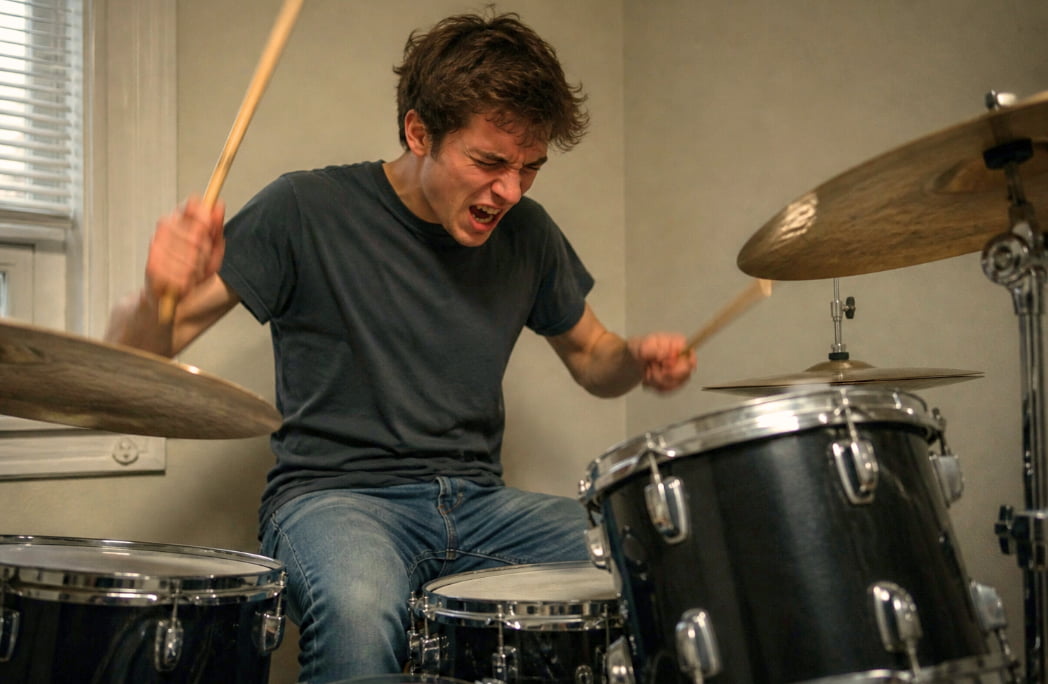
Yes, you can learn drums without disturbing your neighbours, and there are more options available than most people realise. The most straightforward solution is an electronic drum kit, which brings volume down to almost nothing and lets you practise through headphones at any hour. But if you prefer acoustic, there are also practical fixes for both the sound and the vibration that travels through floors and walls, and the two problems have different solutions worth understanding. Plenty of people across Sydney practise regularly in apartments, townhouses, and suburban homes without it ever becoming an issue. If you’re looking into drum lessons in Sydney, here’s exactly what works, what doesn’t, and what to consider for your specific situation.
What’s the difference between sound and vibration, and why does it matter?
Sound and vibration are two separate things when it comes to drums. Sound is what travels through the air. Vibration is the physical impact that travels through solid surfaces, floors, walls, and the building structure itself. An electronic kit solves the sound problem almost completely. It does very little about vibration on its own.
This is why someone in an apartment below an electronic kit can still hear rhythmic thumping through their ceiling even when the kit itself sounds quiet in the room. Every kick pedal strike sends energy downward through the floor before it becomes airborne sound. Those vibrations travel through the stands, through the carpet, into the floor joists, and throughout the building structure.
Solving that requires physically decoupling the kit from the floor. A practical layered approach is foam workout matting as the base layer, the kind from any athletic store, followed by a second mat on top. The foam handles the direct foot stomp impact, the mat provides stability. DIY tennis ball risers work well too and cost almost nothing to build. Drummers who’ve tested this by listening from the floor below report a very distinct difference in what travels through. Isolation platforms and rubber buffer feet for stands and pedals are also worth looking at, they’re inexpensive and address the vibration problem directly at the source.
Can I use an acoustic kit at home without causing problems?
In many cases, yes, with some common sense applied.
A short, controlled practice session on an acoustic kit during reasonable daytime hours is genuinely manageable in a lot of Sydney homes. It’s not automatically a disaster. A detached house or a semi with some distance between you and the nearest neighbour sits in a different situation to a unit with shared concrete floors, but even in denser living situations, the combination of timing, duration, and isolation measures gives you more options than most people realise.
The things that turn drumming into a neighbour issue are usually duration, timing, and volume. Playing hard for two hours at 7pm is a problem. Playing a focused 30-minute session at midday, with buffers under the kick pedal and stands, is often completely fine. If you’re genuinely unsure, the simplest thing is to ask. Have a neighbour sit in their lounge while you play at the volume you intend to practise at, and find out if anything is rattling or if the sound is carrying more than you expected. Most people appreciate being included rather than surprised, and you’ll know exactly what you’re working with.
Rubber isolation feet for stands, a thick mat under the kit, and a padded kick pedal beater go a long way toward reducing the vibration that travels into the structure of the building. You don’t need to spend a lot to make a meaningful difference.
So is it actually possible to learn drums at home without the guilt?
Yes, and honestly the situation is less dire than most people assume before they look into it properly.
The neighbours who become a problem aren’t usually the ones who play. They’re the ones who never thought about it from anyone else’s perspective. A short, focused session during the middle of the day is a very different thing to someone hammering away for three hours at 9pm. Most people are fine with the former. It’s the latter that generates complaints.
If you’re already asking this question, you’re probably not going to be that person. The fact that you’re thinking about it before you start puts you ahead of most.
What’s the best home setup for learning drums in a Sydney apartment?
The most practical combination is a mid-level electronic kit with low volume cymbals, proper floor isolation underneath, and practice scheduled during daytime hours with neighbours informed before you start.
A few things that make a real difference:
- Layered floor isolation: foam workout matting as the base layer, then a second mat on top. The foam absorbs direct foot impact, the mat provides stability. DIY tennis ball risers work well and cost almost nothing
- Rubber isolation feet for stands and pedals: inexpensive and address vibration at the source before it enters the floor
- Mesh heads and low volume cymbals: the difference in airborne sound is significant. You can play the cymbals hard and still hold a conversation
- Hot rods or brush sticks for evening sessions: reduces pad noise further when you need to keep it down but still want to practise
- A conversation with your neighbours before you start: let them know the hours you plan to play, give them your number, and invite them to tell you if anything is rattling or carrying more than expected. Most people respond well to being treated like adults and it means any issue gets resolved with a knock rather than a formal complaint
The kit brand matters less at the beginner stage than getting the isolation and cymbal setup right. A mid-range electronic kit properly set up in a Sydney apartment will cause fewer issues than an expensive kit sitting directly on floorboards with nothing underneath it.
Are electronic drum kits actually quiet enough for home practice?
For most Sydney homes and apartments, yes, with isolation underneath. The pads and mesh heads themselves produce minimal airborne sound. Low volume cymbals reduce volume by around 70 to 80 percent compared to regular cymbals, meaning you can crash them hard and still talk over the sound. Mesh heads on toms and snare feel close to real heads when tensioned properly and are dramatically quieter than standard heads.
The kick pedal remains the main variable. A beaterless kick trigger or a soft surface kick pad reduces that impact substantially. Combined with floor isolation, most people in the building won’t know you’re playing during reasonable hours.
One clarification worth making: acoustic wall treatment, foam tiles, and heavy curtains absorb high frequencies inside the room and reduce flutter echo, making things sound less harsh in the space itself. They don’t stop sound from leaving the room. Worth doing for comfort, but not the solution to the neighbour problem on its own.
What’s the difference between playing electronic and acoustic drums?
Electronic kits are genuinely good for learning, but there are real differences worth knowing about so you’re not caught off guard the first time you sit behind a full acoustic kit.
The most noticeable difference is rebound. Mesh heads on electronic kits tend to have more bounce than acoustic heads, which means your sticks return to your hand with less effort. On an acoustic kit, the rebound is different depending on how the head is tuned, and it generally requires a bit more active control from your hands. Most players adjust within a session or two, but it’s worth being aware of rather than surprised by it.
Cymbals are the other adjustment. Electronic cymbal pads feel and behave differently to real brass. The swing, the wash, and the way the sound responds to where and how hard you hit aren’t fully replicated. On a real kit, a light touch on the edge of a crash sounds different to striking the bell, and those nuances take some time to develop. If you’ve only ever played electronic cymbals, your first few sessions on a real kit will involve recalibrating.
The feel of the kick is also different. A real kick drum with a front head has a physical resistance and response that electronic kick pads and beaterless triggers don’t fully replicate. Drummers who’ve spent a lot of time on electronic kits sometimes find they need to adjust their foot technique slightly on an acoustic kit, particularly around control and dynamics.
None of this means electronic practice is wasted. The coordination, timing, hand technique, and musicality you develop transfer directly. The adjustment when you get onto a real kit is real but it’s also quick, especially if you’re getting lesson time on an acoustic kit alongside your home practice. That combination is the most practical approach for anyone in a noise-sensitive situation.
Can I actually learn drums properly on a practice pad?
Yes, and for the first few months of learning, a practice pad develops the foundational skills faster than a full kit does because it removes distractions and forces precision.
Hand technique, stick control, rebound, rudiments and timing are all trainable on a single pad. A pad forces you to develop them with precision because there’s nowhere to hide sloppy technique. You can hear a metronome clearly while playing, which keeps timing honest and prevents the sloppy habits that develop when you’re focused on too many things at once.
Beyond the standard pad, there are a few quiet practice techniques that serious drummers use that most beginners never hear about. Four-time world snare drumming champion Jeff Queen teaches using a doorknob that snaps back when released to build traditional and Stevens grip stamina. You align your forearm with your wrist, place the doorknob between your ring and middle fingers, and rotate. It’s completely silent and builds genuine grip strength. Playing on soft surfaces like carpet, a bed, or pillows is another legitimate chop builder that produces almost no noise. Mental imagery, actually drumming through a piece in your head without touching anything, is used by professional drummers to rehearse patterns and build muscle memory silently. It sounds too simple to work until you try it seriously.
The limitation of pad practice is foot coordination and the physical experience of moving between surfaces. A practical approach for noise-sensitive situations is to do foundational work at home on a pad and use lesson time on a full kit. You build hand skills consistently at home, apply them on a real kit during lessons, and sidestep the noise problem entirely in the early stages.
Why does having a teacher change how much noise you actually make?
Because a teacher restructures how you practise, not just what you practise, and that directly affects both the volume and the duration of your sessions.
Without guidance, the natural tendency is to run through songs or patterns at full intensity for as long as possible. That maximises noise, maximises duration, and maximises the chance of complaints. It also reinforces existing habits without anyone identifying what needs to change.
A teacher gives you a specific diagnosis of what’s actually holding your playing back right now and a targeted exercise to fix it. This is the 80/20 principle applied to drumming. Most real progress comes from working on a small number of specific things, not general run-throughs. A 30-minute session focused on one specific coordination issue or grip problem will produce more improvement than two hours of playing through songs, and it does so at lower volume for less time.
Parkinson’s Law applies here too. A tight but reasonable practice window forces you to prioritise what actually matters. Lessons impose that structure for you, which means shorter, quieter, more focused sessions between lessons rather than extended loud run-throughs that wear out your neighbours and reinforce existing habits at the same time.
There’s also the bad habits problem. Without a teacher, you can make genuine progress while quietly building technique errors that cap your development without you knowing. A teacher catches them early, which saves months of undoing something that should have been corrected in week three.
What do Sydney noise regulations actually say about drumming at home?
Most Sydney councils follow NSW Protection of the Environment Operations Act guidelines, which restrict noise audible from a neighbouring property after 10pm on weekdays and midnight on weekends in residential areas, with some local councils applying earlier cutoffs.
The practical reality is that within those hours, neighbour tolerance varies significantly. A detached house in Penrith sits in a very different situation to a unit in Surry Hills or a terrace in Glebe. A well-isolated electronic kit played between 10am and 8pm is unlikely to generate complaints in most Sydney residential settings. Even a controlled acoustic session during the middle of the day is manageable in many situations, particularly in freestanding homes.
Knowing your specific council’s guidelines is worth doing, but the relationship with your immediate neighbours matters more than the regulations in most practical situations. A conversation before you start, and a willingness to check in and adjust if something is carrying further than expected, does more than any amount of technical noise reduction to keep things running smoothly.
Will practising quietly hold back my progress?
No, and in some areas quiet practice develops better technique than loud practice does.
Playing at low volume forces precision. When you’re not relying on force, dynamics, stick consistency, and control all become more apparent. Challenging yourself to play as quietly as possible is itself a dynamic control exercise, and it’s one that most beginners never do because they’re focused on just getting through the patterns. The control developed at low volume transfers directly to a full kit.
Where quiet practice has a genuine ceiling is physical stamina and feel. Playing a full acoustic kit at performance volume is physically demanding in ways that electronic and pad practice don’t fully replicate. That’s why lesson time on a proper kit matters even when most home practice is quiet. If you have access to a rehearsal space, a practice room, or a friend’s garage, getting on a full acoustic kit periodically keeps that physical side developing alongside everything else.
So can you actually learn drums without becoming a problem for your neighbours?
Yes, and the situation is far more manageable than most people assume before they look into it.
Short, focused sessions during reasonable hours, with a bit of thought given to isolation and timing, are genuinely fine in most Sydney living situations. The people who end up with complaints are almost always the ones who played too long, too late, or without ever having a conversation with the people around them. None of those are hard problems to avoid.
Find drum teachers in Sydney and ask them for advice, most should have no problem giving you advice on brands and models that would best suit your set up at home as well as advising on an acoustic vs electronic drum kit.
Get the setup right, talk to your neighbours, keep sessions focused rather than extended, and get proper guidance so your practice time is productive rather than just noisy. That combination solves the problem almost entirely.
 September 30, 2026
Where Could I Find an Affordable Clarinet Teacher in Sydney?
TL;DR A limited monthly budget can still leave you with options for clarinet lessons in Sydney. Start with the price… September 26, 2026
Where to Actually Look Before You Buy an Instrument
The obvious first search usually isn't the right one. The instinct is almost always the same. A lesson gets booked,… September 23, 2026
What Should I Learn First on Piano? A Beginner’s Step-by-Step Guide
TL;DR Start by learning the keyboard pattern, a small group of notes, finger numbers and a steady beat. Practise a… September 23, 2026
How Much Does Logic Pro Cost for Beginners?
TL;DR Logic Pro is Apple's music production software for Mac. In Australia, Logic Pro for Mac costs $299.99 as a…