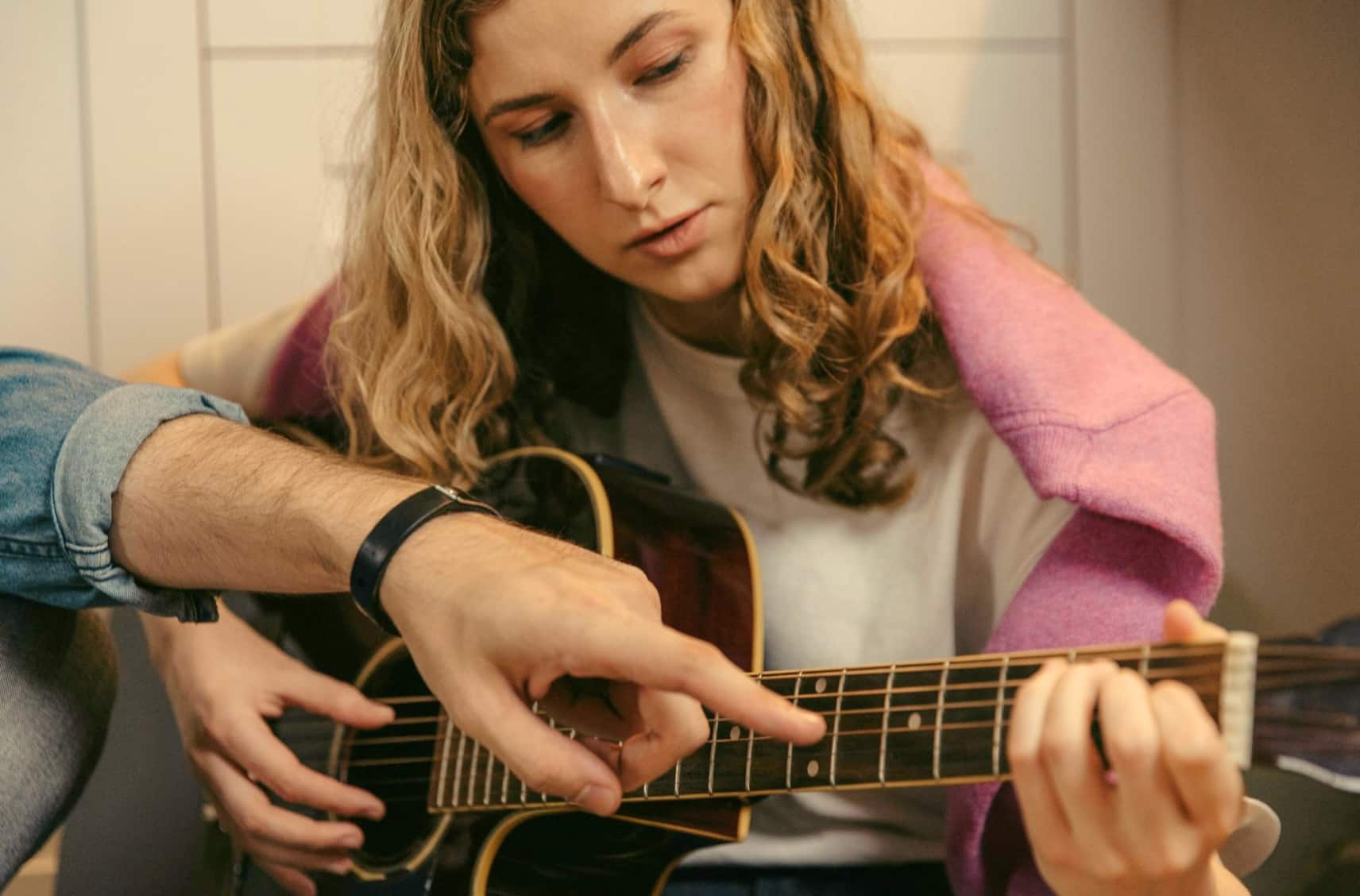
Yes, you can learn guitar without lessons, especially at the beginning. But most beginners eventually plateau without structure, feedback, and a clear progression. Starting with or adding guitar lessons gives you direction, corrects mistakes early, and makes your practice time far more effective.
Can you learn guitar without guitar lessons as a beginner?
Yes, beginners can learn guitar without guitar lessons, and many people do.
Guitar is one of the most accessible instruments to start on your own. You can learn a few chords, follow tabs, and play songs quickly. That early progress feels motivating and keeps you engaged.
The problem isn’t starting. It’s what happens after that.
Why guitar is easy to start without lessons but hard to progress
Guitar is easy to start because early wins come quickly, but it’s hard to progress because those wins are often surface-level.
You can learn songs, memorise shapes, and feel like you’re improving. But without structure, you’re building isolated skills rather than a connected system.
Most guitar players don’t quit early. They just stop improving.
Where most self-taught guitar players get stuck
Most self-taught players get stuck once they move beyond basic songs.
They can play what they know, but struggle to improve overall. This usually shows up as inconsistent rhythm, messy transitions, and difficulty learning anything more complex.
The issue isn’t effort. It’s that they’ve built familiarity, not transferable skill.
Why chord fundamentals matter more than learning songs early on
Chord fundamentals matter more because they determine how far you can go.
It’s very easy to fall into playing your favourite songs and learning tabs. That feels productive, but it trains memory, not skill.
If you only learn songs from tabs, you’re training memory, not skill.
Without fundamentals:
- you memorise shapes instead of recognising patterns
- you struggle to adapt to new songs
- everything feels disconnected
With fundamentals:
- chord changes become smoother
- songs become easier to learn
- the fretboard starts to make sense
It’s like copying answers instead of understanding the method. One gets you through a song. The other lets you handle anything similar later.
What you should learn first if you’re teaching yourself guitar
If you’re learning guitar without lessons, you need a clear order to follow.
A strong beginner path looks like this:
- open chords like G, C, D, A, E
- smooth chord transitions and basic strumming
- rhythm and timing with a metronome or backing track
- barre chords
- pentatonic scales and simple lead playing
- basic theory like chord relationships and patterns
Songs should sit inside this progression, not replace it.
Without a sequence like this, it’s easy to jump between topics and stall your progress.
Can you learn guitar from YouTube or online tutorials?
Yes, you can learn guitar from YouTube, but it works best as a tool, not a full system.
YouTube is excellent for learning songs, fixing specific issues, and getting inspiration.
What it doesn’t give you is structure.
The biggest trap isn’t lack of information. It’s too much of it. Watching more videos feels like progress, but it often replaces actual practice.
Another common mistake is switching between multiple teachers too early. Each one explains things differently, which creates confusion instead of clarity.
If you’re using YouTube, pick one structured path and stick with it before branching out.
How to practise guitar properly if you’re learning by yourself
You can make strong progress without lessons if your practice is structured.
Most people confuse playing with practising. Playing is repeating what you already know. Practising is working on what you can’t do yet.
A simple approach:
- practise difficult sections slowly
- focus on control before speed
- repeat until it feels consistent
- then apply it back into songs
Playing fast isn’t the goal early on. Accuracy builds speed. If you practise sloppy, you reinforce mistakes.
Recording yourself is one of the most effective tools you have. It lets you spot issues you won’t notice while playing.
Short, consistent sessions beat long, unfocused ones every time.
Why guitar is harder to progress without guitar lessons
Guitar is harder to progress without guitar lessons because there is no feedback loop.
You can practise consistently and still reinforce small mistakes without noticing. Timing might be slightly off, technique inefficient, or tension building in your hands.
Without correction, those mistakes become your default.
A teacher shortens that process by identifying and fixing issues early.
What guitar lessons actually fix that self-teaching doesn’t
Guitar lessons fix the gaps that self-teaching leaves behind.
A good teacher will:
- correct your timing and rhythm
- improve your technique so playing feels easier
- clean up inefficient movement
- give you a structured practice plan
- keep you accountable
The biggest difference is direction. You stop guessing what to work on and start progressing with purpose.
Even a few lessons can give you a roadmap that saves months of trial and error.
Why playing with other musicians accelerates your progress
Playing with other musicians is one of the fastest ways to improve.
It forces you to stay in time, listen properly, and adapt. It also exposes weaknesses that don’t show up when you practise alone.
You can spend hours practising by yourself and still miss key issues. Playing with others highlights them immediately.
If lessons aren’t an option, this is one of the best ways to improve faster.
How to decide if guitar lessons are worth it for you
Guitar lessons are worth it when you want to move beyond basic playing and actually improve.
If you have access to a good teacher at a reasonable rate, it’s usually worth starting in person.
If location or cost is an issue, online lessons still provide structure and feedback.
If budget is tight, even occasional lessons are valuable. One lesson every month or two can correct mistakes and give you direction.
The value of lessons isn’t linear. The jump from no lessons to occasional lessons is significant because you move from guessing to having clarity.
From there, more frequent lessons improve results further. Weekly lessons are the most effective for maintaining momentum.
Even occasional lessons can save months of practising the wrong thing.
What a bad first guitar can do to your progress
A poorly set-up guitar can slow your progress more than most people expect.
If the strings are too high or the instrument is hard to play, everything feels harder than it should.
This leads to unnecessary strain, slower improvement, and frustration.
Many beginners think they’re the problem when it’s actually the instrument.
A proper setup makes learning noticeably easier.
Acoustic vs electric vs classical guitar for beginners
The best guitar depends on what you want to play.
Acoustic suits strumming and singer-songwriter styles. Electric is easier to press and suits rock and lead playing. Classical uses softer strings and a different technique approach.
The most important factor is choosing something you’re excited to play. That’s what keeps you consistent.
How long can you progress without guitar lessons
You can progress without guitar lessons for a while, but most players plateau within 6 to 12 months.
This depends on how structured your practice is. If you follow a clear progression, you can go further. If you rely only on songs, progress usually slows sooner.
The key sign is whether your overall ability is improving or just your familiarity with specific songs.
Why most guitar players plateau and how to avoid it
Most guitar players plateau because they lack structure, not effort.
They practise regularly, but repeat familiar patterns instead of developing new skills.
To avoid this:
- build chord fundamentals alongside songs
- practise rhythm deliberately
- work on weak areas instead of avoiding them
- get feedback when possible
Progress comes from targeted improvement, not repetition alone.
Do you need weekly guitar lessons as a beginner
Weekly guitar lessons are the most effective if you want consistent progress.
You don’t need them to start, but they help prevent drift once things become more complex.
Regular feedback keeps your playing clean and your practice focused.
How to know if you’re progressing properly on guitar
You’re progressing properly if your playing is becoming cleaner, more controlled, and easier over time.
You should notice smoother transitions, more consistent rhythm, less tension, and faster learning of new material.
If those aren’t improving, your practice likely needs more structure or feedback.
Can guitar lessons help if you’ve already tried and given up
Yes, guitar lessons can help if you’ve tried learning before and stopped.
Most people don’t quit because they can’t learn. They stop because progress becomes unclear or frustrating.
Lessons act as a reset. They identify what’s holding you back and give you a clearer path forward.
That’s often enough to get you progressing again.
If you want a structured starting point, you can compare guitar teachers across Sydney.
 September 30, 2026
Where Could I Find an Affordable Clarinet Teacher in Sydney?
TL;DR A limited monthly budget can still leave you with options for clarinet lessons in Sydney. Start with the price… September 26, 2026
Where to Actually Look Before You Buy an Instrument
The obvious first search usually isn't the right one. The instinct is almost always the same. A lesson gets booked,… September 23, 2026
What Should I Learn First on Piano? A Beginner’s Step-by-Step Guide
TL;DR Start by learning the keyboard pattern, a small group of notes, finger numbers and a steady beat. Practise a… September 23, 2026
How Much Does Logic Pro Cost for Beginners?
TL;DR Logic Pro is Apple's music production software for Mac. In Australia, Logic Pro for Mac costs $299.99 as a…