Most people who start piano lessons have a fairly clear image of what they want. They picture themselves playing something from start to finish, on their own, in a room. What fewer people think about before starting is whether that image describes solo piano, or whether what they actually want involves playing with other people.
The distinction matters more than it sounds. Solo and accompaniment piano draw on many of the same technical skills, but they develop different musical instincts, they suit different contexts, and they reward different kinds of practice. Picking the wrong focus early does not ruin anything, but it does slow you down. This post explains the difference clearly so you can make a more useful decision before your first lesson.
What Is the Difference Between Solo Piano and Accompaniment?
Solo piano means playing a piece independently, where the piano carries both the melody and the harmony. Everything the listener hears comes from you. Classical repertoire, jazz improvisation, most pop piano arrangements, and exam syllabuses are all structured around this model.
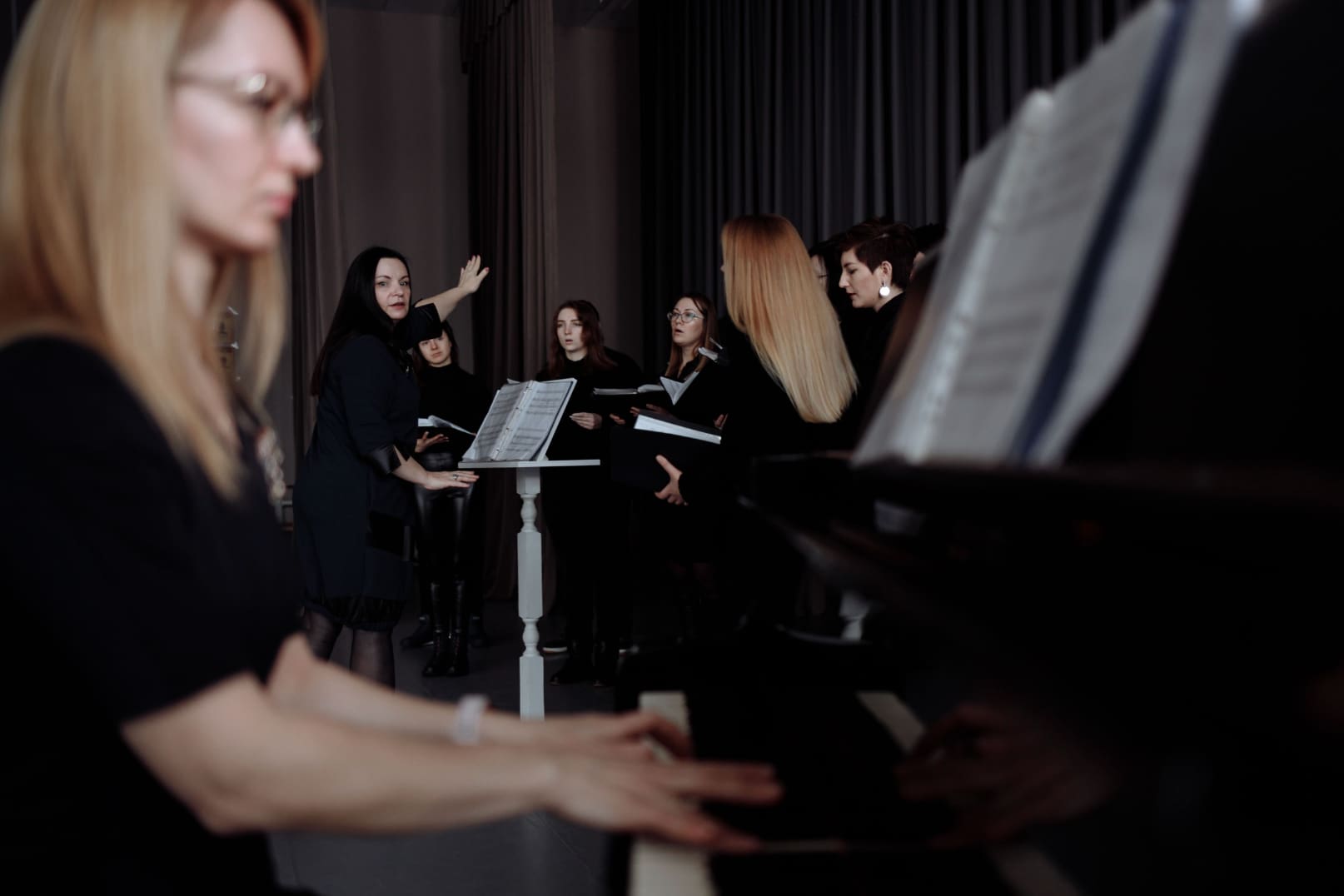
Accompaniment means supporting another performer. You might play behind a singer, a violinist, a choir, or an ensemble. Your role in that context changes considerably. Rather than carrying the musical interest yourself, you are providing harmonic foundation, rhythmic support, and dynamic flexibility to whoever is out front. A good accompanist makes the soloist sound better. An average one makes them work harder.
The skills overlap significantly at the foundational level. Reading music, understanding harmony, developing technique, and building repertoire are all shared. What diverges is the listening orientation. Solo pianists develop an internal ear for their own playing. Accompanists develop an external one, focused on matching, responding to, and supporting another performer in real time.
Which Type of Piano Lessons Should I Take?
The most useful answer is to start with what you actually want to do with the piano.
If you want to play pieces you love on your own, perform in recitals, sit exams, or compose and record music, solo lessons are the right foundation. The structured repertoire progression in solo teaching builds technique systematically and gives you a clear sense of where you are and where you are going.
Accompaniment is for you if…
- You want to play in a band, accompany a singer or another instrumentalist
- You play in a church or community choir
- You work in musical theatre
- You enjoy collaborative music playing in general, etc.
…then accompaniment skills will serve you more directly. That does not mean starting with accompaniment lessons exclusively, particularly as a beginner, because you still need the foundational technical work that solo teaching provides. But it does mean telling your teacher about your goals early, so the repertoire and exercises they give you are oriented toward those contexts.
Most piano teachers integrate both to some degree, particularly at the intermediate level and beyond. A good teacher will not treat these as separate tracks unless you are at a level where the distinction becomes genuinely relevant.
Can Beginners Learn Accompaniment Piano?
Yes, but with realistic expectations about what that looks like in the first year.
Effective accompaniment requires a reasonably solid grasp of chord voicings, the ability to read and adapt quickly, and enough technical fluency that you can listen outward while your hands do their job without constant conscious attention. None of those things is impossible for a beginner, but none of them arrives immediately, either.
Most piano teachers who work with students aiming toward accompaniment will spend the first several months building exactly this groundwork through solo repertoire, because it is the most efficient way to develop the underlying skills. The transition to accompanied playing tends to happen naturally once the student has enough fluency to focus on something other than what their hands are doing.
A 2024 study indicated that young musicians recognised they had developed greater self-confidence and cognitive skills playing in an ensemble, such as critical thinking and self-awareness, and facing challenges related to the process of learning music in an ensemble, such as managing emotions of frustration and adapting to different music learning styles and techniques, helped build one’s musicianship. Starting with solo work is not a detour from accompaniment goals. It is usually the most direct route to them.
Is Accompaniment Piano Harder Than Solo Piano?
Different, rather than harder or easier. Though in some specific ways, yes.
The technical demands of solo piano repertoire can be more extreme. Advanced solo works by Chopin, Liszt, or Ravel require a level of physical and musical precision that has no direct equivalent in most accompaniment contexts. In that sense, the ceiling for solo difficulty is higher.
What makes accompaniment genuinely challenging is the real-time responsiveness it requires. A solo performer controls the tempo, the dynamics, and the interpretation. An accompanist does not. When a singer breathes in an unexpected place, or a violinist takes a phrase slower than rehearsed, the accompanist adjusts immediately without disrupting the musical flow. That kind of flexible, reactive listening is a skill that takes sustained practice to develop, and one that solo repertoire alone does not fully build.
There is also the matter of transposition. Singers frequently need repertoire in a different key than the published accompaniment, and an accompanist who can sight-transpose, even partially, is considerably more useful than one who cannot. This is an advanced skill, but it is worth knowing about if accompaniment is your longer-term direction.
Do I Need to Learn to Read Sheet Music for Piano Accompaniment?
For most accompaniment contexts, yes, more urgently than for solo piano.
Solo piano students can sometimes develop a playable repertoire through a combination of ear training and rote learning, particularly in popular and contemporary styles. That approach has real limits, but it works for a while.
Accompaniment is harder to manage without reading, because the music often arrives as a printed score shortly before a rehearsal, and the expectation is that you can work from it reliably. Church musicians, musical theatre accompanists, and ensemble players who cannot read fluently are significantly limited in what they can take on.
If sight-reading is a gap in your current skills, it is worth raising with your teacher explicitly rather than hoping it resolves itself. Targeted sight-reading practice a few minutes per day compounds quickly, and most students who work at it consistently see meaningful improvement within three to four months.
What Should I Look for in a Piano Teacher if I Want to Accompany?
Someone who has actually done it, not just studied it.
Accompaniment is a practical skill developed through experience playing with other musicians, in rehearsals, in performances, under the pressure of a live context where things go slightly wrong, and you adapt. A teacher who has worked regularly as an accompanist in choirs, ensembles, or theatre brings a different kind of knowledge to those lessons than one whose background is primarily solo performance or academic teaching.
It is worth asking directly: do you have experience as an accompanist, and can you help me develop the specific skills for that context? Most piano teachers are candid about where their strengths lie. If accompaniment is genuinely your goal, finding a teacher who can address it specifically will save you a considerable amount of time.
Piano lessons in Sydney that cover both solo and accompaniment work are available through most established music schools. A trial lesson is usually the most efficient way to find out whether a particular teacher’s approach suits what you are working toward.
 September 30, 2026
Where Could I Find an Affordable Clarinet Teacher in Sydney?
TL;DR A limited monthly budget can still leave you with options for clarinet lessons in Sydney. Start with the price… September 26, 2026
Where to Actually Look Before You Buy an Instrument
The obvious first search usually isn't the right one. The instinct is almost always the same. A lesson gets booked,… September 23, 2026
What Should I Learn First on Piano? A Beginner’s Step-by-Step Guide
TL;DR Start by learning the keyboard pattern, a small group of notes, finger numbers and a steady beat. Practise a… September 23, 2026
How Much Does Logic Pro Cost for Beginners?
TL;DR Logic Pro is Apple's music production software for Mac. In Australia, Logic Pro for Mac costs $299.99 as a…